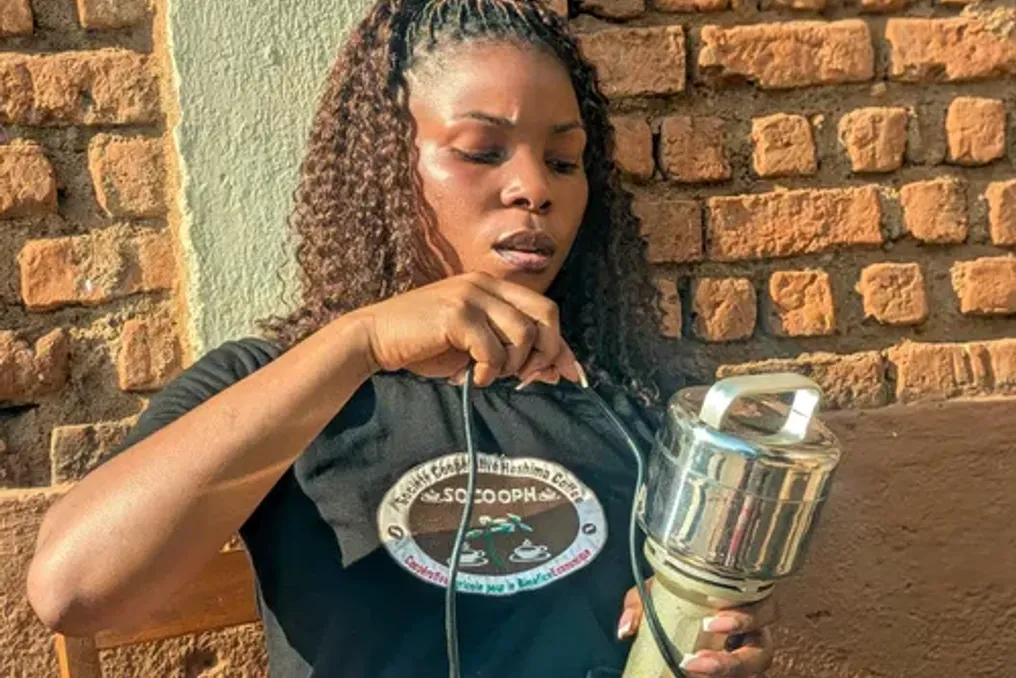
Every workday at Akonkwa Mountain Coffee in Bukavu begins with young employees gathering around beans grown on the hills and islands of South Kivu, one of the 26 provinces of the Democratic Republic of Congo. Some staff members are responsible for sorting the coffee, removing defective beans before roasting. Others roast and grind it, package it into bags, and prepare orders for supermarkets, cafes, hotels, and independent shops. Additionally, employees track sales and ensure the delivery of packages to Bukavu, as well as to customers in Goma and Kinshasa via freight agencies.
For Ivonne Rusimane, who studied economics at university, this small processing company provided an opportunity to apply her knowledge without leaving the coffee production region where she lives. Rusimane, a sales and marketing employee at Akonkwa Mountain Coffee, noted that since the company required an economist to support economic activities, including market research and product promotion, this became part of her daily work. She ensures that customer needs are met and that the product is available in various points of sale.
Her work is part of a new initiative to create a domestic market for a crop that South Kivu traditionally grew primarily for export. This shift has become more urgent because armed conflicts have made access to farms and international buyers less predictable. Bukavu, the capital of South Kivu, was captured by AFC/M23 forces in February 2025. Commercial life continues, however, fighting and armed groups in the vicinity can restrict access to coffee-growing communities and make bean transportation riskier and more expensive.
The threat remains relevant. In May 2026, a Médecins Sans Frontières team encountered a security incident while traveling in the Mvenga area. Although the team returned safely to Bukavu, this incident illustrates the conditions entrepreneurs face when sourcing outside the city.
Akonkwa Mountain Coffee founder, Akonkwa Mulihano Joseph, believes that part of the solution lies in shortening the distance between producer and consumer. The company, established in 2024, has a processing facility in Bukavu and operates through washing stations in the territories of Kabare, Kalehe, and Idjwi. It employs 10 young people—six women and four men—and sources coffee through a network of over 1500 farmers.
Mulihano built the business around three interconnected goals: helping farmers access local and international markets, improving the quality of their coffee, and encouraging more Congolese people to consume coffee grown and processed in their own country. He emphasized that 'something had to be done so that farmers could continue to benefit despite the lack of international buyers.'
South Kivu is one of the main Arabica producing regions in the DRC. Its highlands attracted cooperatives, international traders, and specialty coffee buyers, but most of the value chain was oriented outwards. A 2025 study published in Frontiers in Sustainable Food Systems revealed inconsistencies in the South Kivu coffee value chain, showing that most coffee was exported, making producers highly dependent on the political situation, traders, roasters, and international prices. The same study identified local processing and consumption as a way for Congolese enterprises to retain most of the value and reduce this vulnerability. It also warned that consumer samples were mainly composed of young, middle-to-high-income coffee enthusiasts, rather than the general population. Reliable national data on how much coffee Congolese people consume remains limited.
Nevertheless, Mulihano sees opportunities in individual shops. Papi Ayigirхва, a cafe owner in Bukavu, began purchasing products from Akonkwa partly because he wanted to support a business run by young people. He noted that previously, the shelves of many local cafes were dominated by imported brands. Ayigirхва stated that he decided to try local Congolese coffee, and frankly, his customers appreciate it very much and are gradually getting used to it. Initially, most buyers of local coffee were foreigners, but according to Ayigirхва, the situation is changing as more Bukavu residents try it. 'Once they discover it's good quality coffee, they start drinking it more often. They value it not only because it's accessible but also because of its quality.'
Awareness remains a hurdle. Many buyers are still unaware of local brands, as he said, but tasting creates an opportunity that advertising alone cannot. 'Once they try it, I believe they won't want to drink other coffee.'
Mulihano reported that competing with imported products requires more than just patriotic appeals. The company trains farmers to pick only ripe berries to prevent defects from entering the final cup. At the processing stage, workers sort, roast, and grind the coffee locally, then package it for the retail market. For export, operators must also comply with documentation, traceability, and quality requirements. Mulihano added that this may include proof of origin, certification of quality from national coffee bodies, and, if required by the buyer, third-party certification such as organic certification. Traceability is particularly important in eastern DRC, where informal cross-border trade has long complicated distinguishing between legally sold coffee and contraband.
The focus on quality reflects a broader lesson from recent research: Congolese coffee consumers, like consumers elsewhere, care deeply about the taste and experience of the drink. A 2025 South Kivu study showed that local consumers and roasters are interested in the sensory quality and pleasure associated with coffee, not just its origin or social impact. This makes roasting, consistency, attractive packaging, and reliable supply central elements of the domestic market strategy.
Opportunities extend beyond one company. In the Kalehe territory, Heshima Coffee uses a cooperative model to link farming, processing, and new products. Founded in 2017, Heshima collaborates with over 250 farmers, most of whom are women. It sells roasted coffee in Bukavu and other provinces, and has diversified its products to include coffee-based soap. According to cooperative member Lydie Kahiriri, this initiative was created partly to provide women and youth with opportunities for paid labor throughout the value chain. She is also trying to change the perception of agricultural labor. Kahiriri stated: 'Some people considered hoeing work humiliating, but with Heshima Coffee we changed that perception.'
For cooperative members, coffee generates income at several stages: growing and harvesting berries, processing beans, and developing consumer products. This distributes opportunities more widely than just selling raw coffee, giving the cooperative more than one potential source of income when one market weakens. However, both Heshima and Akonkwa face the same central challenge: local production does not automatically convince consumers to buy local. Kahiriri noted that imported coffee can still be perceived as higher quality, even when Congolese products meet high quality standards. Changing this perception requires businesses to improve both the product and the way it is presented.
Economist Deogratias Kubaka, a lecturer at the Official University of Bukavu, stated that South Kivu enterprises must invest in sorting, roasting, modern processing, packaging, marketing, and communication if they want to compete consistently with foreign brands. Organizing farmers into cooperatives can reduce some costs, and improved production methods can enhance quality and yield. Government policy could accelerate this shift through access to financing, tax breaks for processors, support for cooperatives, and procurement programs that give local products a fair chance.
Creating a domestic market will not replace exports. International sales remain important for bringing income into farming communities, and restored security will facilitate the resumption of ties for farmers and buyers. However, local consumption can provide producers with a second market instead of leaving them dependent on a single route that conflicts or price fluctuations might close. It can also keep more jobs—roasting, grinding, packaging, branding, and sales—within the DRC.
At Ayigirхва's cafe, this strategy is measured cup by cup. A bag processed by young workers in Bukavu and filled with beans bought from South Kivu farmers becomes a drink ordered by a local customer. The transaction is modest, but its repetition in cafes, hotels, shops, and homes begins to create a stable market that Mulihano and Kahiriri are trying to build. For a sector accustomed to seeking buyers abroad, the growing presence of Congolese coffee in Congolese cups offers something valuable: another way to support farmers in production, youth in employment, and local business in motion, even when the road to the international market becomes uncertain.