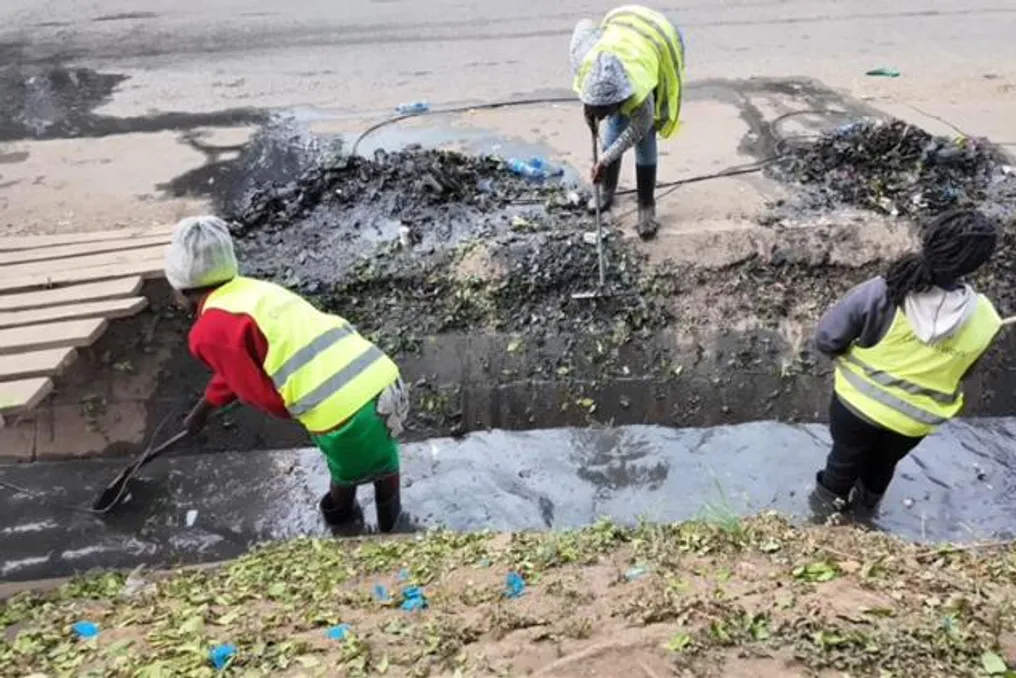
Nairobi residents prepare for El Niño thanks to drainage system improvement work
Read more
CGTN
cgtn.com

Nairobi residents prepare for El Niño thanks to drainage system improvement work

Residents of Nairobi are feeling anxious about the forecasts of an approaching El Niño, a familiar sensation for those who have lived in Kenya's capital for several years. The author recalls past sudden floods when main roads turned into raging rivers in minutes, causing hours of transport disruption and leading to the loss of homes and property for families in low-lying areas.

However, during filming for CGTN in the Kenyan capital, the author noticed an unexpected fact: the city is not passively waiting for flooding. Active and urgent work is underway to prevent the consequences.

It was observed that workers in bright reflective vests were installing heavy concrete slabs, and they were also digging out large accumulations of plastic bottles, dirt, and trash that had been under drainage lines for months. In addition to cleaning, teams are laying new concrete waterways and installing large sewage pipes to divert heavy rainwater away from residential areas.

During the shoot, the author spoke with Bramwell Simiyu, Nairobi's Chief Officer for Disaster Management and Coordination. He stated directly that blocked waterways were the cause of previous floods. Simiyu explained that 'part of the reason we had floods in the past was due to cases of blockage or clogging of the drainage system, waterways, paths.' He added that a subcommittee has been established to clean drainage systems and repair identified clogged sections.

Simiyu emphasized that the city's focus is on real people, not just maps and engineering plans. 'We went around and identified all the hotspots from a humanitarian perspective,' he reported. 'We are focusing on areas where we might face significant disruption to life and livelihoods.'

Visiting the outskirts of the capital, where flooding usually occurs, the author saw local residents watching the government excavators' work with a sense of relief. He met Cecilia Mwasa, a small vendor who knows the pain of losing a home to water. Cecilia noted that floods had long caused chaos, but this time residents hope their homes will not flood because the government is repairing the drainage systems.

At the same time, it became clear that government measures are only one side of the issue. Small entrepreneurs cannot wait for promises when their daily income is at risk. Joseph Gikundi, owner of a small retail shop, instead of remaining inactive, built raised wooden shelves to lift all his goods above the floor. He explained that they had to take measures so that 'when it rains, when the water comes in... we could manage somehow.'

Standing near the camera crew by one of the recently expanded drainage outlets, the author felt genuine hope. These drainage works represent a real chance. The United Nations describes El Niño as a natural climatic pattern that occurs every two to seven years when waters in the central and eastern equatorial Pacific Ocean become abnormally warm. This warming can alter atmospheric circulation over thousands of miles, shifting rainfall and temperature patterns everywhere.

Despite the high risk to Nairobi, the author is convinced that if the cleaned waterways withstand the arrival of the storm, Nairobi will not just survive this weather phenomenon but will protect the people living in the city.

Similar stories

Strong El Niño threatens African agriculture, demanding advance preparation
Read more
foodformzansi.co.za

Strong El Niño threatens African agriculture, demanding advance preparation

Africa may face a season of intense heat, drought, flooding, and disrupted rainfall patterns due to the strengthening of an unusually powerful El Niño event in the Pacific Ocean.

The latest forecast from the U.S. National Oceanic and Atmospheric Administration (NOAA) indicates that El Niño is strengthening, with a greater than 90% probability that it will become a very strong event during the autumn-winter period of 2026/27 in the Northern Hemisphere. There is a 69% chance that the event will exceed the strength of any recorded El Niño since 1950 between October and December.

Dr. Henno Havenga, senior lecturer in climatology at the School of Geospatial Sciences at Northwestern University (NWU), noted that the term 'super El Niño' is widely used but is not an official scientific classification. He explained that this description refers exclusively to an extremely strong El Niño event. El Niño occurs when the central and eastern parts of the equatorial Pacific Ocean become abnormally warm, and atmospheric circulation above it changes. These changes can affect weather conditions far beyond the Pacific Ocean through so-called teleconnections.

Havenga emphasized that the strength of the developing event does not guarantee catastrophe in all countries or regions; El Niño only changes the odds, but does not dictate the weather from one area to another. Nevertheless, it can increase the probability or exacerbate certain conditions typically associated with El Niño.

For most of Southern Africa, such conditions include reduced rainfall, drought, and abnormally high temperatures. The heat worsens the damage as it increases evaporation and the demand for water for crops, livestock, and people precisely when reserves may be depleting.

He added that even within one country, rainfall might arrive too late, fall in the wrong places, or come down in short, destructive squalls instead of the timely and evenly distributed rain needed for agricultural crops. 'The timing, distribution, and intensity of precipitation can either amplify or compensate for the typical El Niño signal locally.'

According to Havenga, agriculture is one of the most vulnerable sectors, but the consequences will extend far beyond the farm. Poor harvests can lead to reduced food availability, weakened rural incomes, and rising prices.

He warned that commercial producers may have access to insurance, financing, irrigation, or alternative markets, whereas smallholder or subsistence farmers may lose both family food and income-generating produce.

Water security issues are equally pressing. Hot and dry weather increases demand while simultaneously reducing the amount of water in rivers, reservoirs, and wells. Havenga noted that local authorities cannot afford to lose treated water due to leaks and poorly maintained infrastructure during such a period. He advised that 'reducing leaks and unnecessary losses from existing water infrastructure is one of the most practical interventions available to us. At the same time, all users should generally conserve water.'

Intense El Niño can put a strain on healthcare systems, energy systems, and ecosystems. Extreme heat poses a particular danger to outdoor workers, the elderly, children, and people with chronic illnesses. Drought can affect drinking water quality, sanitation, and nutrition, while floods can contaminate water sources and increase the risk of diseases.

Havenga stated that one cannot assume that every ecosystem will simply return to its previous state after a severe drought. However, reducing anthropogenic pressure, including excessive water abstraction, land degradation, and unnecessary habitat disruption, can improve the ability of ecosystems to withstand and recover from this phenomenon.

He insisted that governments must repair water infrastructure, prepare food security programs, and ensure the ability to quickly launch disaster response systems. Havenga called for developing financial aid, agricultural support, and drought relief mechanisms before farmers and communities find themselves in difficulty.

He stressed that drought is a slow-developing risk. Its consequences may initially be unnoticed, but it develops gradually, and this slow progression can catch people off guard. 'The advantage is that early warning systems allowed us to discuss this event starting in May. We must use this warning to reduce our vulnerability and prepare for a difficult season, rather than waiting until the drought has already set in.'

Popular