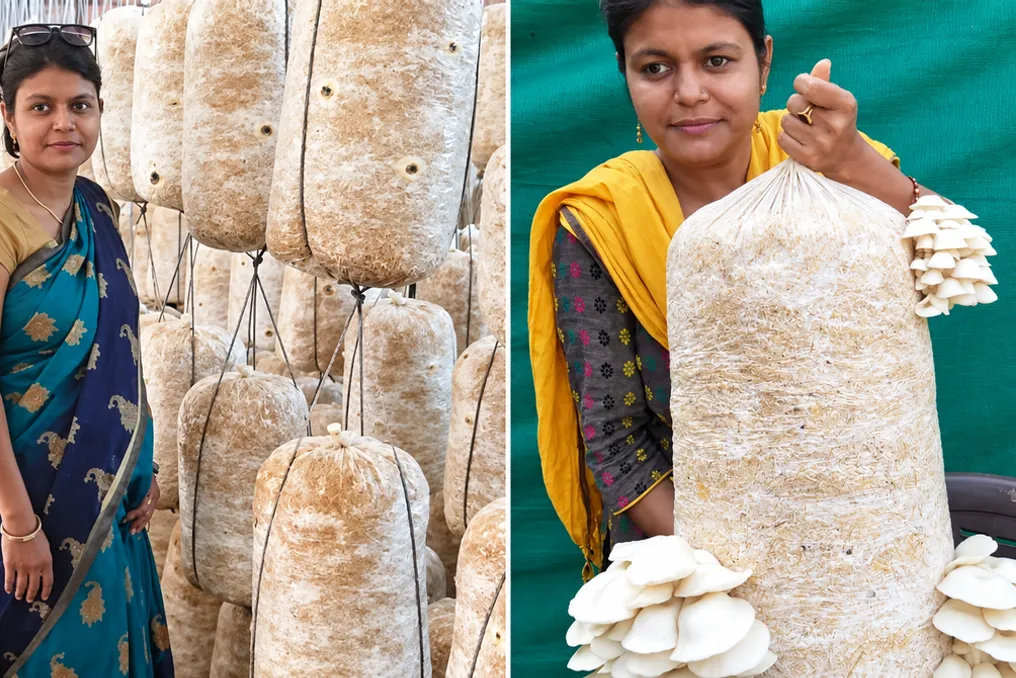
After her college was closed, Professor Nidhi Katare decided to start mushroom cultivation. Today, thanks to this business, she earns up to 1.5 lakh rupees monthly.
In 2016, Professor Nidhi Katare, who taught at a college in Gwalior, arrived to give a lecture but discovered that the building was soon to be demolished. This was a huge and unexpected shock for her. In an interview with The Better India, the 38-year-old teacher recalls that during the construction of this college, she was responsible for creating scientific laboratories from scratch, and all of them were built under her supervision. However, when the authorities received a good sum for the land on which the college stood, it was torn down.
“I taught at this college for almost 10 years. The campus turned into ruins right before my eyes. It was so heartbreaking. It felt like a decade of my work was wasted. That’s when I decided to invest my time and energy into something I could call my own,” she added.
Despite numerous offers from other educational institutions, the postgraduate student in microbiology decided to pursue entrepreneurship and launched a mushroom cultivation business that now brings her an income of up to 1.5 lakh rupees per month.
Turning Curriculum into Business
Nidhi was born and raised in Pharkhadabad, Uttar Pradesh. She obtained a Master's degree from Shivaji University in Gwalior, Madhya Pradesh. A year later, in 2007, she started working as a teacher at a private college in Gwalior city. As part of her curriculum, she taught students about mushroom cultivation, but she did not suspect she would build a career in this field until the event in 2016 occurred. “Since I studied microbiology, I already knew the intricacies of mushroom cultivation. It seemed like the best idea for a business,” she notes.
Thus, in 2017, she founded her company Natural Bio Impact and Research Pvt Ltd for mushroom cultivation. Starting with 3000 rupees, she acquired 10 kg of oyster mycelial culture and grew mushrooms at home in a 10 by 10 square foot room. However, contrary to expectations, the yield was low.
“For every kilogram of mycelial culture, we were supposed to get at least 10 kg of mushrooms. This meant we should get a total of 100 kg of produce. But our harvest was 30 percent less than planned,” she says.
In the initial stages of her venture, Nidhi relied on cultivators from Agra and Delhi to procure mycelial cultures. She noticed that the quality of the supplied mycelial cultures was poor. “Often the mycelium was delivered crushed because it was packed in low-quality burlap sacks. It was also contaminated with mold, which led to reduced yield. This also affected the size and quality of the grown mushrooms,” she adds.
Step Towards Increasing Yield
However, the next step helped her expand her business. In the same year, Nidhi used her ancestral property of 1500 square feet to create a laboratory with separate rooms for incubation, inoculation, and pasteurization. Explaining the mycelium cultivation process, Nidhi explains: “First, we boil wheat and barley straw. Then we sterilize them with fungicides. After that, we pack them into small bags and place them in autoclaves for sterilization. After incubation using mother mycelium, we store the bags for six to seven days. During this process, white mold is applied to the wheat bran. This is how the mycelia are prepared.”
Nidhi also points out mistakes that farmers should avoid when preparing mycelial cultures. She warns: “Usually, farmers take shortcuts when preparing mycelia. For example, the mycelia should be soaked overnight in fungicide and left aside overnight. They skip these steps to save time, keeping them only for two or three hours.”
“They might not notice the damage then, but it will become visible after 10-15 days when the fungus attacks their product,” she adds.
Nidhi uses these mycelia for year-round cultivation of oyster mushrooms. Today, she harvests up to 150 kg of mushrooms every two months. She sells fresh mushrooms at a price of 100 rupees per kilogram and dried mushrooms at 800 rupees per kilogram to pharmaceutical companies. Nidhi uses Pleurotus Florida oyster mushrooms, known for their medicinal properties. According to an article published in the International Journal of Current Pharmaceutical Research, these mushrooms are considered a valuable health product with high protein content. The study notes that they possess various valuable biological properties, including antioxidant, antimicrobial, anti-inflammatory, anti-tumor, and antidiabetic properties.
In addition, she is able to produce 1000 kg of mycelium per month, which is sold to at least 150 farmers from the states of Chhattisgarh, Madhya Pradesh, Uttar Pradesh, and Rajasthan. By selling fresh and dried mushrooms, their mycelium, as well as other unique products such as mushroom papads, marinades, cookies, and protein powder, Nidhi earns 1.5 lakh rupees a month.
Simultaneously, she continues to teach biology to 11th and 12th-grade students. “I haven't quit teaching because I am passionate about it. My husband has always supported me on this path. There were times when I lost hope, but he always encouraged me. He even quit his job as a branch manager at Reliance to support me in marketing and business expansion,” she shares.
Her husband, Sanjay Katare, told The Better India: “We started from scratch. We knew that these mushrooms were in high demand from pharmaceutical companies, but we didn't know how to market the product to the right people.” He continues: “There was a time when I went door-to-door to sell our oyster mushrooms to traders in the Delhi market. Today, we sell our products across India to cities like Bengaluru, Pune, Mumbai, Surat, and Kutch, among others.”
Commenting on his decision to leave his job to support his wife's business, he noted: “It was a very risky decision since neither of us had a job, and we needed to take care of our young son. There were even moments when we thought about giving up this business and returning to our private jobs because we weren't making good profits due to low yields.” However, their perseverance paid off in the long run. “We got a good boost in the first phase of the COVID-19 pandemic when the demand for oyster mushrooms in pharmaceutical companies increased. This also motivated us, as we were able to survive when others were losing their jobs,” Sanjay adds.
Meanwhile, for Nidhi, this business has helped her feel strong. “Today, I do not depend on any private institute. I teach because of my passion and earn a living through my business. I have managed to create something for myself. And that is what I can pass on to future generations,” she concludes.