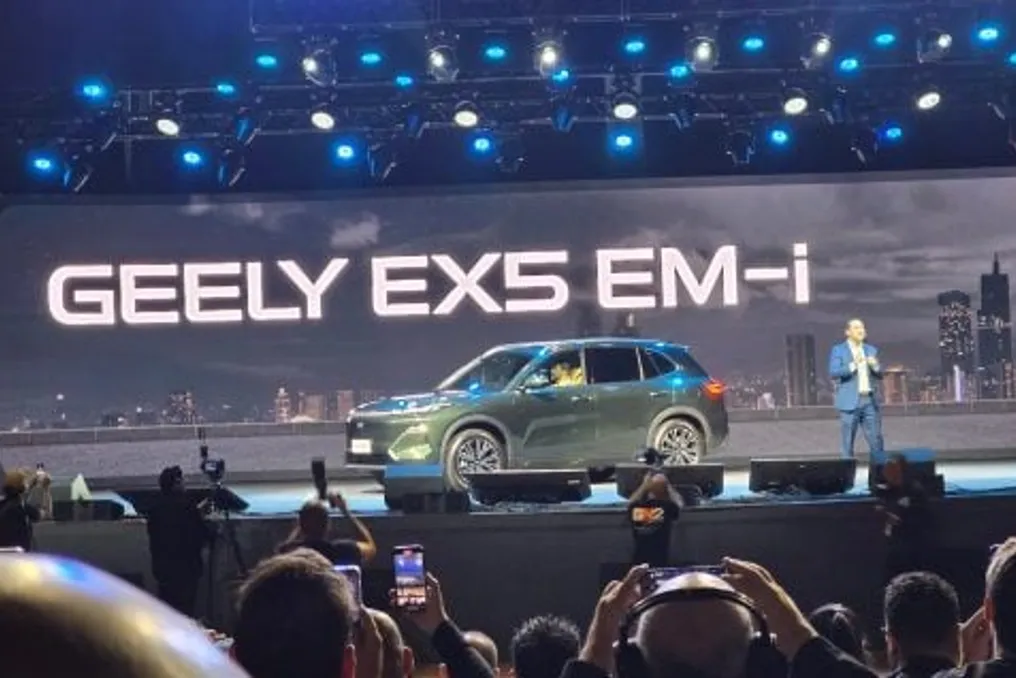
Less than a year after Renault Geely Brazil (RGdB) announced the change of its corporate name and the additional investment of R$ 2 billion from the Chinese brand in the São José dos Pinhais (PR) unit, the first vehicle produced, the Geely EX5 EM-i plug-in hybrid, was removed from the assembly line. The Franco-Chinese partnership is progressing rapidly, with a total investment of R$ 5.8 billion planned by 2027. The sale of this plug-in hybrid is expected to begin in November, while domestic production of the electric model EX2 will start in December, with sales anticipated two months later.
Both models exceeded sales expectations during the current import period. Francois Provost, Global President of the Renault Group, visited Brazil and expressed his confidence in the executive team for meeting all established objectives. Fabrice Cambolive, who served as former president of the Brazilian subsidiary between 2015 and 2017 and currently holds the position of Global Vice President of Sales and Operations at Renault, confirmed that there will be local production of four models by the end of 2027: two from the French brand and two from the Chinese brand.
Geely holds 26.4% of the share capital of RGdB, an operation managed by Argentinian Ariel Montenegro since 2025. Furthermore, the E-Tech 4x4 hybrid technology will be offered in flex version and will also be available in the Boreal and Niagara models in 2027. Montenegro emphasized that purely electric vehicles will gain a larger share in major global markets.
Despite this, there are challenges, such as the drop in electric vehicle sales in the United States and Canada, and incentive cuts in China. When asked about the possibility of delaying the electrification pace if the Middle East war ends and oil prices fall significantly with production normalization, Montenegro considered such a scenario unlikely.
In a conversation with the portal Autoesporte, Combolive projected that half of the Renault cars sold in Brazil will be hybrid or electric by 2030. He highlighted that this initiative represents a unique model that could encourage other manufacturers to follow a similar trajectory.
In the Brazilian context, the process of disposing of vehicles at the end of their useful life is notoriously complex, often resulting in abandonment or sale as scrap metal. The Franco-Italian-American conglomerate concluded one year of operation of its Vehicle Dismantling Center (CDV) in Osasco (SP). This pioneering structure, unique to a manufacturer in South America, focuses on legal and traceable dismantling, validating the business model based on circular economy principles for obsolete vehicles.
In the first year, the CDV dismantled 1,150 automobiles from auctions or insurance companies, enabling the recovery of over 20,000 components. Of these, 11,000 have already been placed on the spare parts market, demonstrating the growing demand for reused parts with verified origin. There was also the environmentally correct disposal of 862 tons of materials and nearly 14,000 liters of fluids.
The recovery of components can reduce raw material consumption by up to 80% and CO2 emissions by up to 50% compared to manufacturing new parts. Stellantis' strategy follows the pillars of Remanufacturing, Repair, Reuse, and Recycling. Additionally, there is the Vehicle Refurbishment Center (CRV) in Betim (MG), which has recovered over 500 vehicles in three years.
The Osasco CDV, with installed capacity for up to 8,000 annual dismantlings, has now reached the scaling phase. Next steps include expanding the catalog of certified components, broadening the distribution channels for after-sales service, and consolidating reverse logistics in the region. The company has two more international CDVs, located in Italy and Morocco, and plans a fourth in France.
The double-cab intermediate pickup Niagara, scheduled to debut in November, was recently presented in Córdoba, Argentina, and will be imported to Brazil. It succeeds the Oroch and aims to compete mainly with the Toro, but also with Maverick, Rampage, and Mako. It shares the same structure as the medium SUV Boreal, including identical hood and front bumper, manufactured in São José dos Pinhais (PR). The front of the vehicle attracts attention with its vertical grille and the Renault inscription in small chrome pixels. It features a high waistline, robust wheel arches, and rear column door handles, following the standard of modern SUVs derived pickups. It will be available in 4x2 and 4x4 versions.
Internally, the rear seat offers 200 mm of legroom, a differential in the category, and features a 25° reclining backrest and a hidden compartment of 36 liters behind it. The dashboard combines a 10.2-inch digital instrument cluster and a 10.1-inch multimedia center with Google Built-In and a 360° camera system. A novelty is the generative and multimodal AI assistant Google Gemini. The vehicle has 26 advanced driver assistance systems (ADAS).
The dimensions of the Niagara are 4.94 m in length (4.91 m in 4x2 versions), 2.96 m wheelbase, 1.72 m height, and 1.83 m width. The wheels can be 17 or 18 inches. The bed capacity is 938 liters and features a retractable rigid cover, a 12V socket, and an electrically opening tailgate. Its payload is 654 kg (with five occupants) and towing capacity is 710 kg, the highest among intermediate pickups. The ground clearance is 223 mm (233 mm in 4x4 versions), with approach and departure angles of 22.1° and 22.3°, respectively. The independent multi-link rear suspension has received specific adjustments for South American usage conditions. The brakes are ventilated discs on all four wheels.
The 1.3 Turbo TCe flex engine generates 156 hp (on gasoline) or 160 hp (on ethanol), with a torque of 27.5 kgf·m. The transmission can be a six-speed manual or an oil-bath dual-clutch automatic with electronic selector. The on-demand all-wheel drive system offers six selectable driving modes on the console. Renault will not launch all four versions of the Niagara in November, but rather over subsequent months; the hybrid version with an electric motor on the rear axle will only arrive in the second half of 2027.