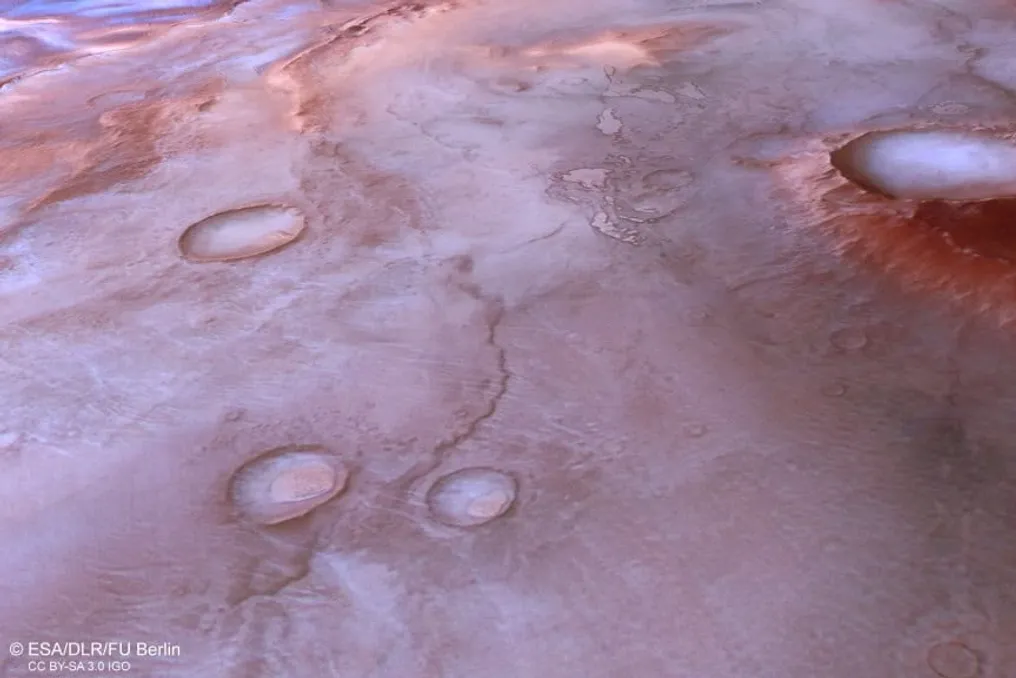
An image obtained by the Mars Express probe shows the Thyles Rupes area at the south pole of Mars, where pink, purple, and red tones are observed. These unusual colors arise from the interaction of dust and frost on the surface.
The photograph was taken using the High-Resolution Stereo Camera (HRSC), an instrument of the European Space Agency (ESA). It focuses on the zone where a glacier and a rock formation over one kilometer high are located.
Mars is usually known for its reddish appearance, which is mainly caused by iron oxides. However, in the Thyles Rupes region, the mixture of various materials creates a palette that includes rosy and purple shades.
Part of the dark material in this area is related to volcanic activity. It is rich in minerals such as olivine and pyroxene, which are also widely found in the Earth's mantle. Olivine consists of magnesium, iron, and silicate, while pyroxenes are a group of silicate minerals composed mainly of silicon and oxygen.
Lighter blue areas are associated with frozen carbon dioxide. Closer to the south pole, this material persists even in spring, the period when the image was taken.
This area also contains part of the south polar cap. The main cap does not melt, while the seasonal layer of CO2 frost increases and decreases depending on the season.
The purple appearance noted in the image is not permanent. According to the article, the landscape changes throughout the day depending on the amount of dust in the air, soft morning light, the presence of ground frost, and the combination of ice with dust.
Different types of dunes can also be seen. Mixed winds in the region prevent the formation of finely sculpted dunes, similar to those found in other parts of Mars. Among the structures, so-called barchanoid ridges are visible—arcuate dunes with both ends facing the wind.
Thyles Rupes extends for hundreds of kilometers and has walls over one kilometer high. Its name combines the word Rupes, Latin for 'escarpment', and Thyles, a reference to the mythical northern land mentioned in the ancient world.
This formation also helps trace part of Mars' geological history. It covers some craters and is covered by others, indicating differences in the age of these structures.
It is hypothesized that Thyles Rupes formed similarly to some terrestrial mountains, when internal forces cause crustal uplift. The difference is that Mars does not have plate tectonics like Earth.
The planet is described as a body with a single plate, possessing a so-called stagnant lid. In this scenario, Thyles Rupes likely originated during the cooling of Mars' interior. As the crust contracted, some parts were pushed upwards.
Images obtained by orbital probes, such as Mars Express, allow for detailed observation of these features. The Mars Express probe and NASA's Mars Reconnaissance Orbiter have been recording different areas of the planet for the past decades.