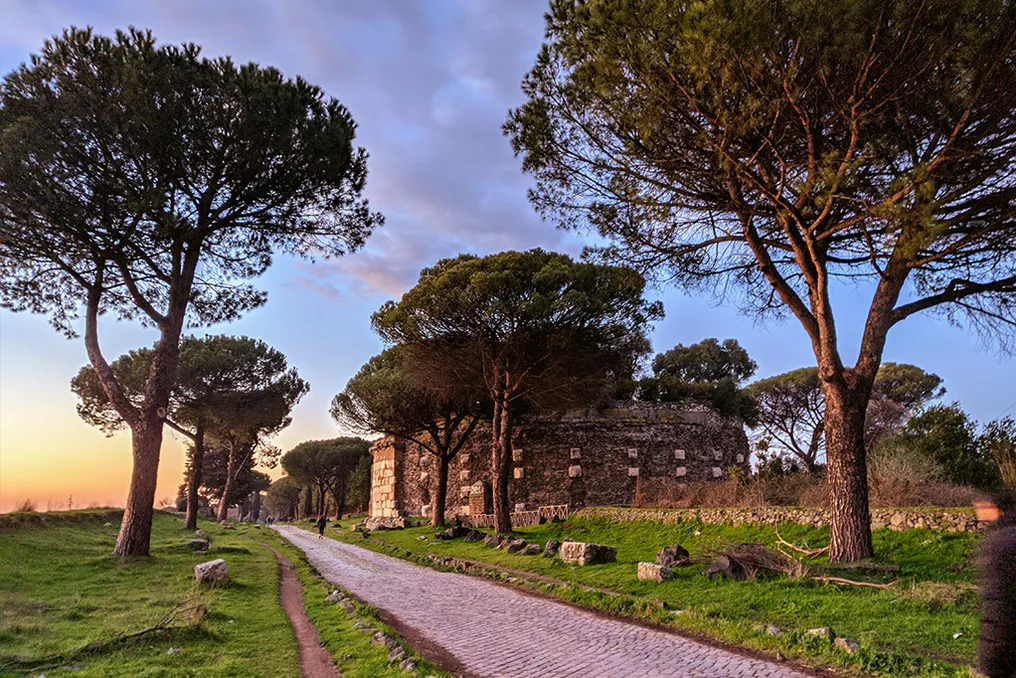
The popular expression 'all roads lead to Rome,' which refers to the extensive roads built by the Romans to connect the provinces to the capital of the Roman Empire between 27 BC and 476 AD, has its veracity questioned by a new study.
Researchers published findings in the scientific journal Nature, analyzing the road network of the Roman Empire. They concluded that the saying is, in fact, a myth, because technically, it would apply to several other Roman cities.
Cities such as Antioch, Ancyra, and Byzantium, located in the region of modern-day Turkey, as well as Corinth in Greece, were considered more advantageous for those traveling by land than Rome. According to the article, the main land routes of the empire did not always pass through the Eternal City.
Corinth, for example, had greater integration into the road network due to its roads connecting the Peloponnese Peninsula to the rest of Greece. Ancyra was also a superior alternative as a crucial transport point in Anatolia, which served as a link between Asia and Europe.
The case of Rome presented unique characteristics. The research authors used an anatomical analogy to describe the situation of the capital: the Italian Peninsula functioned as an 'appendage' of the imperial road network, and Rome was positioned in the middle of this appendage, distant from the main flow of roads, situated on the margins of the most central routes.
Despite this, the city's importance was not diminished. For much of antiquity, Rome maintained its role as the political, economic, and cultural center of Western civilization. At its peak, in 117 AD, the Roman Empire covered almost 5.5 million square kilometers around the Mediterranean Sea, covering vast areas of Europe, the Middle East, and North Africa.
The popular saying emerged much later, during the Middle Ages, when a French poet named Alain de Lille uttered the phrase: 'mille viae ducunt hominem per saecula Romam,' which means 'a thousand roads lead man forever to Rome.' If we consider Rome in a broader sense, as a cultural pole of the ancient world, the saying can be considered valid.
To reach their conclusions, the researchers calculated the level of connectivity of Roman cities with the road network. Using the digital atlas called 'Itiner-e,' they mapped approximately 300,000 kilometers of Roman roads.
It is relevant to note that land transport was not the only mode of travel in the Roman Empire. The study points out that Rome could have had a more relevant role in maritime and river transport than in road transport, although the focus of the investigation was not on sea routes, suggesting that future research should deepen these routes in ancient Rome.