In Brazil, Fiat pioneered converting its passenger vehicle into a utility truck of the pickup type. In 1978, the Italian manufacturer adapted the newly launched 147 model, transforming it into a small service pickup. It is noteworthy that this new vehicle originated from the monocoque of the 147, which had been launched in 1976.
Although this concept was not unprecedented globally, with Henry Ford launching a pickup derived from his Ford T passenger vehicle in 1917, some North American companies were already using the robustness of the Ford T in 1908 by adapting bodies for cargo transport. However, Ford itself took nine years to present a factory model.
In Brazilian territory, after the launch of the 147 Pick-Up, the Fiorino pickup emerged, which used a structure similar to the Panorama van but had a longer wheelbase than the 147. Because the 147 was a compact car, the pickup derived from its monocoque appeared disproportionate and very short. For this reason, Brazilians nicknamed the little pickup 'Tamanquinho,' referring to wooden-soled footwear. To increase its professional functionality, Fiat resorted to the Panorama base and launched, in 1981, the pickup renamed Fiorino.
The Fiorino quickly gained popularity among small and medium-sized businesses looking for an agile and economical vehicle for transporting goods. This success sparked interest from competitors in this market niche. In 1982, Volkswagen introduced the Saveiro, based on the Parati, while Ford offered the Pampa, derived from the Corcel. Later, GM entered this sector with the Chevy 500, using the Chevette as its base.
All these models followed a pattern similar to the one initially adopted by Fiat with the 147 and later with the Panorama. Fiat's pioneering initiative in the national market thus began to influence other brands, helping to create a new segment in Brazil. Fiat, however, continued to develop this product line. With the launch of the Uno in 1984, the brand obtained a new compact that would serve as a future platform for its pickup. Keeping the name Fiorino, Fiat launched the new generation of the utility vehicle in 1988, now based on the Uno.
The design and main cabin components were similar to those of the compact, which simplified the production process, given that the 147 had been discontinued in 1986. This change modernized the product and aligned it with the company's new family of compact cars.
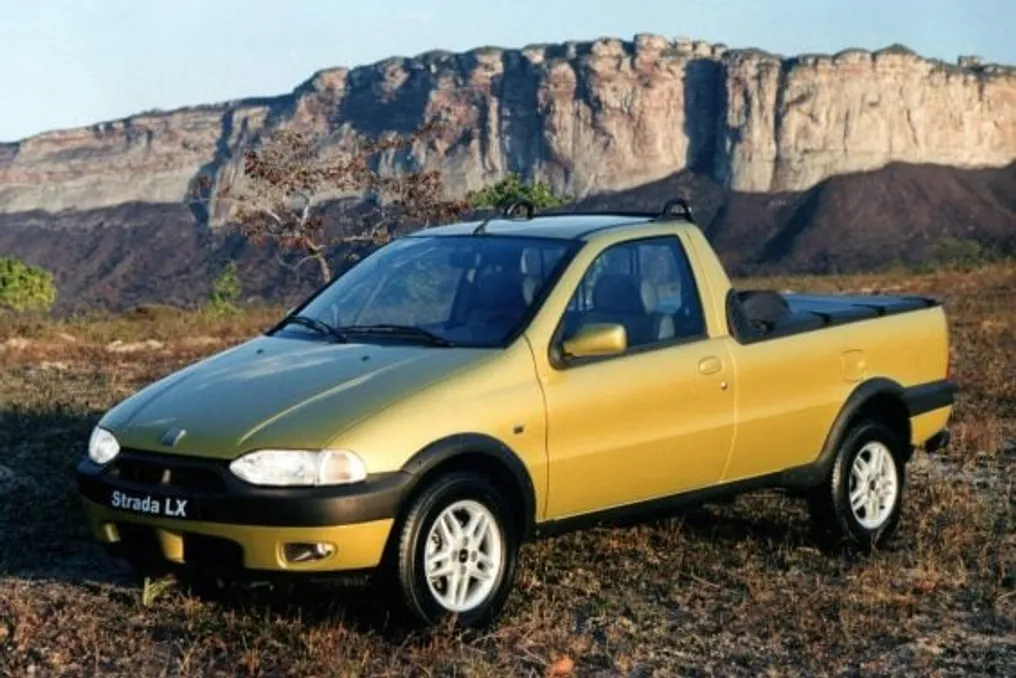
Until that period, the Volkswagen Saveiro held the lead in this small pickup segment. However, Fiat did not give up; after the launch of the Palio in 1996, the company developed a new pickup based on the structure of the newly launched compact. With a modern and attractive design, in addition to a robust mechanical base suitable for a work utility, Fiat launched the Strada in 1998.
Unlike what happened during the transition from the 147 family pickup to the Uno pickup, keeping the name Fiorino, the new model received its own designation. The Strada also incorporated a rear suspension with a rigid axle and leaf springs, an ideal solution for the load capacity and resistance expected of a utility vehicle. The national market quickly began to view the Fiat Strada differently, which was directly reflected in sales.
Maintaining the strategy of constantly updating the new pickup for the consumer, an extended cab version was launched in 1999, attracting a new audience to the small pickup segment. In 2001, Fiat presented the Adventure version, an enhanced Strada inspired by off-road vehicles. These additions allowed the brand to expand the group of consumers interested in small pickups, boosting sales and reinforcing the Strada's reputation for robustness. The vehicle appealed to both small and medium entrepreneurs who used it as a work tool during the week, and as a leisure car on weekends—a perception that competitors were slow to understand and replicate.
With the diversity of innovations and the offering of multiple versions for different profiles, the Strada conquered leadership in its segment at the beginning of the century. The Italian manufacturer did not stop there; in 2009, it launched the Strada with a double cab, making the utility even more suitable for family use.
Another innovation occurred in 2013 with the addition of a third door to facilitate access to the rear seat. This door had a reverse opening and dispensed with the central pillar, which significantly optimized passenger entry. At this point, the Strada was already configured as a true family pickup, while rivals were still struggling to keep up with its pace of evolution.
In 2020, the Fiat Strada was already among the best-selling vehicles in the Brazilian market. In another competitive advance, Fiat launched a completely new generation, including the four-door double cab configuration, further elevating the product's quality. In this version, the Strada balanced its role as a work tool and a weekend leisure vehicle even more effectively. This success was so great that, in 2021, the Fiat utility assumed the leadership of the national market, a position that had been dominated by hatchbacks for approximately thirty years, remaining in that position until 2024.
Undoubtedly, the launch of the 147 Pickup in 1978, derived from the passenger model, was a strategic success for Fiat. This formula evolved over the decades to culminate in the Strada, which established itself as one of the brand's greatest commercial successes in Brazil, representing almost half a century of development of light pickups by Fiat in the national market.