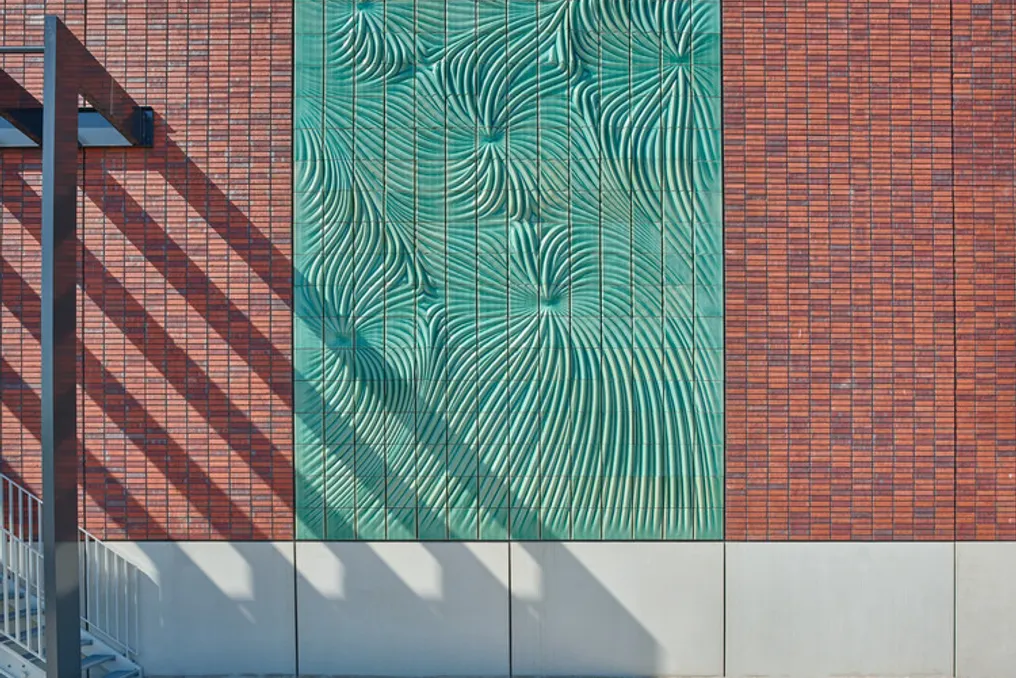
The Powerwall project is an artistic interpretation of the invisible electromagnetic forces emanating from the 150 kV substation, transforming them into a large-scale ceramic relief. This work gives a tangible architectural expression to the technical infrastructure in the city of Beaverwick.
The substation, located near the Bazaar in Beaverwick, was commissioned by TenneT to meet the growing demand for electricity in the region. There are expectations that the surrounding area will change: it will cease to be a zone characterized by technical infrastructure and a large commercial facility, and will become a mixed urban quarter including residential buildings, workspaces, public areas, and a closer connection to the waterfront.
In light of this, Powerhouse Company viewed the substation not merely as an infrastructure building, but as a potential industrial heritage of the future. The Powerwall, integrated into the brick facade wall by Studio RAP, uses the building's function itself as the starting point for the project. It is inspired by electromagnetic fields, translating their invisible movement into a smooth ceramic relief.
At a distance, the 8 by 5 meter artwork is perceived as a single composition. Upon closer inspection, its surface reveals the individual geometry and texture of 322 unique ceramic elements. The central challenge was to transform this continuous pattern into separate elements that could be manufactured, fired, and assembled while maintaining the visual flow of the entire piece.
Studio RAP used computational design combined with extensive physical prototyping to develop the relief. Prototypes helped study depth, transitions between details, the behavior of ceramics during production and firing, as well as the interaction between geometry and glaze. This iterative process allowed the logic of design and production to evolve together, rather than treating manufacturing as an isolated stage.
Each detail was made in Studio RAP's workshop in Rotterdam using robotic clay printing. This method allowed for the production of hundreds of ceramic elements with individual shapes while maintaining control over the relationship of each element within the overall composition. After firing, the pieces were coated with a translucent turquoise glaze. The relief was designed specifically to interact with the glaze, allowing it to behave differently on edges, grooves, and recessed areas. This creates variations in color and reflection that become more noticeable as daylight moves across the facade.
Powerwall harmoniously fits into the rhythm of the substation's brick facade, framed by deep stone supports, and forms a strong contrast with the massive palette of materials of the rest of the building. Instead of hiding the technical purpose of the substation, the artwork makes it visible in a different form.
As electrical infrastructure becomes increasingly visible in urban settings, Powerwall demonstrates how these necessary structures can also contribute to shaping the identity and experience of surrounding areas. The building remains functional and safe, while its technical function becomes the starting point for a new architectural element.