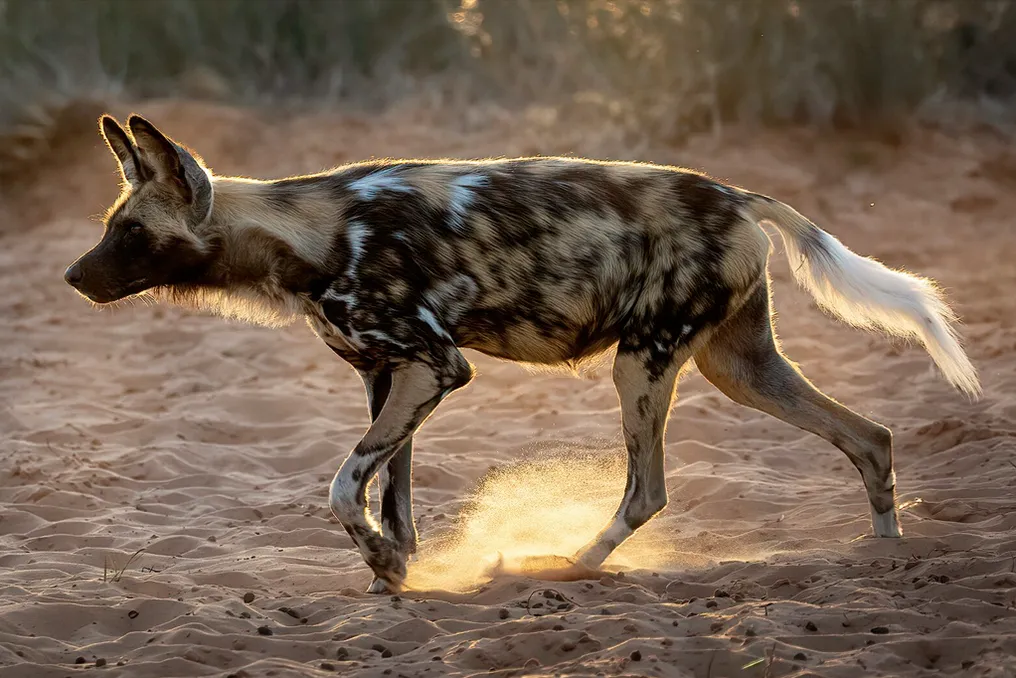
A pack of African wild dogs undertook a long journey across Zambia, traversing the country along a winding route to find new breeding partners. This saga exceeded the 4,000 km mark, setting a new record for the distance traveled by African mammals.
In groups like this, reproduction is usually limited to one dominant male and one dominant female. Given this, pack members have two choices: submit to the alpha leader and assist in raising the family offspring, hoping for future leadership; or leave alone in search of more immediate mating opportunities.
Interestingly, Kafue National Park offers ideal conditions for wild dogs, covering over 22,000 square kilometers, with a great variety of prey and abundant food and shelter, suggesting a comfortable life for them.
However, the wild dogs chose to travel long distances, utilizing their endurance and long legs for locomotion. In biology, this movement is called dispersal, characterizing the displacement of animals in search of a mate, aiming to decrease competition for resources and avoid inbreeding.
In mid-July 2025, two sisters began the dispersal. Two weeks later, three more brothers followed the same path. To track this journey, researchers equipped one member of each group with a radio telemetry collar. The full account of this trip was detailed by the researchers in an article published in the journal Ecology.
The situation became complicated after the siblings left the den. Despite being carnivores, the wild dogs are constantly under threat from other predators. Lions pose a major danger to both adults and pups, while hyenas facilitate the theft of their prey. Furthermore, crossing rivers increases the risk of being attacked by crocodiles.
The females remained for several weeks in an area near the park that had less protection and fewer prey compared to Kafue National Park. The males, on the other hand, showed more audacity, marching east towards an unprotected area of Zambia.
After months apart, in September of the same year, the family briefly reunited, located a thousand kilometers from home. The siblings spent only one day together before heading south separately: the males avoided main roads, and the females used a wooded area.
This decision turned out to be decisive. In October, one of the unfitted females was likely captured in a trap intended for wild animal hunting. Subsequently, the collared female suffered the same fate, having her collar cut, which resulted in the loss of contact with the group's sisters by the researchers.
The males' luck was different. The group managed to establish itself in a new territory located on the Great Rift Valley, approximately 419 kilometers from their starting point. In total, their journey through Zambia amounted to 4,126 kilometers.
For the researchers, this case serves as evidence that African wild dogs have the capacity to recolonize areas where they were previously extinct. However, the adventure raises concern, as it is not ideal for these animals to have to travel long distances solely for mating purposes.