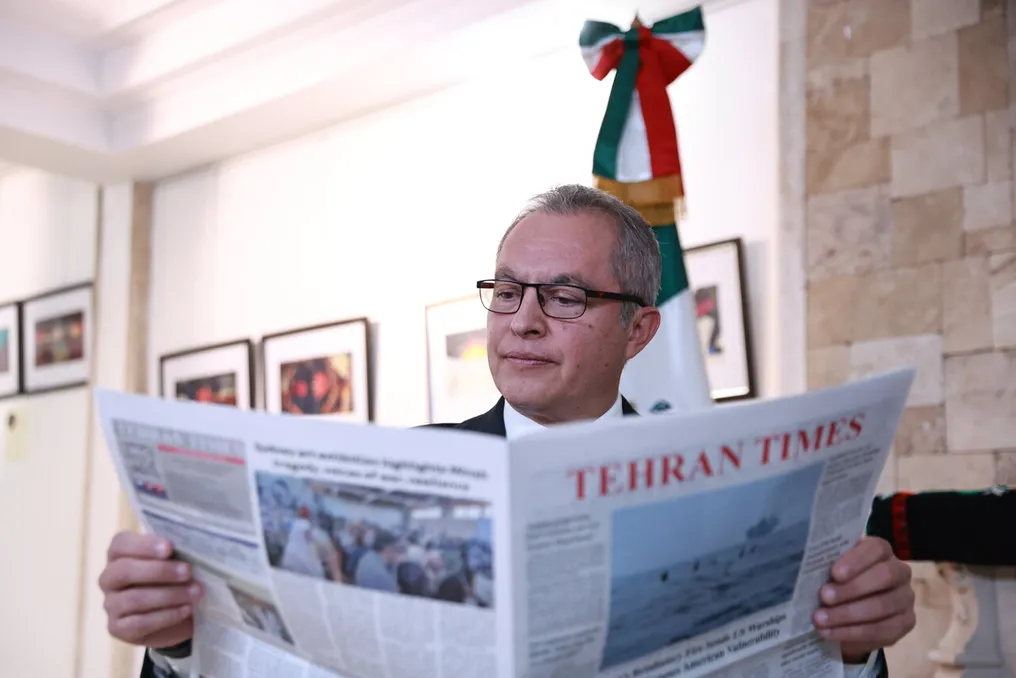
In Tehran, at the Mexican embassy, an extensive discussion took place between the Mexican Ambassador to Iran, Guillermo Puente Ordóñez, and the publication Tehran Times. The discussion focused on a special exhibition titled '68 Voices, 68 Hearts,' which was presented at the embassy.
The exhibition was held as part of the third week celebrating Mexico's indigenous peoples and communities abroad. It included 40 images accompanied by 20 stories, as well as audiovisual materials detailing various indigenous traditions in their native languages. An embassy staff member noted that through these resources, the exhibition offered an opportunity to explore different ways of understanding and representing the world that is part of Mexico's cultural and linguistic heritage.
During the interview, the ambassador also touched upon deep parallels between the cultural diversity of Mexico and Iran, the significance of art in establishing connections between peoples, the current state of bilateral relations, Mexico's experience hosting the Iranian national team at the World Cup, and his personal reflections on life in Iran.
The ambassador thanked them for their interest in the '68 Voices, 68 Hearts' exhibition. He explained that the title refers to the 68 indigenous language groups of Mexico and reflects the country's broad cultural and linguistic diversity, which, he said, exceeds this number. He emphasized that the exhibition aims to reflect a piece of the various idiomatic and ethnic cultural expressions of modern Mexico, tied to its ancient past and traditions, mentioning that Mexico has 360 different linguistic expressions.
Puente Ordóñez believes that the peoples of Mexico and Iran are very diverse. He thinks that Iranians will understand his point that this diversity and ethnicity are closely linked to the geography of both countries, as different parts of the country feature various expressions originating from multiple cultures. He noted that Mexico is one of the most culturally diverse nations, including various ethnic groups and languages that enrich the national culture.
He added that the national culture is integrated by all these different expressions, whether local or more provincial geographically, and that this diversity gives meaning to Mexico as a country, society, and culture. The ambassador also suggested that such richness of colors and expressions can be found in Iran.
In addition to this exhibition, events were organized demonstrating similarities between Iranian and Mexican peoples. For instance, a seminar on the folk expressions of Iranian and Mexican culture was held at the embassy. During this seminar, it was decided to collaborate with an Iranian master dedicated to promoting Iranian folk expressions, particularly dolls that can serve as decorations or toys. Similar traditions exist in Mexico.
As part of this seminar, the Iranian instructor created Mexican dolls using Iranian techniques. These dolls were subsequently displayed at the Frida Kahlo and Diego Rivera exhibition at the Niavaran Cultural Complex. This exhibition consisted of three parts: the first about dolls, the second a photographic exhibition from Mexican cultural institutions, and the third inviting Iranian artists to interpret the image of Frida Kahlo. The Iranian cultural association independently selected about 90 paintings.
This third part of the exhibition took place in Niavaran for two weeks and was highly successful, attracting about 10,000 visitors. Furthermore, the seminar itself, related to doll making, was part of the exhibition, attracting many children and people who enjoyed the process of creating items with Iranian teachers and techniques while maintaining a connection to popular Mexican cultures.
The ambassador agreed with the premise that art plays an important role in building bridges between the peoples of Iran and Mexico. He believes that such dialogue is the best way to bring people closer. He cites the seminar and the Frida Kahlo and Diego Rivera exhibition in Niavaran, as well as participation in the Tehran International Book Fair and publications at the embassy. He is confident that connecting Iranian cultural popularizers and artists with their counterparts in Mexico will lead to positive results in the future.
Puente Ordóñez stressed that if the Mexican embassy can contribute, especially considering that young generations of Iranian and Mexican artists will continue to collaborate, it will help strengthen bilateral relations and foster better mutual understanding beyond often negative stereotypes.
Mexico and Iran have maintained diplomatic relations for decades, although the intensity of interaction has fluctuated due to Western sanctions and regional conflicts. The ambassador characterized these relations as friendly, noting their historical foundation dating back to the late 19th century. He expressed hope for continued efforts to strengthen the dialogue. He noted that the historical background shows the existence of many important ties and hopes that the cessation of political tension and conflict in the region will allow bilateral relations to resume and strengthen.
In Mexico's view, its foreign policy is based on the principles of the Constitution, and the country always adheres to these principles. He also mentioned that the president, as head of state and government, directs and determines Mexico's foreign policy.
If one had to name one achievable goal for Mexico-Iran relations over the next three years—whether in trade, sports, or diplomacy—the ambassador expressed hope for stronger relations in the future. He is convinced that only joint efforts can work towards improving relations, based on the cultural ties he mentioned at the beginning of the interview.
The ambassador noted that hosting the Iranian national team at the World Cup was a good example of what he had previously discussed. He believes that this small but recent sporting example summarizes his thesis on societal rapprochement: the admiration Mexico holds for Iran's history and culture, and vice versa. After this experience, he observed that people in Iran, upon learning he was the Mexican ambassador, approached him themselves to thank him for hosting the team at the World Cup.
He clarified that Mexico co-hosted the World Cup with the USA and Canada, and they were fortunate enough to host the opening match. In 2010, when South Africa hosted the World Cup, an interesting historical parallel occurred in football.