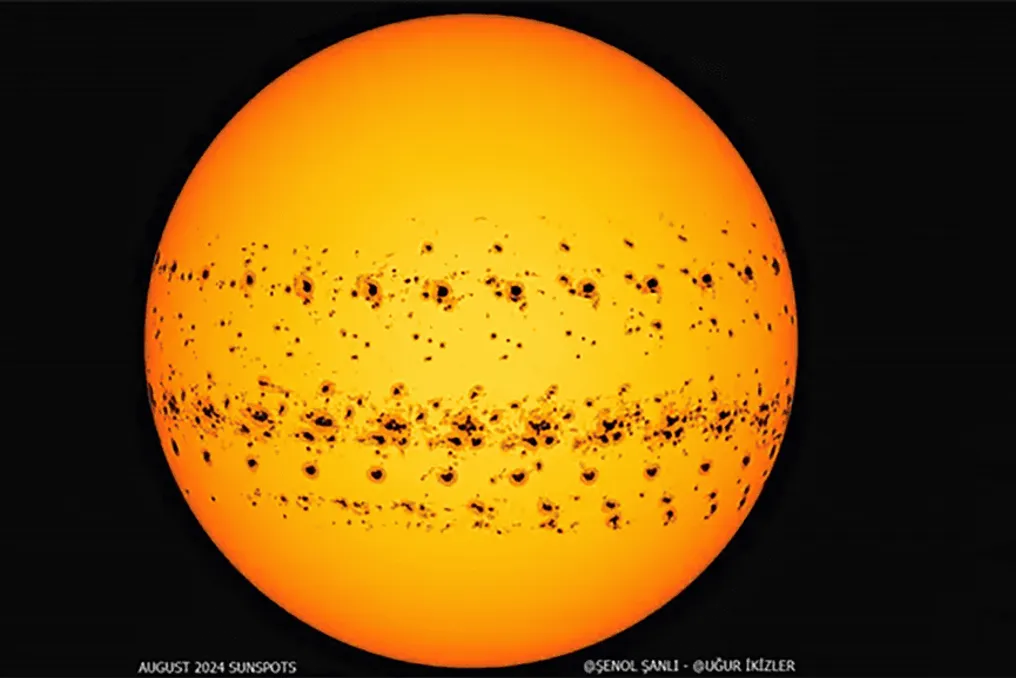
For the first time in over six months, the Sun did not show visible spots on Friday (the 18th). This condition had not been observed since February. On Saturday (the 19th), the star maintained its clear appearance for the second consecutive day, marking a pause in its active activity.
Despite its seemingly calm exterior, scientists confirm that spots are still present on the hidden side of the celestial body. Since the Sun rotates on its axis, these active regions should reappear in the coming days.
Summary:
These dark markings on the Sun appear because they represent areas significantly cooler than the rest of the disk. While the overall surface temperature reaches about 5500°C, the spots fluctuate in the range of 3500°C to 4500°C. It is this temperature difference that creates the strong visual contrast observed from Earth through special telescopes.
The origin of this phenomenon is related to the powerful magnetic field generated by plasma—hot gas of charged particles that moves continuously. When these forces concentrate at a specific point, they block the flow of heat from the star's interior. Due to less energy reaching the surface, this particular area cools down and takes on a dark appearance.
When excess energy accumulates in these zones, strong bursts known as solar flares occur. These events eject clouds of particles into space, which can reach Earth, affecting satellites, GPS systems, and electrical grids. As compensation, in addition to technological failures, this process also generates the beautiful spectacle of the aurora borealis and australis in the polar regions.
More Details:
Thanks to this dynamic, the number of sunspots serves as a direct indicator of the celestial body's activity. The peak of the current Solar Cycle 25 was recorded on August 8, 2024. On that day, the Space Weather Prediction Center (SWPC), part of the U.S. National Oceanic and Atmospheric Administration (NOAA), estimated the number of sunspots at 337, which was the highest daily figure since March 2001.
The number of these formations varies during the natural cycle with an average duration of 11 years. This cycle fluctuates between a Solar Maximum, filled with storms and instability, and a Solar Minimum—a period when the star enters a state of quiescence. During the last recorded minimum, between 2018 and 2020, the Sun reached an accumulation of over 700 completely clear days.
According to the Spaceweather.com meteorology and space climate platform, the temporary absence of spots strengthens the opinion that Solar Cycle 25 is gradually approaching its end. Although rotation should soon bring new dark spots, this brief lull serves as a harbinger of a more peaceful and stable behavior that the celestial body will exhibit more often in the coming years.