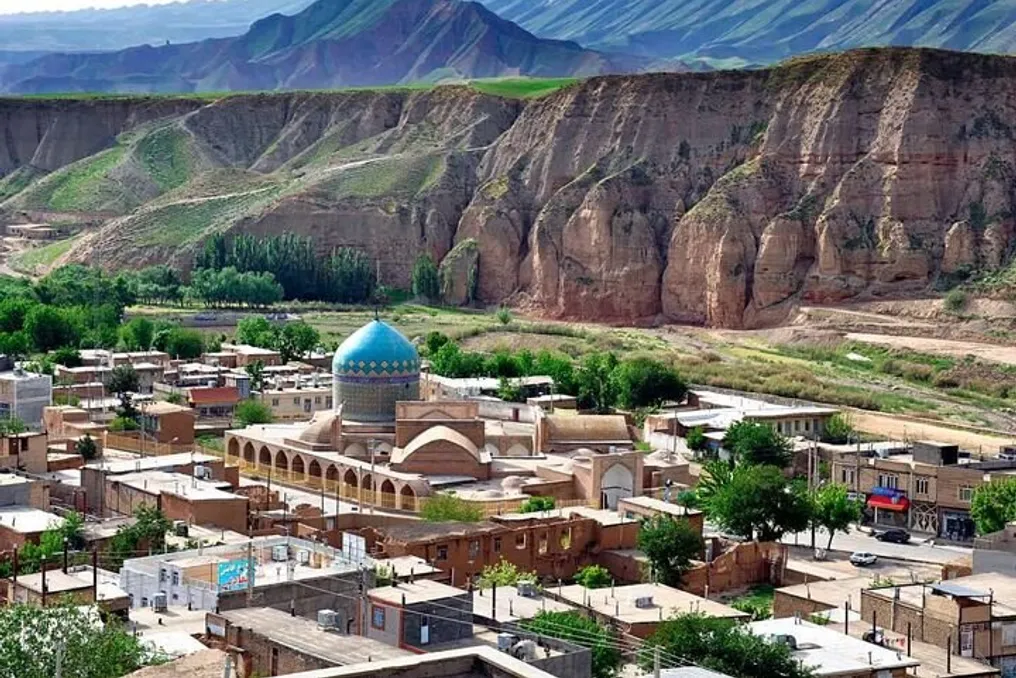
Located in the historical landscape of Kalat in northeastern Iran, the Gonbad Qabud Mosque is an outstanding monument reflecting nine centuries of architectural changes, artistic expression, and cultural continuity.
This religious structure, also known as the Blue Dome Mosque, Nadiri Mosque, and Jameh Mosque of Kalat, is more than just a place of worship. Its successive architectural layers demonstrate the influence of various eras of Iranian history, ranging from the Seljuk period to the Ilkhanid, Afsharid periods, and subsequent Qajar restorations.
Historian Alireza Javari asserts that historical evidence indicates that the original structure of the Jameh Mosque of Kalat dates back to the Seljuk period. However, over the centuries, the mosque has undergone significant changes and expansions, with each era leaving its unique architectural and artistic mark.
The main dome is attributed to the Ilkhanid period, and Nader Shah Afshar, the 18th-century ruler who turned Kalat into one of his important fortresses, is considered responsible for completing parts of the complex. The surrounding buildings and iwans were built or developed during the Afsharid period, adding another layer to the long history of this monument.
The most distinctive feature of the mosque is its blue-turquoise appearance. The extensive use of turquoise tiles on the dome and iwans gave the monument its name, as this color is traditionally associated with the sky and infinity in Islamic architecture.
Architecturally, the mosque includes four iwans and a large two-tiered blue dome. A cylindrical drum supports the dome, and the space beneath it forms a regular octagon, each side measuring approximately four meters. The main courtyard is rectangular, measuring approximately 19 meters wide and 27 meters long.
Fragments of yellow-blue tilework are preserved on the four iwans, while extensive examples of seven-colored tiles can be seen in both the interior and exterior decoration. Floral and arabesque motifs, along with intricate geometric patterns, adorn the iwans and arcades.
According to Javari, these decorative elements are not merely ornaments; they reflect the religious and cultural symbolism of the eras in which they were created and demonstrate the technical mastery of Iranian artisans in combining color, geometry, and form.
The monument also bears physical evidence of its continuous use and restoration. A stone inscription from the Qajar period, written in Nastaliq script near the main entrance, records major repair works carried out in 1250 AH by the governor of Kalat, Yalang Tush Khan ibn Fath Ali.
The mosque was officially registered as a national heritage site of Iran in 1967 under registration number 661. Nevertheless, historical photographs from the 1960s document a significant deterioration and damage to some parts of the structure.
Conservation efforts intensified in subsequent decades as heritage protection agencies began restoration and conservation work to prevent further decay. Today, the mosque is considered one of the most important cultural and tourist attractions of Kalat.
According to Javari, a new restoration project has recently begun. This project, reportedly allocated 500 million Tomans, includes roof reconstruction, repair of damaged structural sections, extensive grouting, and restoration of the roofing structure. The goal of the work is to strengthen the building against rain, temperature fluctuations, and earthquakes.
The preservation program also includes the repair and repainting of over 500 square meters of interior and exterior surfaces. Javari emphasized the need to use historically compatible materials and colors so that modern interventions do not overshadow the historical appearance of the monument.
For Kalat, the significance of the Gonbad Qabud Mosque extends beyond mere architecture. Over the centuries, the mosque has served as a gathering place and point of interaction for various communities and local groups, making it part of the social and religious history of the region.
Thus, its preservation is not just about repairing an old building, but an effort to preserve the physical chronicle of the cultural layers that have shaped Kalat over centuries.
As the restoration work progresses, the mosque is expected to accommodate more visitors and strengthen its role in the cultural tourism sector of Razavi Khorasan province. For travelers interested in Iran's architectural heritage, Gonbad Qabud offers something rare: a unified structure where successive chapters of Iranian history remain visible in its dome, iwans, inscriptions, tiles, and preserved architectural fabric.