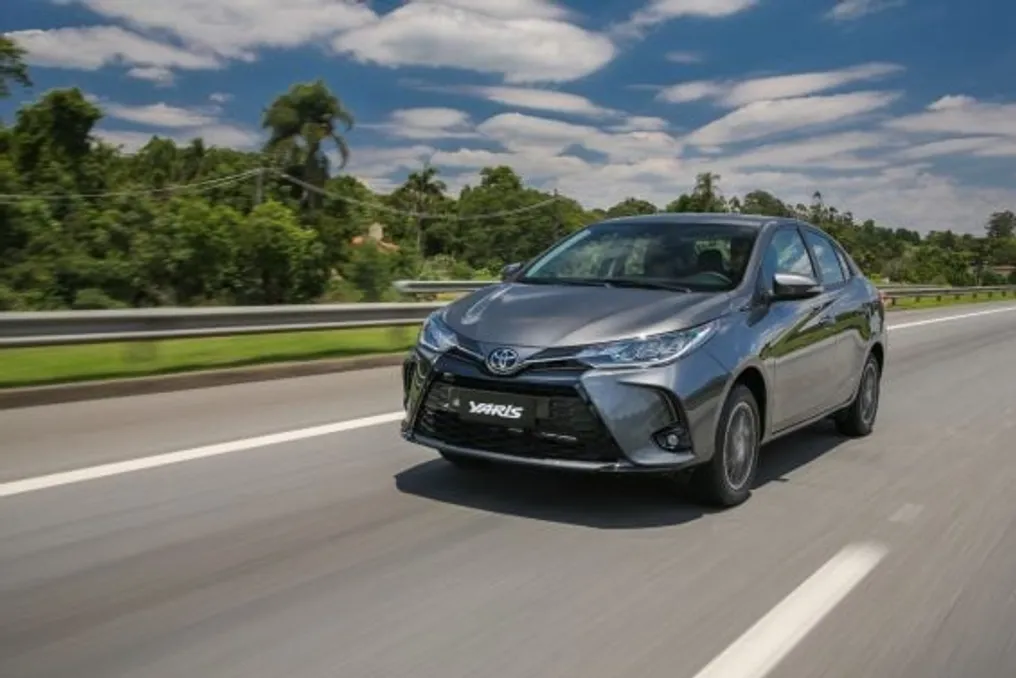
The Toyota Yaris has established itself in the Brazilian market as a reliable, discreet, and rational vehicle. The sedan version of this compact added good space both inside and in the trunk, making it an advantageous option for those looking for a used or pre-owned car.
Due to these qualities, the Toyota Yaris Sedan has become a common choice for taxi drivers, ride-share drivers, and families who value durability and the fact that the car is not highly targeted, which translates into more attractive insurance quotes. Despite lacking the emotional appeal of some competitors, the model has built a solid reputation over almost eight years of presence in the country.
The Yaris was introduced in Brazil in 2018 with the goal of filling the gap between the Etios and Corolla models. The intention was to position it as a premium compact, offering more sophistication than the Etios, but with a lower cost of ownership than a known mid-size sedan.
Manufactured in Sorocaba (SP), the Yaris was launched in hatchback and sedan body styles, using already known Toyota line engines: the 1.3, with up to 101 hp, and the 1.5, with up to 110 hp. Options included manual and automatic CVT transmissions.
The 2022 line update resulted in a leaner Toyota Yaris profile. The 1.3 engine was discontinued, as were the manual versions. From that point on, the model began to be sold exclusively with the 1.5 engine and continuously variable transmission.
These were signs that the production of the Yaris hatchback and Sedan would be brief. In 2025, both vehicles had their manufacturing ended; only the Sedan registered 134 thousand units plated since 2018. To replace the duo, Toyota launched the Yaris Cross, its first compact SUV.
It is important to note that the Brazilian Yaris has no direct link to the European model, which is more modern, features a hybrid version, and is based on a different platform. The national compact derives from the model produced in Thailand and shares the same structural base as the Etios.
This Asian origin reinforces the car's proposal: to be a rational compact, focused on low maintenance and durability, without major technological or design advancements.
Performance and Mechanics
The mechanical assembly of the Yaris is one of its strengths. The 1.3 and 1.5 naturally aspirated, four-cylinder, multi-valve engines, shared with the Etios, are recognized for their robustness and ease of maintenance. Both have dual valve trains and intake and exhaust variable valves.
The powertrains of the Yaris hatchback and Sedan showed slightly higher power than the Etios and operate with a seven-speed simulated CVT gearbox, similar to that used in previous generations of the Corolla.
While the mid-size sedan received praise for this gearbox, in the Yaris, the combination with the 1.5 engine, in particular, provides smooth, predictable, and economical behavior, given that the Yaris is not a performance-focused car.
The Toyota Yaris was designed to prioritize efficiency. In versions equipped with the 1.3 16V engine—available up to the 2022 facelift—the performance is adequate only for urban use, showing moderate acceleration and restrained responses. Its power reaches 101 hp with ethanol and 94 hp with gasoline, generating a torque of 12.9 and 12.5 kgfm, respectively, at 4 thousand rpm, with considered interesting fuel consumption.
1.5 Engine Details
Focusing on the Toyota Yaris with the 1.5 16V engine, this engine provides a more pleasant drive, especially on highways, allowing the vehicle to maintain speed with less effort. It delivers 110 hp with ethanol and 105 hp with gasoline. The torque reaches 14.9 kgfm with vegetable fuel and 14.3 kgfm with fossil fuel, both recorded at 4 thousand rpm.
The 2022 line introduced Eco and Sport driving modes, which allow adjusting the behavior of acceleration and the gearbox. However, the main focus of the vehicle remains fuel consumption.
Sedan Dimensions and Comfort
The Toyota Yaris Sedan maintains the same wheelbase (2.55 meters) and width (1.73 meters) as the hatchback. However, it has a length of 4.42 meters, being 28 cm longer, which significantly optimizes cabin utilization.
In addition to a generous trunk capacity of 473 liters, the engineering managed to move the rear seats back, providing space for five adults that exceeds the average of the compact sedan category.
The CVT gearbox is fundamental to the feeling of comfort when driving the Yaris, as it operates smoothly, without jerks, and avoids the characteristic noise of the 'blender effect' found in older CVT transmissions.
Although the space is satisfactory for all occupants, there are ergonomic reservations: the front center console is positioned very far back, which bothers the central rear passenger when entering or exiting the vehicle. The overall ergonomics are correct, but the steering position could be more adaptable. Furthermore, the Toyota seatbelt system requires specific handling to be activated.
The suspension, composed of McPherson in the front and torsion beam in the rear, works well in isolating road irregularities and potholes. However, the acoustic insulation fails at higher speeds, and the interior finish, which makes excessive use of plastic, lacks aesthetic appeal.
Considering the 2023/24 Toyota Yaris Sedan XLS version, KBB Brasil assessed an average Reseller Price of R$ 108,992 and a Private Sale Price of R$ 99,183 (data from September 2026).
In terms of safety, the 2024 Yaris Sedan XLS line was already equipped with driving assistance features, such as forward collision warning with autonomous emergency braking and lane departure warning.
Other safety features include seven airbags, stability and traction control, hill start assist, rearview camera, Isofix, and electrochromic mirror. The multimedia center has a 7-inch screen and supports Android Auto and Apple CarPlay. The package is completed by automatic air conditioning, leather seats, keyless entry, sunroof, electric trio, and USB ports for the rear seats.
Even a used Yaris Sedan can benefit from the extended warranty offered by Toyota, which can reach 10 years, provided the previous owner performed all services at the dealership network within the deadline.
The Yaris Sedan maintains its reputation as an extremely durable car, a common characteristic of Toyotas in Brazil. The 1.3 and 1.5 engines are simple and their components are easily found, in addition to having a competitive cost.
Owner reports, collected from forums, discussion groups, and Reclame Aqui, indicate some recurring problems in the Yaris. To date, the Yaris line has not suffered any recalls.