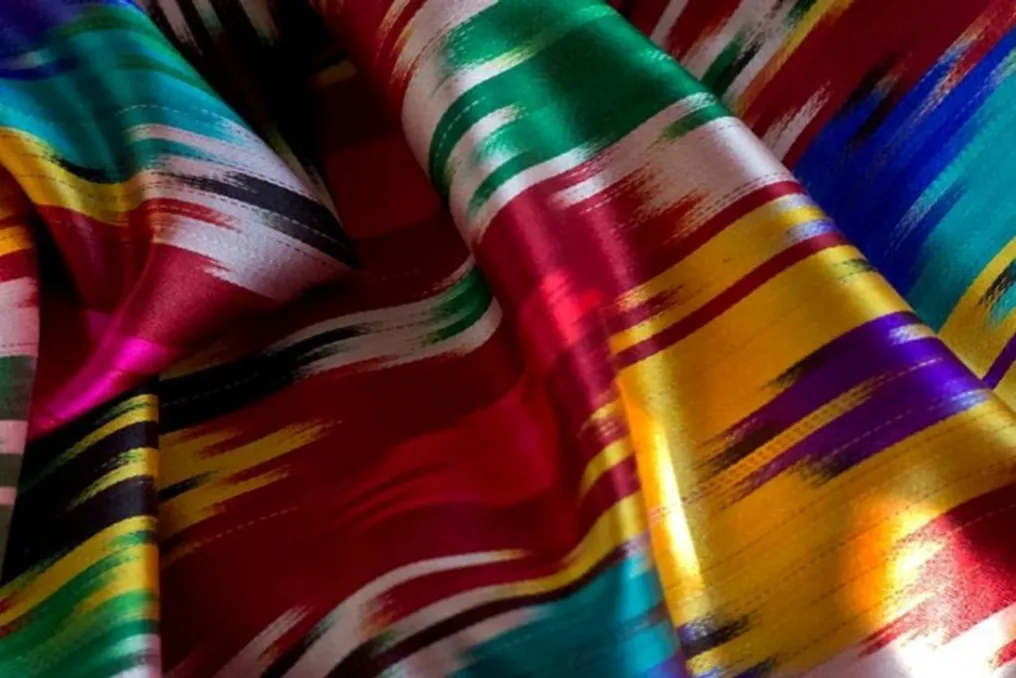
In the Autumn-Winter 2026/27 season, elements such as velvet, embroidery, complex ornaments, voluminous headwear, wide silhouettes, and handcrafted items have unexpectedly resurfaced in global design. These features, deeply rooted in Uzbek culture, have become noticeable on international runways.
A correspondent from Podrobno.uz compared shop windows in Tashkent stores with fashion shows to determine whether this is a sign of global fashion approaching long-known Uzbek aesthetics or merely a desire to see familiar traits in world trends.
In modern Tashkent shopping centers, the line between national and international is blurring. In one place, one can see a blouse with a rhythmic pattern reminiscent of adras, while in another, there are long robe silhouettes with dense embroidery and complex texture. Even foreign brands feature trousers with a handkerchief pattern alongside dark jacquard jackets with floral motifs. This raises the question of why a visual language previously considered too national is now confidently blending with global trends.
Global Trend Towards Expressiveness
It cannot be claimed that minimalism has completely disappeared, but in the Autumn-Winter 2026/27 collections, it ceased to be the only safe choice. Parisian shows demonstrated significantly more texture and visual richness. Vogue's seasonal review includes prints, velvet, and velour, embroidery, decorative details, and an expansion of silhouettes—from broad shoulders to almost theatrical volumes. Accessories have also become expressive: headwear, silk scarves, brooches, long gloves, fringe, and jewelry have returned, refusing to remain inconspicuous.
For residents of Uzbekistan, many of these elements carry an almost domestic feel. The love for rich colors, the combination of multiple patterns, complex fabric surfaces, long outerwear, and headwear as a standalone detail—this is something that does not require reinvention in Uzbekistan. What international fashion currently defines as a return to decoration, craftsmanship, and individuality existed in Uzbekistan for decades as part of celebration, daily life, and family memory.
The Return of the 'Grandmother's' Style
Young designer Fatima Khakimova, whose opinion was gathered in a Tashkent store, notes how traditional silhouettes and fabrics are re-entering modern urban wardrobes and how buyers' perception of these items is changing. She cites dresses and blouses with a yoke. According to her, previously such a cut was associated with clothing from the past, worn by mothers and grandmothers.
Khakimova explains: 'Previously, a yoke dress was perceived as an old-fashioned item. But now this cut has returned, especially when combined with national fabric—khan-atlas and adras.'
Attitudes towards the chapan have changed similarly. A few years ago, it was either part of a traditional costume, a souvenir, or clothing for special occasions. Today, the chapan easily integrates into a casual look over jeans, a dress, or trousers. The more visible the handiwork and the age of the fabric, the higher the value of the item for the buyer.
The designer emphasizes: 'Now, a fashionable young woman almost certainly has some kind of ethno-chapan. Items with embroidery or old fabric—literally from grandmother's chests—are particularly valued.' Thus, the main paradox of the current season is that the global market is actively promoting what in Uzbekistan was long criticized as 'outdated.' In global fashion, this is denoted by terms like archive, craft, heritage, handmade, boho, or artisanal, whereas in Tashkent, there are direct equivalents: chapan, suzan, bahmal, adras, khan-atlas.
Features of Adras and Ikat
It is important to note that ikat is not exclusively an Uzbek invention, as the technique of pre-dyeing threads before weaving is widespread globally. However, in Central Asia, especially in the Fergana Valley and cities of modern Uzbekistan, a unique language of such fabrics has developed. Locals call them abri ('cloud'), and the technique is called abrbandi, meaning 'tying clouds.' This is what creates the characteristic trembling color boundary, giving the impression that the pattern is slightly floating, although its complexity is determined even before weaving begins.
Simply put, ikat is a method of creating fabric, not a single pattern. Threads are dyed before weaving, and certain areas are protected from the dye. Then, the cloth is woven from the prepared threads. Small shifts lead to soft, blurred edges of the pattern. In Uzbekistan, this technique is closely linked to atlas and adras and is viewed not only as a decorative technique but also as an integral part of the craft and cultural tradition.
UNESCO recognizes the connection between the history of Margilan atlas and adras manufacturing technologies and the territory of modern Uzbekistan, noting their importance for local identity. In 2017, the technology for preserving traditional Margilan methods was entered into the Register of Good Practices for the Protection of Intangible Cultural Heritage.
Fatima Khakimova explains the difference in feel: khan-atlas usually has a bright silk sheen, whereas adras combines silk and cotton, appearing more subdued. Bahmal is another texture valued for its depth of color and manual labor. The designer notes: 'Bahmal is handwoven and made of silk threads. Khan-atlas is also made by hand, and it always shines noticeably. Now people are again drawn to exactly these things—the brighter and more textured, the more interesting.'
Furthermore, there is the concept of suzan—embroidered panels and fabrics created within the framework of domestic life, dowry, and family rituals. In suzan, not only the composition (flowers, rosettes, pomegranates, solar shapes) is important, but also the process of labor, as the ornament is inextricably linked to the person who embroidered it.
Central Asian Ikat in Global Fashion
The current similarity between runways and the Uzbek visual code seems new only because this trend has resurfaced. In fact, Central Asian ikat has already been present in high Western fashion. The National Museum of Asian Art at the Smithsonian Institution indicates that in 2005, Oscar de la Renta used ikat in his collections, after which the motif spread widely—from clothing to carpets and wallpaper.
The museum emphasizes that in modern Uzbekistan and the Fergana Valley, this fabric is known as abri, and the technique as abrbandi. Thus, the debate about the similarity between modern geometric patterns and adras is endless, but the influence of Central Asian ikat on Western fashion has been documented by museums for a long time. The question today has shifted: how to name this visual exchange and who has the right to authorship in the public consciousness.
Recognition of the Source
One striking example of the 2026/27 season in Parisian haute couture is the long red velvet coat by Frank Sorbier, which directly references Uzbek ikat. The collection's concept also includes the theme of traveling through Central Asia and Bukhara. What matters is not so much the designer himself, but the principle: the source is not disguised as general 'ethnic,' but clearly named.
This contrast is particularly noticeable in how often the origin of similar ornaments is erased in mass fashion. Product descriptions may contain terms like abstract print, bohemian pattern, scarf print, paisley, or simply ethnic motif. Sometimes it is indeed a different source, and sometimes only a distant visual kinship. However, the local perspective allows for easy recognition of a familiar rhythm, color scheme, or pattern structure, raising the question of why geography is absent from the description.
The Question of Attribution
The most appealing phrasing for such materials is an accusation of 'pattern theft,' but this is too simplistic and often difficult to prove. Firstly, ikat is not only found in Uzbekistan. Secondly, floral and geometric motifs have moved between Persia, India, the Ottoman world, Central Asia, and Europe for centuries. Thirdly, the external similarity of two objects does not prove that the designer saw a specific Uzbek sample.
Nevertheless, there is another side: WIPO states that the fashion industry has borrowed elements from other cultures for centuries, and traditional textiles, ornaments, and clothing forms are poorly protected by classic copyright. Therefore, they are often used for commercial purposes without the full participation of the bearers of tradition. WIPO proposes four main principles: understanding context, respectful transformation, indication of source, and cooperation with culture bearers.
Therefore, it is more correct to speak not of complete 'theft,' but of the problem of attribution. When a fashion house honestly specifies 'Uzbek ikat,' the visual exchange becomes obvious. When this same code is transformed into an abstract boho print, its origin can be erased from the history of the item, and with it disappear the artisans, cities, and technologies that shaped this language. In Tashkent shops, this discussion is simpler: sales consultant Firuza notes that foreigners are primarily attracted by embroidery and bright colors.