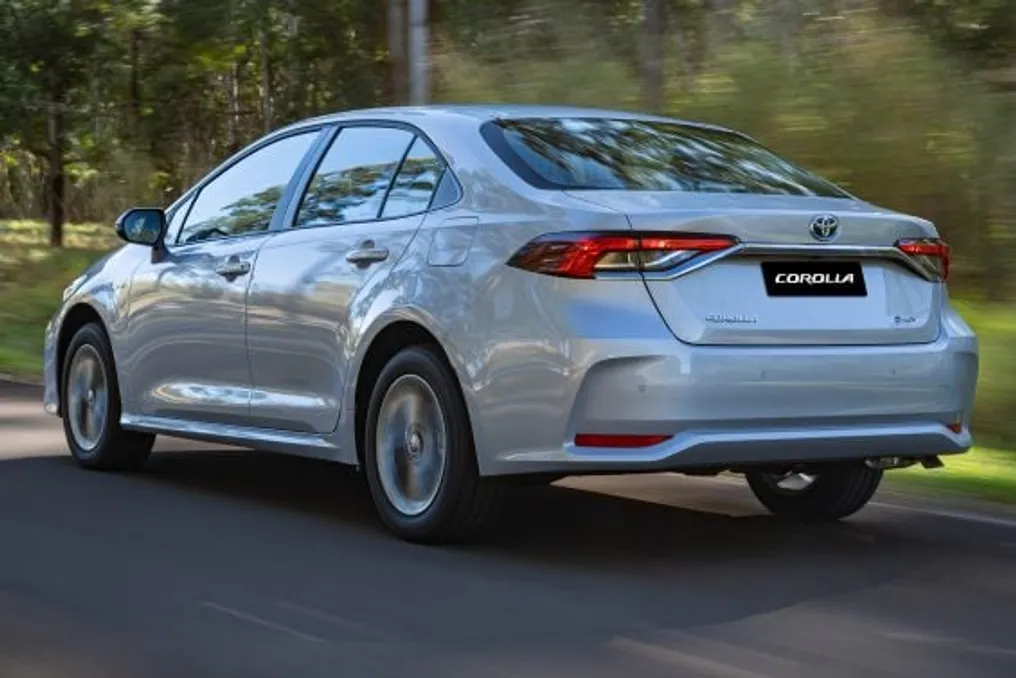
In Brazil, electric vehicles reached a significant milestone by surpassing sedans in sales volume. In June 2026, 21,920 100% electric cars were registered, while sedans recorded 19,476 units. This event marks the first time that the battery vehicle category has overtaken the car type that led the Brazilian market for a decade.
The difference between the categories grew even more in August, when electric vehicles totaled 26,558 units against 16,334 from sedans. This reversal of trend is seen as the clearest indicator of a downward trajectory for the sedan segment in the country.
Historically, sedans held a considerable share of the market. In 2015, they represented 29% of new cars sold, with the Chevrolet Prisma standing out, registering almost 70,000 units, and the Toyota Corolla with 66.9 thousand. However, in 2025, this participation plummeted to only 12%, and the Corolla registered 33.2 thousand sales, half the volume of a decade earlier.
Smaller sedans, which together accounted for 17% of the market, fell to less than 3% currently. The segment closed 2025 with 246.6 thousand units, representing a 17% reduction compared to the previous year.
Milad Kalume Neto, a consultant at K.LUME Consultoria, points out that the main reason for this change is the migration of consumers towards SUVs. However, he suggests that the issue is more complex, as the low sales of sedans could be the result of both consumer migration and lower available supply.
For the consultant, these two factors act together and reinforce each other: consumers have shifted their focus, manufacturers have directed investments where there was greater profit potential, and the decrease in launches accelerated the drop in demand. Kalume Neto emphasizes that manufacturers also bear responsibility in this scenario, arguing that when platforms are shared and the SUV shows higher demand, accepts higher prices, and guarantees better margins, it becomes difficult to justify investment in new sedan models. He compares this pattern to what previously happened with station wagons.
Research helps clarify the buyer's perspective. The International Energy Agency (IEA) documents that SUVs reached 48% of global car sales in 2023 and approached half of sales in 2025. Furthermore, a 2022 study published in Energy Research & Social Science indicated that SUV drivers perceive their vehicles as superior in terms of safety, space, and driving satisfaction, in addition to considering them a symbol of success.
Economists characterize this movement as a kind of 'arm race' on public roads. Michael Anderson and Maximilian Auffhammer calculated, in the Review of Economic Studies, that being hit by a vehicle weighing about 450 kg more increases the risk of mortality by 40% to 50%. Thus, those who opt for a larger car seek personal safety, transferring risks to third parties, who tend to react by adopting similar measures.
In the Brazilian context, a survey conducted by Webmotors Autoinsights with 1,800 participants revealed that 40% of individuals planning to buy a car in 2026 desire an SUV, while 28% still maintain the sedan as an option. Kalume Neto considers this trend global, stating that Brazil is merely following it.
The Brazilian specificity lies in the size of the SUVs, which are smaller compared to European and North American models, and the preference for a larger vehicle due to local road conditions, which include many speed bumps and ditches, in addition to the need to accommodate the family.
The consultant does not believe that sedans will become extinct, but predicts that there will be a reduction in the number of models and a specialization in more defined niches. Small and compact sedans, such as the Hyundai HB20S, Fiat Cronos, Chevrolet Onix Plus, and Volkswagen Virtus, are expected to progressively lose ground, focusing more on corporate fleets.
Mid-size sedans, including the Toyota Corolla, Nissan Sentra, and BYD King, should remain relevant thanks to major market players, albeit with lower sales volumes. In the executive luxury segment, among the Mercedes-Benz C-Class, BMW 3 Series, and Audi A4, Kalume Neto assesses that sedans will continue to dominate.