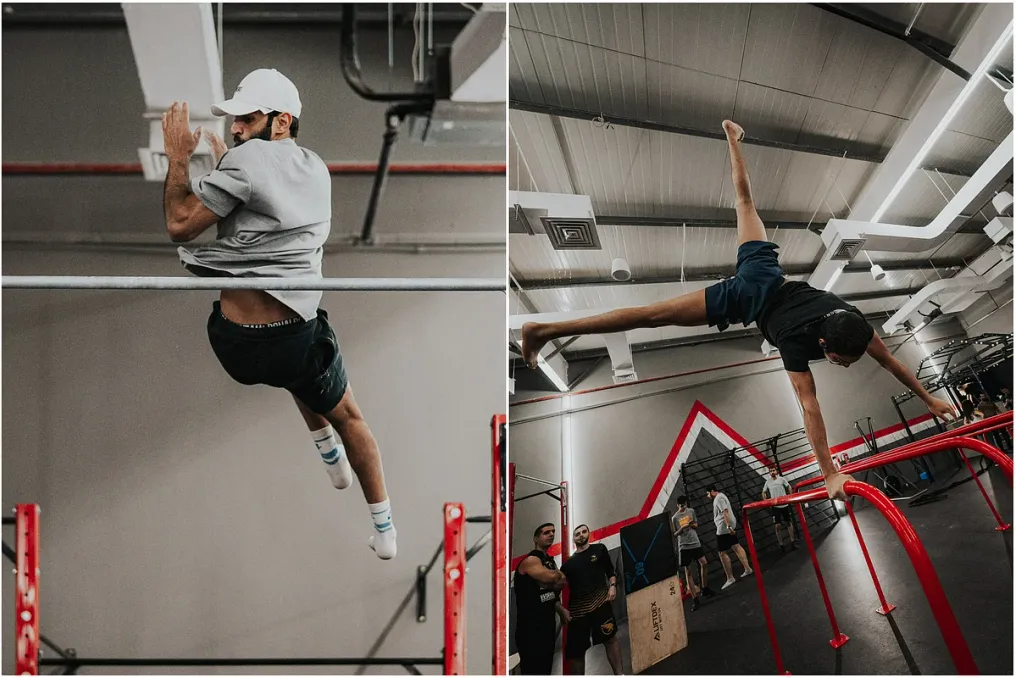
The deceptive promise of quick body transformation is often found in advertising: just fifteen minutes a day and a few simple exercises can lead to an athletic physique. However, real calisthenics looks much more extreme. In a gym in Abu Dhabi, athletes perform complex elements such as bar jumps, horizontal body holds, and muscle-ups, mastering which requires months or even years of gradual training.
For those who practice this sport competitively, calisthenics differs greatly from quick beach workouts consisting of push-ups and squats. Although the discipline has roots in bodyweight training and street workouts, its advanced forms demand significant strength, body control, flexibility, coordination, and patience.
Georgi Petkov, a world champion calisthenics athlete and coach from Abu Dhabi, who has practiced the discipline for about 13 years and taught for about ten, notes that the sport begins with basic movements, gradually preparing the body for more complex elements. He emphasized: 'The more repetitions and repetitions with basics you have, the better your body is prepared to learn a new skill.'
At an advanced level, athletes work on movements like the planche and front lever, where the body is held horizontally through upper body strength and core control. International champion and coach Charbel Khouri says that mastering some of these skills may take athletes anywhere from six months to a year, although progress is individual.
For example, to perform a planche, the shoulders and core must support the body horizontally, whereas the front lever places serious demands on the core and latissimus dorsi muscles. The muscle-up adds an explosive element: the athlete must pull up high enough over the bar to transition from a pull-up to a push-up.
Khouri, who started training in Lebanon at age 13 in 2013, recalls that he could initially only do two or three pull-ups. He continued to participate in national and international competitions and reported winning the Lebanese national championship annually from 2014 to 2024–25. His journey demonstrates the difference between basic bodyweight exercises and competitive calisthenics.
He noted that 'there is much more to calisthenics than just push-ups,' pointing to the skills, progression, and community that develop around the sport. This community aspect is becoming increasingly visible in Abu Dhabi, where local athletes range from beginners learning initial skills to competitors preparing for championships.
Khaled Al Jaberi, founder of Muscle Up Fitness, said that when he became interested in calisthenics around 2018, it was difficult for him to find a gym dedicated exclusively to this discipline in Abu Dhabi. He eventually started working on creating such a gym, which officially opened in October 2022. At that time, he noticed that the local calisthenics community was so small that its members could almost be counted on one's fingers.
The gym subsequently organized competitions, challenges, free meetups in Abu Dhabi parks, and workshops as part of efforts to attract more people to the sport. The goal was not only to train advanced athletes but also to provide newcomers with a path into a discipline that can initially look intimidating.
Al Jaberi stated that the gym developed classes for different levels, guiding people from basic movement variations to intermediate and advanced skills. This progress is visible among the athletes themselves. Meanwhile, Abdullah Al Hosani, a member of the local community, came to calisthenics from running. He explained that recurring injuries from running, including shoulder and lower back problems, prompted him to seek a way to strengthen his upper body. After calisthenics sessions, he noted improved shoulder and back pain due to increased upper body and core strength. He now combines both disciplines, training in calisthenics several times a week along with running, and has competed.
At one of the Muscle Up Battle events, he placed fourth in his first appearance. For young athletes, this sport can offer progression far beyond traditional gym exercises. Zaid Al Salami, a younger participant in the calisthenics community, is already working on movements like the front lever. There are also young athletes in the community mastering handstands and other advanced skills while still in school.
This range of ages and abilities is part of what gives the sport a sense of community: athletes can work towards completely different goals while training around the same bars. For Petkov, the accessibility of calisthenics is part of its appeal. He started training outdoors, using whatever was available, including park equipment and even walls for push-ups. He stated: 'You don't need a specific place or special equipment. You just need creativity, imagination, and knowledge.'
Anastasia Starovoitova, an international champion and coach who started from scratch after discovering calisthenics during a trip to Ibiza, similarly noted that one of the attractive features is the ability to train with your own body almost anywhere. She later competed in France, as well as at European and world levels, ultimately winning the World Championship in Bulgaria in 2025.
However, although this sport can be practiced almost anywhere, mastering its most complex movements is far from easy. Khouri describes the muscle-up as an explosive pull followed by a push to clear the bar. The full planche is one of the most difficult skills he worked on. Starovoitova said that one of the characteristics of calisthenics is the lack of an obvious endpoint. 'You do 10 pull-ups, and then you want to do a muscle-up. You manage the muscle-up, then you want to do an explosive muscle-up, and then you challenge yourself with more weight, more reps—it never ends.'
'That's the cool thing: there is always something new to learn.' This is where the term calisthenics becomes vague on the internet. Social media advertising increasingly uses this term to promote short bodyweight programs, often showing dramatic before-and-after images and promising a radically transformed body in just a few days.
Petkov advised people to be skeptical of the idea that a short program can cause extreme physical transformation. He stated: 'If you weigh 100 kilograms with 40 percent body fat, it is impossible to become a person with 6 percent body fat and super ripped in 15 days.'
But he also makes an important distinction: the exercise itself can still be beneficial. Even if a program is advertised as 'military calisthenics' or another variation, a person who starts exercising regularly will likely improve their physical condition, according to him. Petkov added that the term 'military calisthenics' does not necessarily describe the same thing as competitive calisthenics.
He explained that bodyweight exercises such as pull-ups, push-ups, dips, monkey bars, and even muscle-ups were historically used in military and physical training, especially where agility, speed, and strength were required. However, competitive calisthenics takes these foundations into a much more specialized area, where athletes train for specific skills, controlled static holds, explosive movements, weighted exercises, and, depending on the discipline, freestyle combinations.
This difference is reflected in how the community grew in Abu Dhabi. What might start with a few push-ups, dips, or pull-ups can evolve into a structured progression toward movements requiring years of experience. The difference is visible when an athlete moves from a basic pull-up to a pure muscle-up or from a regular plank to holding the entire body horizontally above the ground. And behind these viral moments usually lies a long period of consistent training.
Petkov also noted that calisthenics teaches athletes to value progress. 'If you want to achieve a certain skill, it essentially takes time. It teaches patience.' This patience also motivates many athletes to continue training long after mastering the first impressive move. Starovoitova noted that she enjoys the opportunity to constantly set new goals for herself, while Khouri spent over ten years moving between freestyle, static skills, weighted calisthenics, and endurance. Thus, for beginners, the message from athletes is less glamorous than social media promises: start with the basics, master proper technique, and progress gradually. Grand muscle-ups and planches come later. And for athletes training in Abu Dhabi, this progression is increasingly becoming the essence of the sport—not just a path to a more beautiful body, but a test of what the body can learn.