
Uzbekistan offers tailored training programs for Japanese employers
Read more
UzDaily
uzdaily.uz

Uzbekistan offers tailored training programs for Japanese employers

The Head of the Migration Service of Uzbekistan, Mukhsinhodja Abdurakhmonov, proposed developing specialized courses for specialists who will work in Japan, based on the specific needs of employers. This was reported by the Migration Service of Uzbekistan.

This proposal was made during a round table held in Japan, which included representatives from the Japan Business Federation KEIDANREN and leading Japanese companies.

Training Approach

According to the proposed model, Japanese employers can participate in defining professions in demand in the labor market, qualification requirements, as well as in developing curricula and assessing candidates.

As part of cooperation with Japan, the Proud Academy in Uzbekistan, together with Proud Partners, operates in Angren, where over 140 drivers receive free language and professional training.

In Tashkent, training programs are implemented jointly with the companies Onodera User Run and Willer Express, covering driving, caregiving, and public catering services.

Additionally, a Japanese language class has been opened in the city of Karshi in collaboration with Orion Computer Co., Ltd. Training for specialists in the construction sector is planned for a later stage.

More than 200 citizens of Uzbekistan work at Shimizu Corporation sites. Projects involving Onodera User Run, Proud Partners, and Orion Computer Co., Ltd. have created at least 576 jobs.

Mukhsinhodja Abdurakhmonov emphasized that the main indicator is not only the number of citizens sent to work but also the quality of their preparation, adherence to contract terms, job stability, and professional growth.

KEIDANREN is the federation of Japanese businesses, uniting leading companies and industry associations across the country.

Similar stories

South Korea plans to hire builders from Uzbekistan using E-7 visas
Read more
uzdaily.uz

South Korea plans to hire builders from Uzbekistan using E-7 visas

The Migration Agency announced plans for South Korea to begin recruiting skilled specialists in the construction sector from Uzbekistan and other countries using E-7 visas. According to the proposed project, the initial monthly salary will be 2,156,880 won, equivalent to approximately 1,560 US dollars.

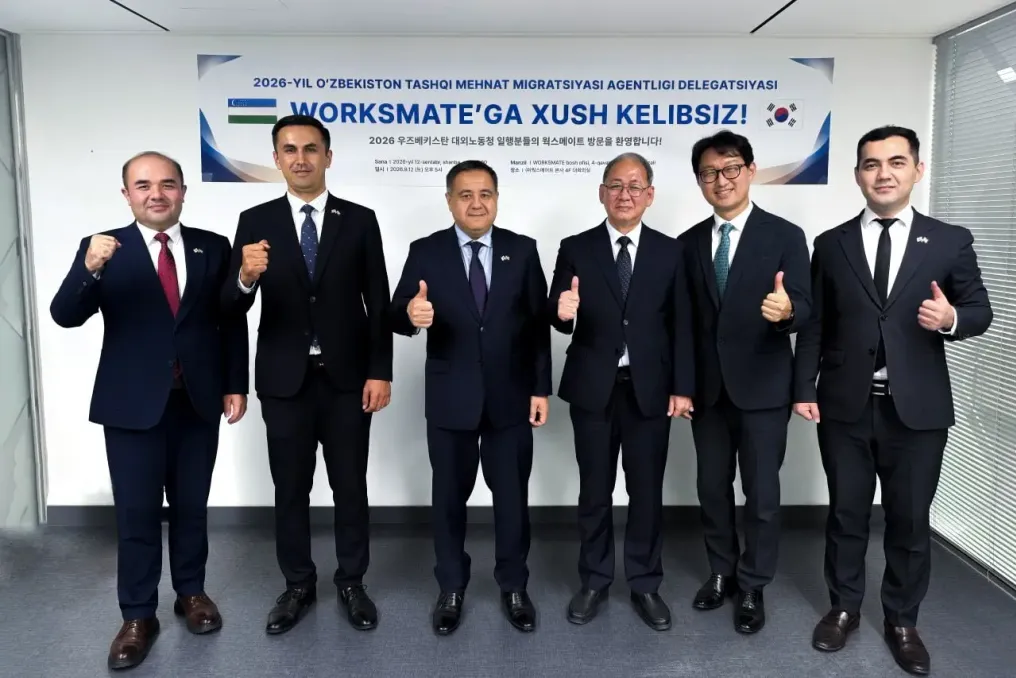
The head of the Migration Agency, Mukhsinhodja Abdurakhmanov, held a meeting with representatives of recruitment companies specializing in construction to discuss opportunities to expand access for Uzbek citizens to the Korean labor market. The meeting included Kim Se-won, founder of Worksmate, and Hyun Ju Lee Si-dok.

Currently, labor migrants are sent to South Korea in an organized manner under E-9 work visas within the existing EPS system between the two states. The parties noted the need to strengthen the selection of candidates who have successfully passed the EPS-TOPIK exam in the construction field.

The Agency proposed establishing more direct contacts with Korean construction firms by providing them with information about the qualifications and opportunities of Uzbek applicants. Worksmate demonstrated the GADA platform, which is connected to over 1,500 construction companies in South Korea. This service allows for storing candidate work experience data, managing documents digitally, and simplifying interaction between workers and employers.

The potential integration of GADA with the Migration Agency's Xorijda Ish platform was also discussed, with special attention paid to protecting the personal data of users from Uzbekistan. Furthermore, the possibility of hiring skilled specialists on E-7 visas was considered. Representatives of Worksmate reported that they are working on a project to attract workers from Uzbekistan, Mongolia, Vietnam, and Thailand with the participation of relevant agencies.

According to the presented terms, the starting salary for project participants will be 2,156,880 won per month, with the possibility of subsequent increases. Graduates of technical colleges with at least five years of work experience, as well as university graduates with a bachelor's degree and at least one year of work experience, can participate; no work experience requirement is set for specialists with a master's degree.

The Migration Agency suggested organizing preliminary and targeted staff training. Students are expected to study the Korean language and professional skills, gain experience in the construction sector in Uzbekistan, after which there will be an opportunity to consider their employment in South Korea.

After the meeting, both parties signed a Memorandum of Understanding (LOI), which provides for the development of cooperation and joint study of promising areas. Worksmate management was invited to Uzbekistan to continue negotiations and analyze the personnel training system.

According to the Migration Agency, approximately 50,000 Uzbek citizens have been working in South Korea on E-9 visas since 2007. During the period 2025–2026, an additional 668 people underwent language, cultural, and professional training at a specialized center in Fergana, established with the assistance of Hyundai Heavy Industries and Ulsan authorities.

Uzbekistan introduces qualification categories for guides and tour interpreters
Read more
uzdaily.uz

Uzbekistan introduces qualification categories for guides and tour interpreters

Uzbekistan plans to implement a system for assigning qualification categories to guides and tour interpreters starting from December 1, 2026.

These measures are stipulated in Cabinet of Ministers Resolution No. 468 dated September 4, 2026, which is dedicated to further improving excursion services in the Republic of Uzbekistan.

The Research Institute for Tourism Development under the Committee on Tourism will be authorized to assign categories to guides upon their application. Qualification certificates will be issued indefinitely.

Concurrently, guides and tour interpreters who have not engaged in professional activity for the past two years will be required to retake the qualification exam.

Category assignment will be voluntary. The absence of any category will not restrict a guide's right to work if they possess a valid certificate obtained in accordance with established legal procedures.

Regulation of Categories

The approved resolution outlines the rules for assigning these categories. The document provides for four levels: amateur guide, specialized guide, professional guide, and 'Golden Fund' guide.

Factors considered when determining the category include professional knowledge and practical skills, the ability to organize and conduct tours, awareness of attractions, communication skills with tourists, knowledge of foreign languages, and adherence to professional ethics.

The category is determined based on the results of professional testing. A score from 56% to 70% corresponds to the amateur guide category, 70% to 85% to the specialized guide, and 86% to 100% to the professional guide.

Thus, the new procedure establishes a voluntary categorization system for guides while preserving the ability to work based on a valid qualification certificate.

Popular