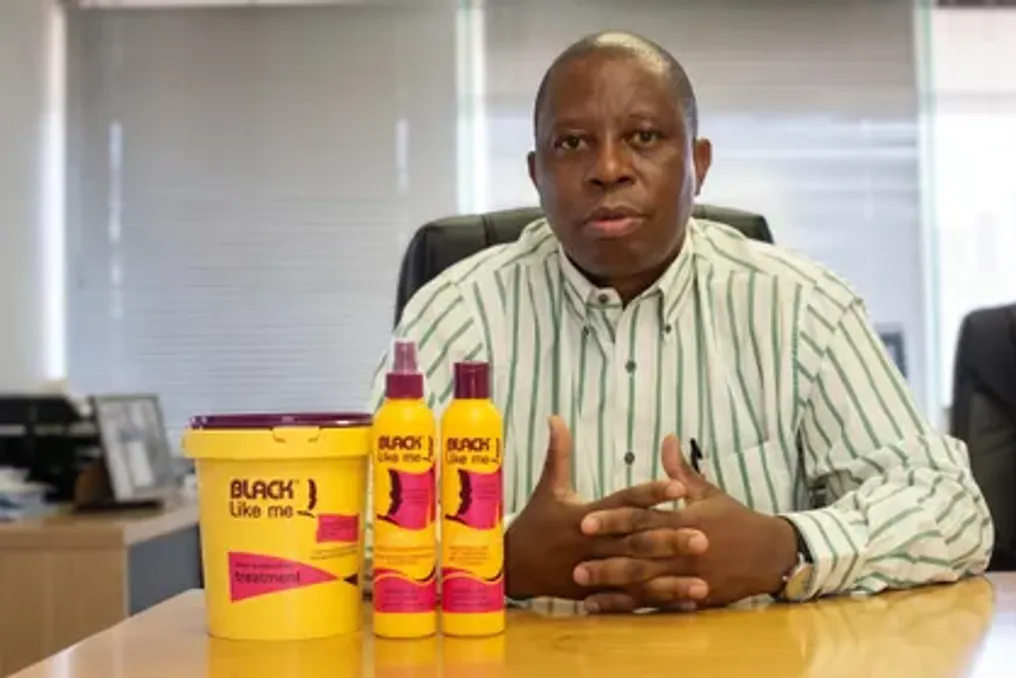
Herman Mashaba transformed the Black Like Me brand, which started with a loan of 30,000 rand, into one of South Africa's most recognized local brands.
In the mid-1980s, during apartheid in South Africa, Black entrepreneurs faced restrictions such as pass laws and land ownership bans, which hindered the creation of long-term businesses. However, the seller Herman Mashaba did not give up.
As hairdressing salons flourished in South Africa's urban settlements, people sought products suitable for black hair, of which there were few. The young salesman from Hammanskraal saw this need and decided not to sell others' goods but to produce his own.
The first batch of Black Like Me was launched on Valentine's Day in 1985. It started with a 30,000 rand loan, a chemical formula, and products mixed in a 200-liter drum. Black Like Me became the first major black-owned hair care manufacturer and subsequently one of the country's most recognizable brands.
A Humble Start in Ga-Ramotsi
Herman Samtseu Philip Mashaba was born on August 26, 1959, in Ga-Ramotsi, a mud housing settlement in Hammanskraal, north of Pretoria. His father died when he was two years old. His mother, Mapula, worked as a domestic servant in Johannesburg, leaving relatives to raise Herman and his siblings in extreme poverty. He had no traditional role models, as neighbors sometimes took water and firewood from neighboring farms.
Rejecting the path of a gardener in white suburbs, he showed initiative in his teens by playing cards. After finishing school, he enrolled at North University (Limpopo University), but did not return after political unrest closed the campus.
Instead, he found work at SPAR and then at a furniture factory, saving enough money to buy a car even before learning to drive. In 1982, he married Connie. Then he began selling everything that fit in the trunk: crockery, linen, insurance, fire alarm systems.
In late 1983, he started selling the African hair care product SuperKurl. He almost immediately became the company's top salesman. Hairdressing salons multiplied, and demand was insatiable. Mashaba earned a decent amount for the time, but did not want to remain an employee. As he later recalled: 'I told myself: 'I am not going to earn this money for this guy.' I wanted to do everything myself.'
An Unusual Partnership Across the Racial Barrier
The next step, taken in 1984, was almost unthinkable. Mashaba approached Johan Kriel, a Dutch production manager and pharmacist at SuperKurl who previously owned his own hair care business. The fact that a Black person asked a white person to start a business together during apartheid was shocking and even illegal in itself, but Kriel agreed. Herman also brought along a sales colleague, Joseph Molvantvu.
When they needed capital, Mashaba approached another businessman, Walter Dubbe, whose wife owned a salon and was already a customer. Dubbe provided them with a large sum of 30,000 rand at a high interest rate—prime plus 10% (about 31%)—and received a 25% stake. The loan was repaid in seven months. Dubbe also suggested the name. Inspired by John Howard Griffin's famous book 'Black Like Me', it was conceived as a statement of pride: Black people can build this themselves.
Kriel developed a curling lacquer that could be produced much faster than competitors. Production began in small rented premises at SBDC in Ga-Rankuwe, the former home region of Bothwaters. Mashaba drove his Toyota Corolla, covering 10,000 kilometers a month, bypassing pass law restrictions and building a distribution network salon by salon. Connie left her job as an accountant at Southern Sun hotels, accepted a pay cut, and kept the books from the beginning.
Products sold out quickly. Within a few months, the partners started earning well. Later, Mashaba bought out Molvantvu, and then Kriel. By the early 1990s, the company had a 6,000 square meter factory in Mabopane township, employing about 180 people, and had become a generic name. Mashaba even sponsored a hair and beauty series on SABC television.
Fire, Setbacks, and Persistent Return
Success did not come without dramatic events. On November 17, 1993, an arsonist burned the Mabopane factory to the ground. Mashaba later described that day as one he still finds difficult to explain; he called his survival a miracle.
The company resumed production within a few weeks. In 1997, he sold 75% of the shares to Colgate-Palmolive in the hope that the multinational corporation would take the brand global. However, bureaucracy prevented this. Two years later, he bought it back at a lower price than he sold it for. In 2002, Black Like Me entered the UK market, making Mashaba the owner of the first Black-owned South African company to sell its products there.
Connie Mashaba remained in the business operations center and later became the managing director. The brand expanded to new products and markets. In 2005, the cosmetics company Amka acquired 49.9% of the shares. More than 40 years later, the company continues to exist, now involving the next generation of the family.
Like a pioneering visionary, Herman Mashaba became the mayor of Johannesburg and the founder of ActionSA.
However, the founding of Black Like Me remains a moment that seems almost cinematic: a child from a township who started selling from his car's trunk, a Dutch chemist crossing the racial barrier, a difficult loan repaid in seven months, and a name that served as a declaration. In a system designed to stop him, the first batch of Black Like Me, mixed in a drum, nevertheless turned into an empire.