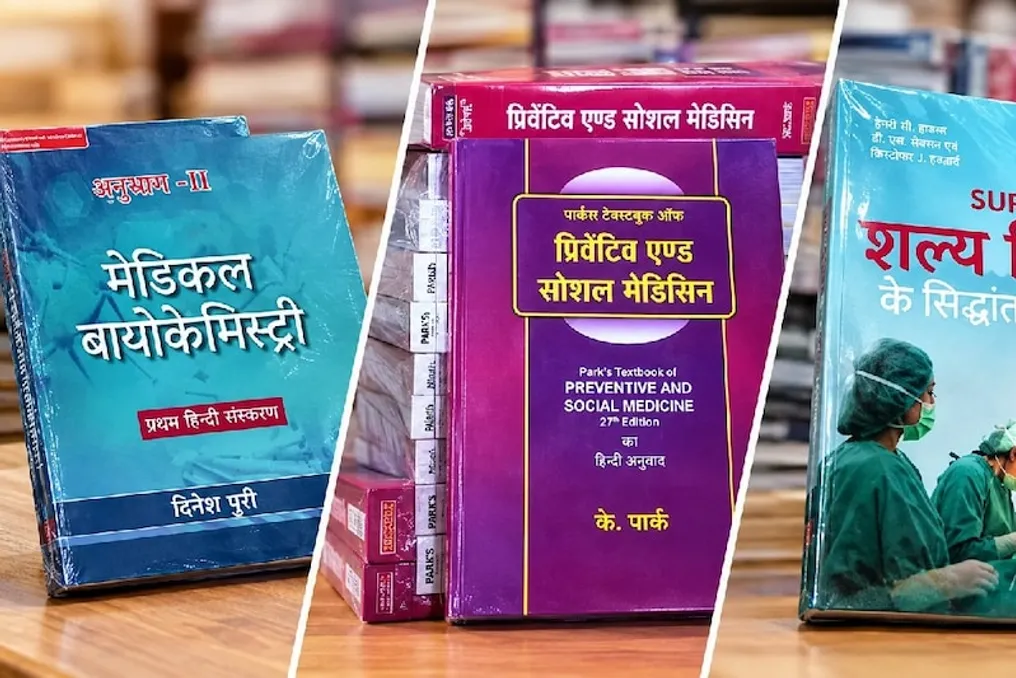
Just four days after the celebration of Hindi Diwas, the public has once again raised the discussion about teaching in Hindi. An analysis of data from the state of Madhya Pradesh showed that despite significant financial expenditure and the printing of fifty thousand textbooks, not a single student dared to write answers to medical exams in Hindi over three years.
Preparation for medical education in Hindi began back in 2022. The state of Madhya Pradesh actively promoted this initiative, receiving approval from the Prime Minister and the Home Minister. A group of 300 doctors was formed who diligently worked on translating voluminous medical books into Hindi, creating an atmosphere as if everything would be translated into Hindi. However, after four years, progress remains minimal.
The question arises regarding the feasibility of such large one-time expenditures, especially in a country where children in government schools might receive reprimands for speaking Hindi, while parents rejoice when their children speak English. Although students can theoretically become doctors, as happens in China and Russia, the sharp transition from the dominance of the English language to a complex, archaic form of Hindi seems unrealistic.
The plight of poor rural students who struggle to pass the NEET entrance exams to enter medical college cannot be ignored. They find it difficult to master complex, 'pure Sanskrit' books that require expert assistance. Medical terminology is inherently complex; if difficult translation of anatomical terms is added to this, the student will most likely resort to English.
Furthermore, it cannot be claimed that Hindi is beneficial for marginalized sections of the population. These students know that they will not take their MD or MS exams in Hindi. Moreover, when taking licensing exams in the US or UK (USMLE/PLAB), they will not have access to a 'Hindi medium,' and they fear that professors will grade answers in English even if they are written in Hindi.
Nevertheless, the idea of learning in the mother tongue is not flawed. The example of Ratlam Medical College shows that 80% of students received and use Hindi textbooks. The reason is that the director and professors of this college did not view it as an 'ego battle' or a 'top-down order,' but rather explained to the students that it was merely supplementary material for better subject understanding, not a replacement for English.
The key point is that China and Japan did not implement this suddenly; they gradually integrated the native language into subject comprehension through translation. If India wants change, it needs to connect with the real situation on the ground. Since many of us speak a mixed language (Hinglish), we cannot suddenly speak pure Hindi, much less learn in it.
A model similar to the Ratlam model is proposed: teachers explain in Hindi or the local dialect but retain English terminology, and textbooks must be simple enough for a village boy to understand using his mother tongue. If the policy is built solely for votes and headlines, then the annual Hindi Diwas celebrations will turn into a farce, and students will continue to follow old English traditions. To truly integrate Hindi into medical education, the haste of translation must be abandoned, and the experience of Ratlam should be studied, otherwise, the education system will face a problem similar to 'quackery is dangerous.'