Scientists from the Institute of Semiconductors, Chinese Academy of Sciences, in collaboration with other research institutions, have developed a sliding ferroelectric tunnel junction. This junction provides a high tunneling magnetoresistance ratio while maintaining ultra-high durability. The results of this work were published in the journal Science.
This research aims to create non-volatile memory and in-memory computing arrays, where reading contrast and cycle reliability often conflict when using compact two-terminal cells.
Two-dimensional sliding ferroelectrics, such as 3R-MoS2 and 1T′-ReS2, switch polarization through sliding between layers rather than ion displacement. This avoids defect accumulation, which limits traditional oxide ferroelectrics, and supports a lifespan exceeding $10^{11}$ cycles.
However, the remnant polarization of these materials is two to three orders of magnitude weaker than that of oxide analogs. Because of this, two-terminal devices often cannot achieve strong electrical readout without applying aggressive fields, which shortens device lifetime.
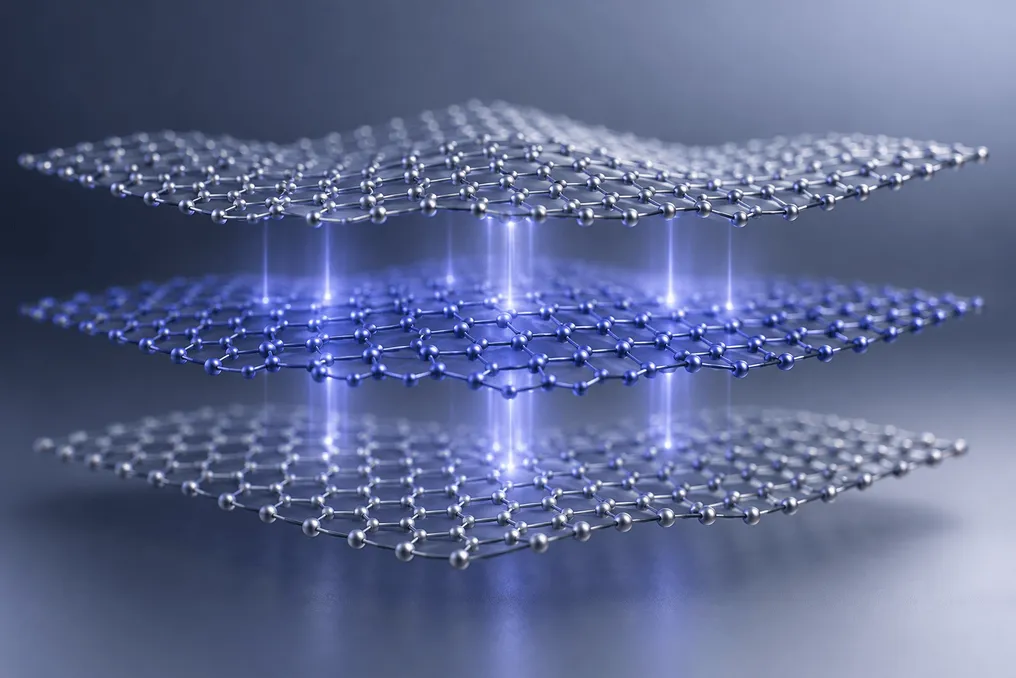
The team employed van der Waals heterostructure engineering methods to stack layers of Cr / h-BN / 3R-MoS2 / graphene monolayer, and subsequently extended this structure to 1T′-ReS2. Hexagonal boron nitride serves as a uniform, low-leakage tunneling barrier, while the sliding ferroelectric creates a stable built-in potential that modulates the barrier height. The low density of states and weak screening of graphene allow the polarization to control the density of charge carriers involved in tunneling.
This dual mechanism converts weak remnant polarization into a significant resistance contrast without compromising the advantage of sliding switching regarding fatigue. At a read voltage of 0.5 V, the device achieved a tunneling magnetoresistance ratio of $1.9 \times 10^7$, more than four orders of magnitude higher than previous sliding ferroelectric junctions. Furthermore, it maintained a working current density of $222 \text{ A/cm}^2$ and a durability exceeding $10^{11}$ switches.
Reliable switching was maintained with pulses lasting up to 13 nanoseconds at an energy consumption of $6.5 \text{ fJ/bit}$. An $8 \times 8$ array demonstrated stable bistable non-volatile behavior across all 64 cells, highlighting its potential for integration into dense storage and crossbar in-memory computing circuits.