Women Lead India's Semiconductor Sector, Driving Technological Revolution
Read more
YourStory [india, en]
yourstory.com

Women Lead India's Semiconductor Sector, Driving Technological Revolution

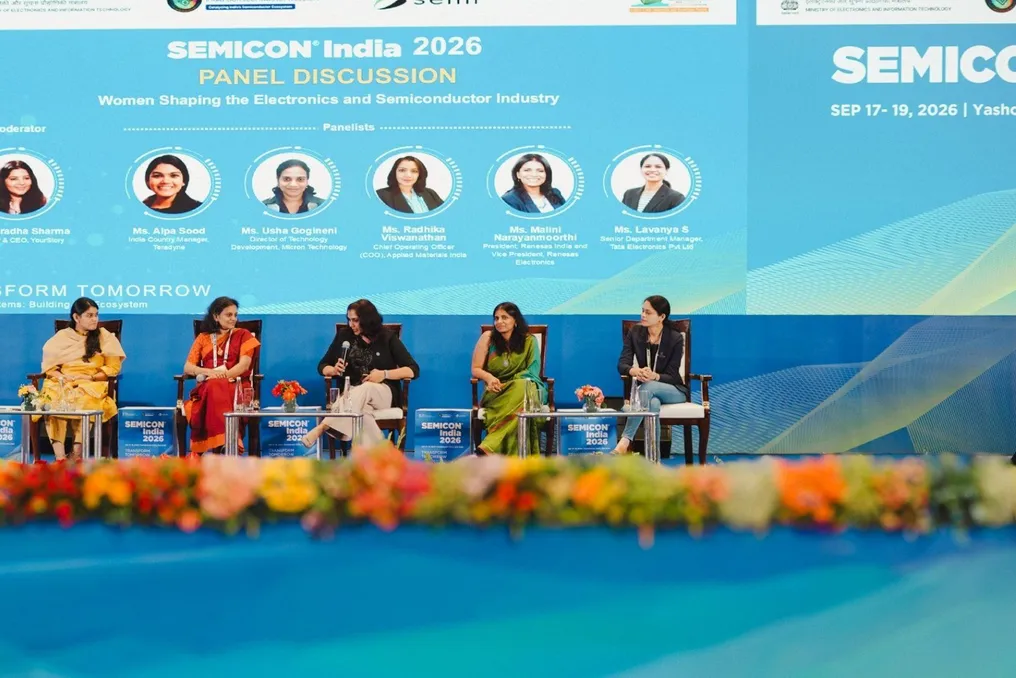
At SEMICON India 2026 in New Delhi, five senior women leaders from global chip manufacturing companies gathered to discuss the conditions necessary for women to reach top positions in the semiconductor industry. The panel discussion titled 'Women Shaping the Electronics and Semiconductor Industry' took place on September 18, 2026, on the second day of the three-day event, and was moderated by Shraddha Sharma, founder and CEO of YourStory and The Bharat Project.

Speakers included Alpa Sood, Country Manager at Teradyne India; Usha Gogineni, Director of Technology Development at Micron; Radhika Viswanathan, Chief Operating Officer at Applied Materials India; Malini Narayanamurthy, President of Renesas India and Vice President of Renesas Electronics; and Lavanya S, Senior Department Manager at Tata Electronics.

SEMICON India 2026 runs from September 17 to 19, 2026, in New Delhi, jointly organized by the India Semiconductor Mission (ISM) and SEMI. The event brings together global chip manufacturers, policymakers, and industry leaders over three days.

Opening the session, Shraddha thanked Amitesh Kumar Singh, CEO of the India Semiconductor Mission, for consciously including the women's panel on the SEMICON India stage, noting that previous editions of the conference were predominantly male. She acknowledged that when discussing deep technology and R&D, men are primarily recalled. Shraddha urged the audience to study the achievements of the speakers and share their stories with their daughters, sisters, and friends.

Alpa, who initially studied law and now leads Teradyne's business in India, summarized her role as: engineers create the best products, and she ensures their delivery to those who need them. She emphasized that this work requires resilience, and it is okay to cry if you come out smiling the next day.

Usha shared her complex journey: from IBM in the United States, through earning a Ph.D. from MIT, to returning to India and taking on a leadership role she hadn't planned. She attributed this to curiosity, a willingness to try new things, and the adaptability required by every new venture. The absence of a fixed twenty-year goal allowed her to embrace opportunities as they arose, without viewing them as distractions.

Radhika, who spent a decade working on global operations strategy in semiconductors and participated in the first ISM 1.0 approved project, recalled a photo from SEMICON India 2024 showing about 28 men and no women. She kept this photo on her phone, showed it to her leadership team, and stated that it became one of the reasons for her move to India in April 2025.

Malini, a mother of two, built her career in applied engineering, choosing breadth over depth, and returned to India about five years ago to build and scale Renesas' design team.

Lavanya, who previously worked at TSMC in Taiwan before joining Tata Electronics to launch India's first factory, mentioned that the then-CEO of TSMC said every CEO starts as an engineer. She noted that regardless of gender, the path forward is to take on the most challenging projects early on.

The most pointed moment arose when Shraddha asked about a pattern she observes globally: women in leadership roles are often labeled as either too emotional or, if they demand more, as difficult, unlike men who meet the same standards.

Malini shared an instance where she was told she wasn't ready for a position because she cried at work, which, in the eyes of the assessing man, made her emotional. Her reaction was to listen to him, and then honestly assess whether the remark was fair, instead of rejecting or blindly accepting it. She concluded that she would lead by being sincere, logical, and communicative, and if this sometimes involved tears, it was part of her personality, and others should accept it.

Alpa's story began in her first four years of work, when she was repeatedly told that a woman should go home earlier, and more interesting assignments went to others. The only person who supported her was a security guard in her office, where she was one of the few who stayed until midnight. He wasn't even on duty at the time but waited every night until she finished and walked her to the auto-rickshaw. The lesson she learned was that caring for a woman's safety is real, but it is not a reason to send her home; there is always a way around it, and support can come from someone who has no obvious vested interest in your career.

Usha spoke about her early confusion regarding what kind of leader she should be. Most leaders she saw were men, and the stereotype was that leaders should be strict and strong, while women are expected to be soft and empathetic. The only exception in her career was when all her first, second, and third-level managers at IBM were women with MIT doctorates, including Lisa Su, now CEO of AMD, highlighting how rare this is. Her final answer was to stop choosing between these two molds and to be authentic, stating that modern global leaders recognize that the best style combines both qualities.

Radhika raised a more subtle issue: women often receive less feedback than men because male managers fear perceiving them personally, which is well described in the autobiography of Indra Nooyi. She thanked her Israeli mentor for a phrase that changed her approach to stress: it is not personal, it is just business.

Lavanya advised that if someone leaves a team stating they do not want to work with a woman, the response is not to take it personally. She strongly urged junior managers to seek mentors in different departments and even in other companies.

The numbers explain why this conversation is still necessary. According to a 2025 report by talent solutions firm NLB Services, women make up about a quarter of the Indian workforce in chip design and engineering, numbering approximately 220,000 people. This share is projected to exceed 30% by 2027 and reach 35% by 2030. However, the gap widens sharply at the upper levels: the same report shows that men hold between 93% and 95% of leadership positions in India's semiconductor sector, leaving women with only 5%–7% of senior roles.

Part of this is due to a historical lack of women in core engineering and deep technology fields, as well as the many moments Malini cited where a career can 'slip': marriage, childbirth, raising children. Her advice was that these are not dead ends if one creatively approaches balancing these aspects and continues moving forward.

When asked for practical advice for teenagers, the speakers gave specific recommendations. Lavanya advised girls that they are still routinely steered toward IT for a Bachelor of Science degree, and they should instead choose electronics and communications or electrical engineering, backed by internships on larger projects. Usha told young women not to limit themselves to gender or just software, adding that women tend to overthink the difficulties they will face, whereas, in her experience, the problems are minor, and recognition comes through authority.

Alpa's advice was to study business and finance early on, as well as develop situational awareness—the ability to read the environment and understand how to advance business. Radhika answered Singh's question about how the industry can stop the early exit of women from careers, noting that the next two decades in semiconductors will likely offer one of the most rewarding careers available, and that any problem, personal or professional, can be solved with patience.

As India's investments in semiconductors transition from announcements to launching operational factories, packaging lines, and design centers, the industry will require a much broader talent pool than it does today. The speakers suggested that bridging the leadership gap will depend less on one-off panels and more on whether companies continue to build mentorship networks, flexible career paths, and visible role models. Shraddha concluded by noting that the industry still fails to tell women's stories properly, and thanked ISM for transitioning from policy to execution over four years and for setting a standard by presenting these leaders on the SEMICON India stage.
Similar stories

Government intends to co-finance venture investments in Indian chip startups under the Semicon 2.0 program
Read more
yourstory.com

Government intends to co-finance venture investments in Indian chip startups under the Semicon 2.0 program

Amitesh Kumar Sinha, Additional Secretary of the Ministry of Electronics and Information Technology and CEO of the Indian Semiconductor Mission, stated that acquiring a government-backed startup is not necessarily a failure but can be a return on investment. This distinction is becoming increasingly significant as India transitions to the next stage of its semiconductor industry development.

According to Tracxn data, Indian semiconductor companies have attracted cumulative equity funding of $1.4 billion, with about half of this amount, $701 million, raised since 2025. Now, the government plans to attract more private capital into chip development through joint investments with venture funds.

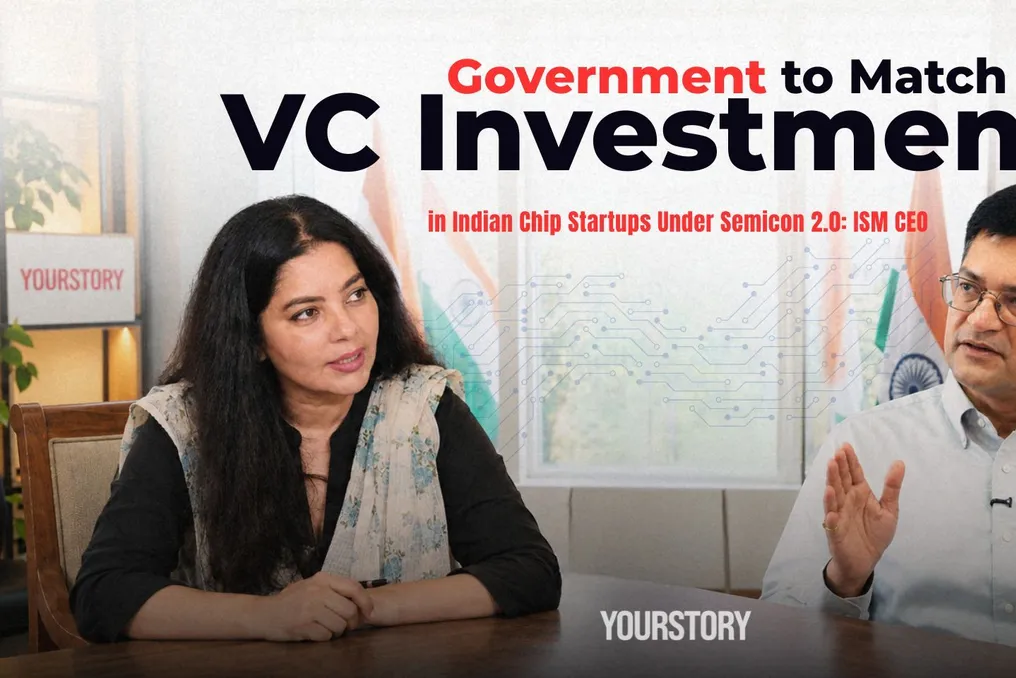
Speaking to Shraddha Sharma, founder and CEO of YourStory and The Bharat Project, just before the opening of Semicon India 2026 in New Delhi, Sinha outlined the concept of Semicon 2.0—the second phase of the mission, which transforms the government's role from a mere grant provider to a co-investor. Under this model, the government will co-finance venture capitalists' investments in approved chip startups at a one-to-one ratio on the same terms.

He noted that 'initial funds for startups are grants; the rest is our investment, so the government shares both successes and failures.' When YourStory previously interviewed Sinha before Semicon India 2025, the Indian Semiconductor Mission had 10 approved projects and provided electronic design tools to 280 colleges. A year later, the number increased to 12 manufacturing units with cumulative investment commitments exceeding 1.64 lakh crore rupees: this includes one silicon foundry, one silicon carbide-based factory, one gallium nitride micro-LED display integrated factory, and nine packaging units. Three of these 12, namely Micron, Kaynes, and CG Semi, have started commercial production, and all are located in Sanand, Gujarat.

In the design domain, support was approved for 24 startups, and Sinha reported that 15 of them attracted venture funding. The first phase, which began in 2022 with an allocation of 76,000 crore rupees, is called Semicon 1.0. The Union Cabinet approved Semicon 2.0 on July 15, 2026, with an allocation of 127,500 crore rupees, and MeitY notified the scheme on August 31, 2026. This program is built on six pillars: design, equipment and materials, fabs, advanced packaging, research and development, and talent.

Sinha emphasized that the timely arrival of Semicon 2.0 demonstrates the long-term commitment shown by Prime Minister and Union Minister Ashwini Vaishnaw. According to Sinha, the first phase aimed to establish demand. The 12 approved projects showed the government what it needed in the supply chain and identified gaps. He explained that 'when your industry is still small, supply chain partners prefer to export to India rather than relocate here.' As a result, only basic goods are established near the plant.

Semicon 2.0 aims to bridge this gap. He explained that equipment accounts for about 65% of the cost of a manufacturing facility, while chemicals, gases, and materials account for approximately half of operating expenses. Attracting such suppliers to India reduces production costs and increases the competitiveness of Indian companies.

Sinha also noted that the time is right for India. Since the global semiconductor industry is expected to expand sharply in the coming years, manufacturers and suppliers will have to scale up capacity somewhere. India's bet is that the growing domestic market, government incentives, and forming manufacturing base can convince more suppliers to move here.

However, the most significant change is happening in the design sector. Under the first phase, the scheme provided startups and MSMEs with initial funding and access to automated electronic design tools, which are prohibitively expensive for a small team. The problem arose after concept validation. Sinha clarified that chip design takes another one and a half to two and a half years depending on complexity, and this requires funds not covered by the scheme. The cost of designing a single chip can range from 25 crore to 35 crore rupees for a simpler version to 1,000 crore to 2,000 crore rupees for complex components.

Semicon 2.0 adds a layer of co-investment. After receiving initial funding, if a venture fund invests in an approved startup, the government invests an equal amount as an investor on the same terms. Large Indian companies that may not want to give up a stake can opt for royalty-based financing, which is also co-financed at a one-to-one ratio. Exit routes align with industry practice, and any company can exit when it decides to do so.

The goal is to attract venture funds to a sector they have largely avoided. Sinha stated that 'in Silicon Valley, Israel, wherever design companies thrive, venture funds invest, understand the business, mentor startups, and help with market access.' He is ready to address the political question that arises when a government-backed startup is acquired by a foreign company. 'If we try to control it, the ecosystem will not form,' he said. The founder being acquired returns with capital and experience, tries again, and after one or two attempts, creates a company that the mission truly wants—an Indian fabless firm with its own intellectual property. If the startup is acquired, the government receives its share according to its stake, just like any other investor, and uses this money to fund the next. In other words, Semicon 2.0 is not designed to prevent exits. Its goal is to create a cycle where successful exits return capital and experience to the ecosystem.

Shraddha asked what share of domestic chip demand the domestic capacity can meet and by when. Sinha answered by segments rather than a single date. In packaging, he expects India to cover domestic demand and export in large volumes within five to six years, taking a leading position in advanced packaging. Even then, 10% to 25% of unique, advanced chips will still be imported because their factories are not here.

In fabrication, the Tata plant in Dholera covers nodes from 28 nanometers to 110 nanometers, and he expects full capability above 28 nanometers to follow with the emergence of more compound semiconductor fabs under Semicon 2.0. In the long term, over 10 years, he said India will achieve self-sufficiency in legacy chips and begin exporting them after meeting its own needs. The most advanced chips at the 2nm level and below may continue to be imported. 'This could take 10 to 12 years,' he noted.

Shraddha's concluding question set a 10-year horizon: what must happen by 2035 for him to call the mission game-changing? His criterion was a specific goal: self-sufficiency in legacy fabs and all types of packaging with large export volumes—that is the baseline. If India closes the gap in advanced technology by then, 'I will call it a success.' If it operates parallel to the advanced level, 'I will call it a super success.'

According to PIB, the Indian semiconductor market was valued at $45 billion to $50 billion in 2024-25 and is projected to reach $100 billion to $110 billion by 2030.

Shraddha asked a question that a student from Patna, Indore, Bhubaneswar, Coimbatore, or Kochi might ask: is this industry only for Tata and IIT startups? Sinha began his answer with design, which he said constitutes about 50% of the semiconductor value chain, with 20% of global design engineers already being Indian. The Chips to Startup program provides free expensive design tools to over 300 colleges, according to PIB, and student projects are manufactured in the Semiconductor Laboratory in Mohali, packaged, and sent back. 'A student who sees the full cycle leaves college as a confident design engineer,' he said.

He added that the Design Linked Incentive scheme attracts Indians with 25-30 years of design experience abroad who now want to start businesses at home. A chip design company hires from 50 to 200 people, and if it scales, 'it becomes Qualcomm, which hires 20,000 engineers in India.' Besides design, he listed chemical, materials science, civil, and mechanical engineering as fields upon which the fab depends, mentioning an industry multiplier of about 5.7 for jobs created outside the plant.

The most striking example for him was Shraddha's comment that deep technological discussions often exclude women. At the CG Power plant in Sanand, operators working with semiconductor equipment and packaging chips are all women recruited from Jharkhand, Madhya Pradesh, Bihar, Odisha, and Northeast, with ordinary education and no prior industry experience. They were sent for training to Malaysia, many of them leaving their hometowns for the first time. 'Meet them today, and they will explain chip packaging to you as confident engineers,' he said. He noted that women already constitute more than half of the electronics workforce, and at some plants, the entire workforce, and he expects this to happen in the semiconductor industry too. Semicon India 2026 will hold a special session on women in the industry, where senior Indian women leaders of global chip companies will speak to students.

Semicon India 2026 will take place from September 17 to 19, 2026, at Yashoboomi in Dwarka, New Delhi, opening with Prime Minister Narendra Modi on September 17, and he will hold his annual Country Roundtable with global CEOs on September 16. Sinha reported that more than 575 companies are participating, compared to 350 last year, of which about 300 are international, and 86 are headquartered in India. Participation has grown to over 50 countries and seven national pavilions, and he noted that 12 states are participating. SEMI, which refrained from holding the conference in India in 2022 and 2023 due to lack of industry, has been collaborating with ISM and IESA since 2024.

This year's novelty is the workforce development pavilion within the exhibition, including student mentorship, training on the full fab process, a one-day session conducted by experts from Singapore on September 18, and company-sponsored hackathons. The Semicon India 2026 mobile app offers navigation of the venue, session schedules, and coordinated AI matching with the ability to book meeting rooms. Main sessions will be broadcast for those who cannot travel to Delhi.

By the metric used by the mission, a design startup becomes a unicorn with revenue of $1 billion. 'Many unicorns are what we want to see in semiconductor design,' Sinha said. Alongside export volumes from legacy fabs and packaging units, he wants the mission to be evaluated in 2035 in this way.

A closer test is quieter. He reported that order negotiations with large global companies for fabs that are now starting commercial production are at an advanced stage; some are ready to book entire facilities and are already discussing expansion at yet-to-be-built plants. If these orders come in over the next year, they will provide an early indication of whether the Indian semiconductor surge is moving from government-supported capacity creation to a commercially sustainable industry. And by Semicon India 2027, the mission may be measured against a completely different baseline than the one it sets this September.

Jagriti helps women create digital enterprises, and TechSparks 2026 will feature a star lineup of participants
Read more
yourstory.com

Jagriti helps women create digital enterprises, and TechSparks 2026 will feature a star lineup of participants

Several significant events have occurred in the world of technology. Apple has entered the foldable phone market with its first foldable device, the iPhone Duo. This gadget is designed to demonstrate the capabilities of joint hardware and software development to ensure an intuitive user experience. The folding format of the iPhone Duo is intended to expand multitasking capabilities, media consumption, and mobile productivity. The price for the iPhone Duo starts from 299,900 rupees for various storage capacities: 256 GB, 512 GB, 1 TB, and 2 TB.

In parallel, billionaire Gautam Adani's airport company is preparing to join the ranks of the world's highest-rated airport operators after attracting $1 billion in funding. Adani Airports Holdings received new equity capital from global and domestic investors, including Temasek, funds managed by BlackRock, Alpha Wave Global, and Premji Invest. Thanks to this, its post-funding valuation reached approximately $19 billion, placing the Indian airport operator in third place globally, behind Aena from Spain and Airports of Thailand.

Google is actively promoting its climate technology solutions on the rooftops of India. Its Solar API can now provide solar potential data for 300 million rooftops across the country, allowing installers to assess homes without physically visiting the site. Furthermore, Google has signed a long-term agreement with ReNew Power to implement a 150 MW solar project in Rajasthan.

Within the technology sector, the flagship startup and technology summit YourStory, TechSparks 2026, will return to Bengaluru from October 13 to 15 under the theme 'The New Technological Order.' All the aforementioned trends will be discussed at the event. Among the key startup participants featured at the summit are Swish, which raised $24 million, and Piston, which secured $15 million in a Series A round. The startup Theater, which raised 75 crore rupees in a Series A round, was also noted.

Additionally, through its incubation, mentorship, market access, and ecosystem building system, the Jagriti Sewa Sansthan Center of Excellence for Women helps women in eastern Uttar Pradesh develop sustainable businesses.

Popular