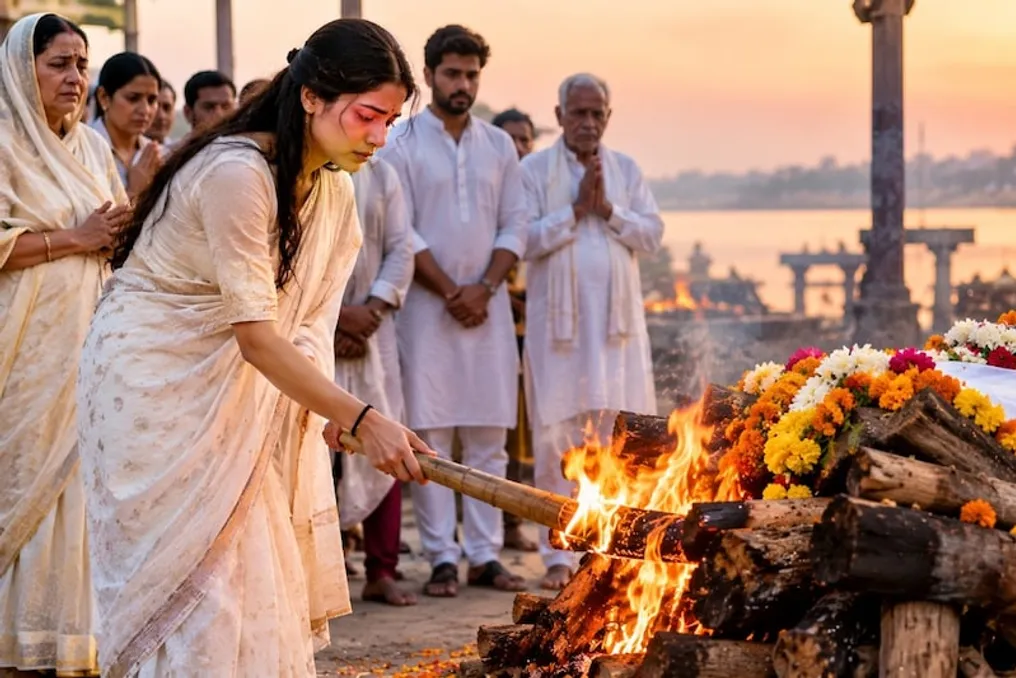
When attending funerals, it is often observed that a male family member performs the funeral rite (Mukhagni) for the deceased. However, the role of daughters in this duty raises questions. Do daughters have the right to perform the funeral rites for their parents, and what rules are established regarding this in religious scriptures?
For a long time, society held numerous different views and traditions concerning funerals. Rules related to burial are mentioned in many religious texts and Dharmic traditions, among which the Garuda Purana holds special significance. This text examines what is specifically stated about the right to perform Mukhagni in the tradition of the Garuda Purana.
Who is permitted to perform the funeral rite?
The Garuda Purana describes many aspects related to death, the soul's journey, and funerals through a dialogue between Lord Vishnu and Garuda. In religious traditions, the responsibility for the deceased's funeral is traditionally placed first on their descendants and closest relatives. Classically, the son was considered the primary person entitled to perform Mukhagni, followed by grandchildren and other close male family members. Nevertheless, there are differences in methods and rights to funerals depending on various Dharmic schools, regions, and communities.
What happens if there is no son?
Religious traditions also mention situations where the deceased lacks a son or another close male heir. In such cases, another relative from the family may take responsibility for the funeral. Some traditions recognize an important role for the daughter in her parents' funerals. In modern times, many families grant daughters the right and duty to perform Mukhagni. Therefore, it is incorrect to assert that the daughter is completely excluded from the funeral process in every Hindu tradition.
Can a daughter perform her parents' funeral rites?
This question sparks the most debate. Interpretations of religious texts and various traditions do not offer a unified opinion on this matter. In some traditional systems, priority was given to the son and male relatives, whereas in many families and religious practices, the daughter participates in performing her parents' funeral. Consequently, it is important to view this not only as a matter of women's or men's rights but also considering the family circumstances, local traditions, and the relevant religious ritual.
Are women prohibited from visiting crematoriums?
Various views regarding women visiting crematoriums are also common in society. In some communities, the tradition of women visiting crematoriums did not exist, while in other places, women participate in funerals. Thus, the assertion that all religious scriptures prohibit women from visiting crematoriums is an overgeneralization. Funeral traditions varied across different eras, texts, regions, and communities.
What is the purpose of the funeral?
In the Sanatana religious tradition, funerals are viewed as the final duty towards the body of the deceased. It is believed that by performing rituals, the family fulfills its responsibility to the deceased and prays for their spiritual journey. This is why performing Mukhagni is perceived not merely as a ritual, but as the final responsibility and tribute from the family.
Daughters also fulfill the final responsibility
Nowadays, many families entrust the responsibility for their parents' funerals to their daughters. In some places, the daughter performs Mukhagni, while in others, she participates in other funeral rituals alongside her brother. When studying religious traditions, one must remember that funeral methods were not standardized. Therefore, it is unjustified to consider one common social system as a universal rule of all Sanatana religions.
Ultimately, funerals are the last duty of the family towards the deceased. In this process, reverence, respect, and family circumstances are most important. Regardless of whether it is a son or a daughter, the feeling of fulfilling the last duty to one's parents is considered the main goal of this ritual.