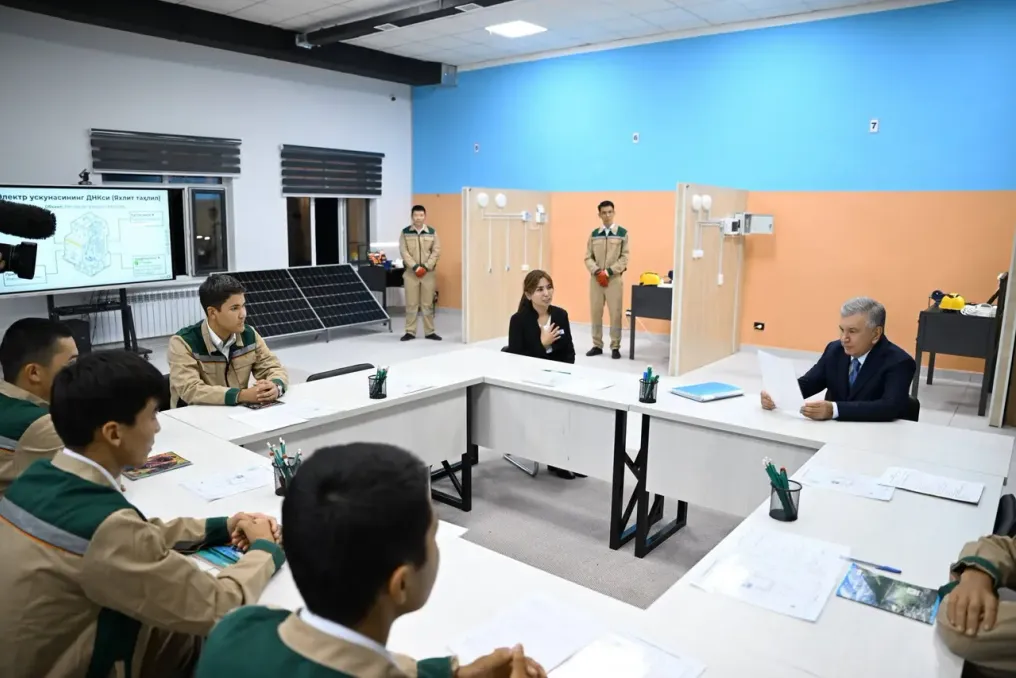
President Shavkat Mirziyoyev inspected the activities of Technical College No. 1 located in Nukus, according to the press service of the President of Uzbekistan. Currently, Uzbekistan is reforming its vocational education system, paying special attention to training youth in modern professions and creating specialists capable of competing in both domestic and international labor markets.
In accordance with the presidential decree of July 17 of this year regarding additional measures for implementing secondary specialized, professional, and higher education programs based on international educational standards in the Republic, the college began using the British international educational program Pearson BTEC. This program, used in 70 countries worldwide, was introduced in Uzbekistan for the first time at this educational institution. Its key feature is the combination of theoretical knowledge with practical skills.
To achieve this goal, modern workshops and digital laboratories were created that meet educational standards. The total cost of the project is 11.9 billion soms, with partners contributing 2 billion soms. As a result, modern workshops with a capacity of 240 places were equipped. Currently, 1203 students are studying at the college.
The institution occupies an area of 4 hectares, and the total area of buildings and infrastructure facilities is 4600 square meters. The introduction of dual education is planned to train specialists for key sectors of the regional economy. Diplomas from the international program will be recognized in more than 70 countries.
An educational spin-off program has also been launched with the participation of private partner Salovutdin Ilosov. Within this program, 136 students are studying in in-demand modern specialties. The main subjects are taught in English, and teaching and methodological materials are also provided in English, which helps students develop both professional knowledge and language skills necessary for working in their chosen field.
Practical training expands the opportunities for graduates to find employment abroad. This year, 25 unemployed citizens who studied welding at the college were sent to work in Estonia, where their salary reaches 3000 euros per month. Furthermore, agreements have been reached to train specialists at the college for an industrial zone being created at a cost of 40 million US dollars. This will strengthen the link between production and education and provide jobs for graduates.
The President reviewed the conditions created at the college, noting the growing demand for qualified personnel in the global labor market. Instructions were given to organize the educational process taking into account the needs of employers.