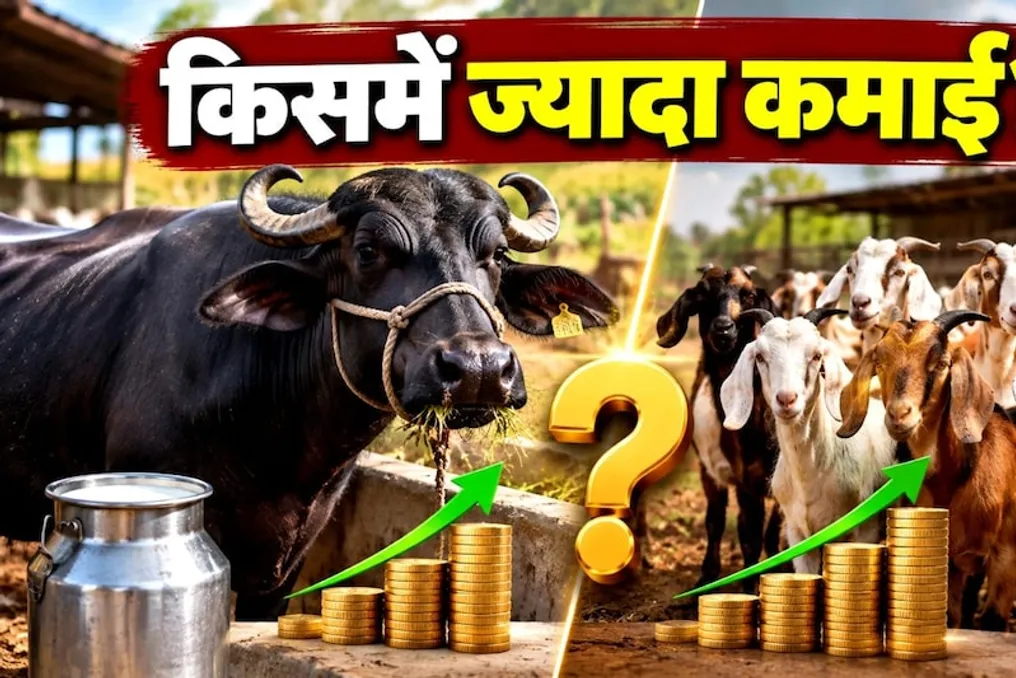
When planning to start a livestock business in a rural area or small town, the question often arises: is it more profitable to keep one good buffalo or ten goats? Both options can generate income, but costs, care, profit, and risks differ between them. Therefore, simply comparing the cost of the animals is not enough; the key is to analyze available financial resources, the availability of feed sources, and the desired timeframe for generating income.
Let's consider the potential benefit of keeping a buffalo. By purchasing a high-quality dairy buffalo, the main advantage is the daily income from milk. The income will depend on the buffalo's breed, its yield, diet, and local milk prices. If a buffalo produces about 8–10 liters of milk daily, and the price is 60 rupees per liter, the daily revenue can reach approximately 600 rupees, which amounts to about 18 thousand rupees per month.
However, this amount is not net profit, as expenses for green and dry fodder, grain, water, vaccination, treatment, and other care must be taken into account. Furthermore, a buffalo does not produce milk constantly; after calving, there is a lactation period followed by a dry period. The advantage of the buffalo is that the demand for its milk is stable, and if buyers, dairies, or milk collection centers are easily accessible in your area, it can provide regular daily income.
Now let's look at ten goats. In goat farming, initial investments can be divided into several smaller parts. Instead of investing the entire sum in one expensive animal, you can purchase several goats. The main advantage of goat farming is the ability to increase the herd size. Healthy, good-breed goats give birth, and over time, the flock can grow. Goat meat is in demand year-round, and demand may increase during holidays and weddings. Although market prices vary depending on location and time, if some of the ten goats begin to give birth, you will get new offspring that can be raised and sold for profit.
Nevertheless, there are also expenses here: a shelter, feed, medicine, vaccination, and maintaining cleanliness are necessary. The risk is that if a disease spreads, several animals may be affected at once, so careless care can lead to losses.
To buy a good dairy buffalo, a large lump sum is usually required, followed by ongoing daily expenses for feed and care. Purchasing ten goats also requires significant funds, but the investment is distributed among several animals. This is why some people find it easier to start goat farming on a small scale.
However, the decision cannot be made based solely on the purchase price. Breed, age, health condition, capacity for lactation or reproduction, and the local market must be considered. The main difference between these two types of businesses lies in how income is generated. In the case of the buffalo, the main earnings come from milk; if the animal produces milk and there is a market for its sale, income can come in daily or at regular intervals.
In goat farming, most of the income is related to the sale of offspring and the goats themselves. Thus, the earning cycle is different, and time is needed for the animals to grow. Therefore, those who prefer income from regular milk sales need to study the dairy farming model. Those who prefer the herd growth and subsequent sales model can consider goat farming.
In livestock farming, expenses include not only the purchase of animals. Providing feed is extremely important. If you have your own land and can grow green feed, costs can be reduced. If all feed has to be bought from the market, most of the profit will go towards feed. A clean and safe area for the animals must also be organized in advance, as well as access to water, vaccination, and timely treatment.
There is no universal answer that suits everyone. If you have a guaranteed milk market, a feeding system is established, and you want a daily income model, you should consider keeping a buffalo. If, however, you aim to earn through increasing the herd size and sales, and the local market for goats is favorable, the ten-goat model may be useful. The most important thing is to study the market first, and then acquire the animals. You need to find out which product is more in demand in your village or city—milk or goat meat, how much feed costs, and at what price the animals are sold. Only after getting answers to these questions should you invest. That is, whether the buffalo or the goat proves to be the more profitable enterprise is determined not only by the animal's price but also by your expenses, the market, the quality of the animals, and proper care.