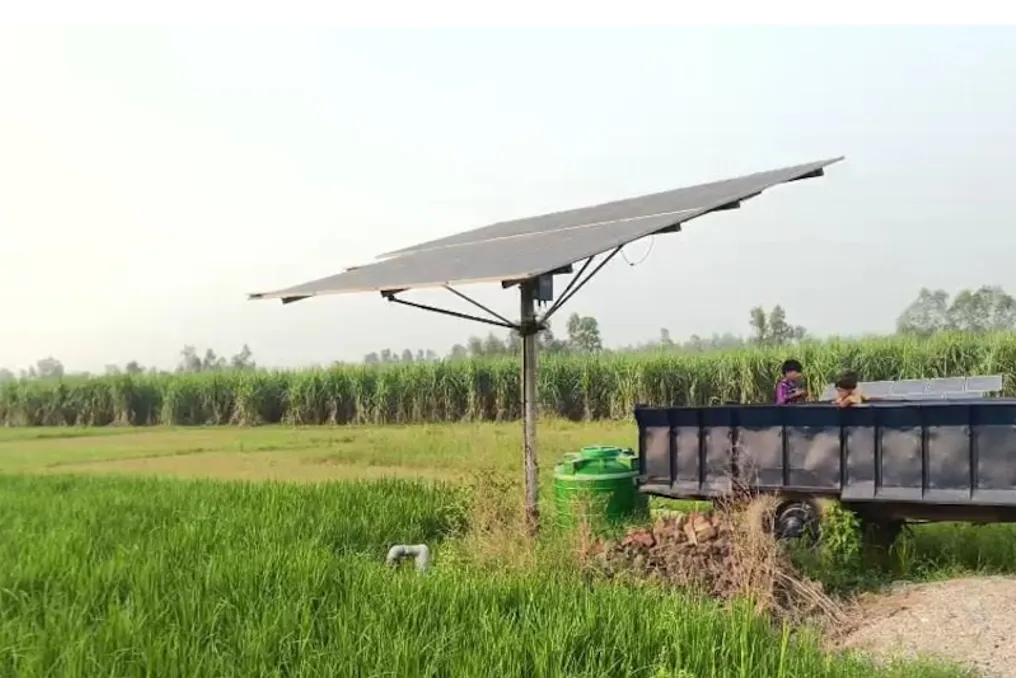
Solar pumps have become a significant help to farmers in Saharanpur, solving problems with water and electricity. Thanks to the solar pumps installed under the PM Kusum scheme, farmers can now irrigate their fields during the daytime. Many of them note that the timely availability of water has reduced the risk of crop desiccation and increased their confidence in agriculture.
Farmer Rishi Pal Singh recounted that previously he used engines and drilling for water supply. When diesel fuel became expensive, he connected to the electricity grid but faced instability in power supply. Often, he had to wait for night for electricity to come on and rush to the field before it would shut down again.
Rishi Pal Singh reported that he learned about the PM Kusum scheme last year and applied. After receiving a government subsidy, a 7.5 kW solar pump was installed on his field. Now, the pump operates under sunlight from approximately 8 AM to 5:00–5:30 PM, eliminating the need to visit the field at night for irrigation.
Rishi Pal Singh has about 15–16 bighas of land where he grows sugarcane, wheat, rice, and vegetables, and also cultivates poplar saplings. He noted that thanks to the solar pump, water is available on time, allowing him to grow water-intensive crops. He expects an increase in production and income due to timely irrigation, as water scarcity previously caused many problems in agriculture.
Farmer Amit Kumar installed a 5 horsepower solar pump on his field about three years ago. He mentioned that during hot weather, the water problem was so severe that he stopped growing sugarcane because using a tractor for irrigation was too costly. Water shortages were also common in Rajbah earlier in the summer.
After installing the solar pump, they can now irrigate about 40 bighas of land per week, and easily irrigate about 5 bighas daily. He no longer has to wait for electricity at night; he goes to the field in the morning and finishes irrigation during the day.
The family of farmer Gaurav Daiya from the village Savanpur Nawada installed solar panels around 2021. The land and solar panels belong to his father, Arvind Kumar Daiya. Gaurav explained that there were no long-distance power lines in their area, so connecting to the grid was unnecessary.
Previously, there were months without water in Rajbah, which damaged crops. Now, the solar pump provides water for 8–10 hours, allowing him to grow rice on his field, which was difficult due to water scarcity. Farmer Mahesh Daiya also considers the solar pump very beneficial for agriculture as it reduces dependence on electricity, allowing the farmer to irrigate the field during the day as needed. The presence of a pipeline also simplifies water delivery to the field.
Mahesh added that during hot weather, power lines often failed due to storms and hurricanes, and falling trees or transformer breakdowns led to multi-day outages. Solar pumps minimize such problems. He urged the government to spread this program among as many farmers as possible.
The stories of these farmers from Saharanpur show that solar pumps are not just an alternative to electricity but a great relief for irrigation. Farmers can now irrigate during the day without waiting for electricity and water in Rajbah. Timely irrigation has reduced the risk of crop damage. Farmers believe that the convenience of solar pumps should be accessible to as many people as possible, which can reduce agricultural costs and dependence on electricity. Furthermore, farmers can consider growing more crops on their land. Solar panels in the fields are now a source of hope for water, agriculture, and higher income for farmers.