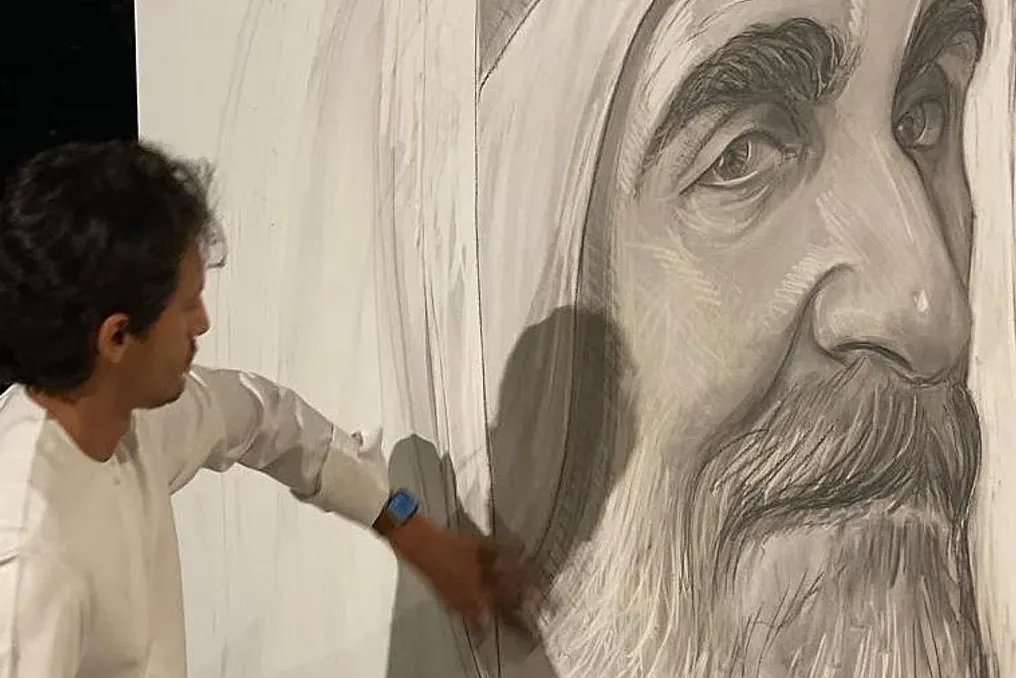
For Ghanem Mubarak, transforming a witness's verbal description into a concrete drawing is less about drawing and more about trying to understand a person's thoughts. He notes that this talent did not appear immediately; when he was about five years old, he watched his uncle Khalid, who was only seven years older, bring the features of a fighter to life on paper by shading the eye and nose.
Since then, he drew daily, learning through trial and error because he did not have access to video tutorials like YouTube. Although his family supported his abilities, they did not approve of a career as an artist. In university, they opposed the study of art, so he chose architecture as the closest discipline.
The work that combined both fields appeared unexpectedly. Major Saleh Al Marzouki contacted Mubarak via Instagram after viewing his works and invited him. The test was rigorous: he had to depict Brigadier Adlrahman Al Hamadi, Director of the Forensic Evidence Department, from a photograph that was shown for only a few seconds before being removed.
Because the resemblance was exact, in 2015, Mubarak joined the department, which defined the next decade of his life. He jokes that sometimes he feels 'a bit like Batman.'
When asked what people misunderstand about this work, he does not hesitate to answer. He objects to the idea that it resembles television plots where a witness describes a face, and he draws literally what he hears, like a stenographer. In reality, most witnesses do not consciously remember the face; they recognize it. His task is closer to interviewing memory itself, which is more psychology than drawing.
He does not complete a session until the resemblance reaches a rate above 95 percent and the witness is satisfied. Mubarak admits that his sketches have contributed to advancing investigations, and these moments are what give the work meaning to him.
Ten years of interacting with witnesses, many of whom are still traumatized, have changed Mubarak's approach to art outside of work. He draws something every day, even for ten minutes in the car, calling it a space for the physical processing of experiences, rather than transferring them to his mind.
Mubarak has learned to intentionally maintain emotional openness during a session and then 'switch off' that openness, comparing it to removing some kind of equipment. His Saluki horses and dogs help him recover in a way nothing else can.
The field of work itself has evolved: pencil, paper, and reference books have given way to compositing programs and, increasingly, artificial intelligence. However, he is cautious about AI replacing the process rather than assisting it. He notes that an algorithm optimized for realistic faces can smooth out precisely the details that are most significant. Recently, he participated in the first group exhibition of AI art in the UAE, organized jointly with Tashkeel at the Museum of the Future.
Outside the interview room, Mubarak's world continues to expand. He breeds Arabian horses on his own farm, Al Mouj, viewing conformation and pedigree as a form of art, and continues to participate in equestrian competitions, a discipline he mastered in high school and never gave up. In his opinion, each activity enhances the others, as they all require precision, focus, creativity, and a sense of beauty.
When asked what lesson people should learn from his story, Mubarak does not point to his badge or exhibitions. He advises everyone to practice a creative skill and dedicate time to it every day, doing so not for money, status, or recognition, but for the sake of creativity itself.