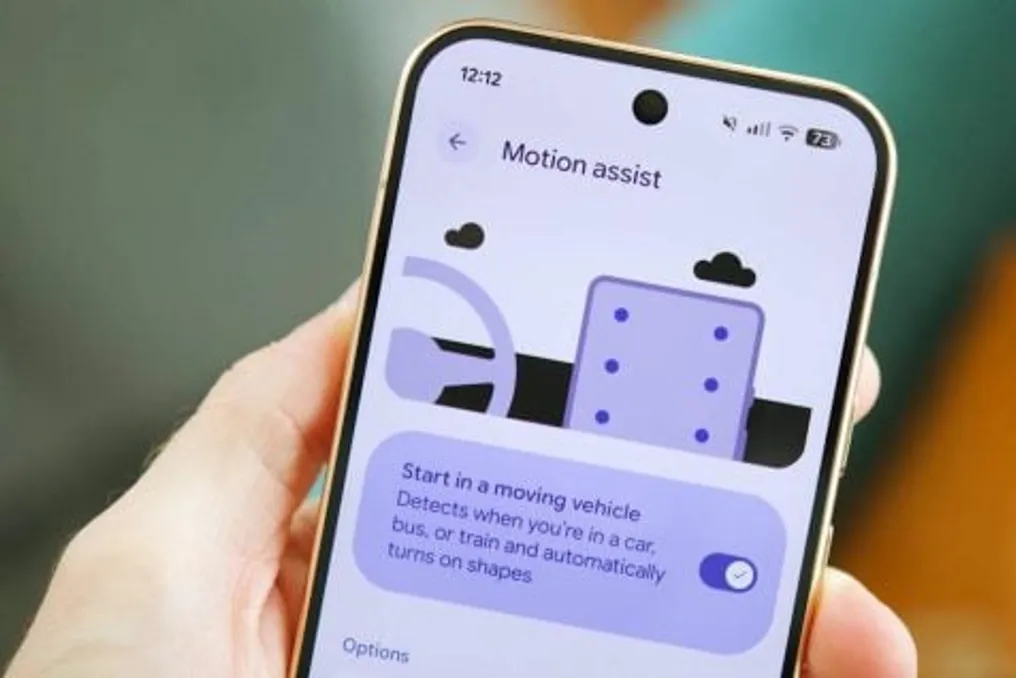
Google has made Motion Assist available for Pixel and Samsung Galaxy devices running Android 17. This feature uses graphic elements on the screen edges with the aim of mitigating motion sickness in people who use their phones while in a moving vehicle, whether reading or playing games.
The functionality operates based on the device's sensors, reacting in real time to variations such as acceleration, braking, and curves. It was specifically designed for individuals who suffer from motion sickness, a condition characterized by a misalignment between what the eyes perceive and what the inner ear registers.
Official documentation clarifies that this assistance is intended for passengers, not drivers. When Motion Assist is active, the screen displays two columns of smaller shapes on the sides. The gyroscope and accelerometer provide data for this animation, which moves in the opposite direction of the car's movement.
The intention is to provide continuous peripheral visual reference, helping to synchronize visual information with the body's physical perception, which reduces the sensory conflict that causes nausea. The user has the freedom to select the shape of the elements—circle, square, pentagon, or rhombus—in addition to configuring the opacity and choosing the color from dynamic, red, yellow, green, or blue options. There is also the possibility to automatically switch the shape and color every few seconds.
Google issued a warning stating that a small percentage of users may experience an exacerbation of symptoms with the feature enabled. To activate Motion Assist, the procedure involves navigating to Settings, Google, All services tab, Personal and device security, and selecting Motion Assist. The menu also allows configuring automatic activation when the device detects it is in a vehicle, which Google recommends adding a shortcut to Quick Settings for easier control. Tapping a silent notification disables the feature.
Implementation is occurring gradually through Google Play Services, starting with version 26.33.32, without requiring a firmware update. On Samsung devices, Android 17 corresponds to One UI 9, which was launched with the Galaxy Z Fold 8 and Z Flip 8 and will continue to be progressively implemented on older models. If the function does not appear, the company suggests restarting the phone. The advancement was announced on X by Mishaal Rahman, responsible for Android community engagement at Google, and until January of this year, recognized as one of the most well-known journalists covering the system. It is worth noting that Apple has had a similar function since September 2024, called Vehicle Motion Cues, introduced in iOS 18.