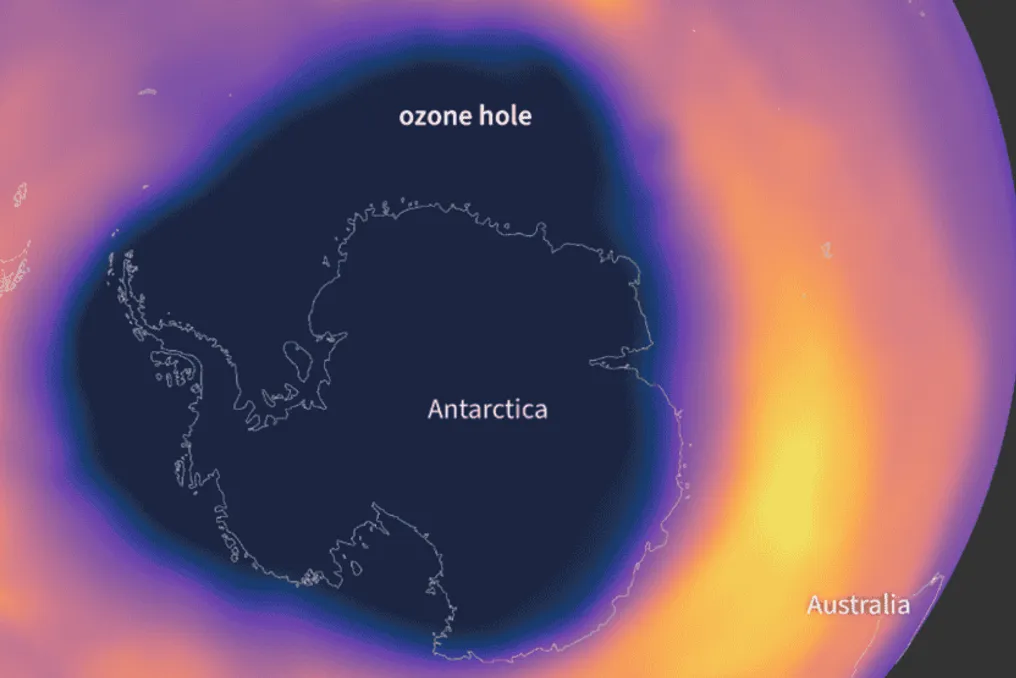
The ozone hole located over Antarctica registered one of the smallest sizes observed in several decades in 2025. The World Meteorological Organization (WMO) interprets this data as evidence of the success of international initiatives aimed at preserving the ozone layer, which is responsible for filtering out much of the harmful ultraviolet radiation emitted by the Sun.
According to the WMO's recent Ozone Bulletin, the hole recorded in the previous year was classified as the fourth or fifth smallest since 1992, the starting point for observing severe deterioration patterns of the layer. Furthermore, it was the second consecutive year that both its depth and extent were considerably below the average established between 1990 and 2010.
It is important to note that annual fluctuations are influenced by large-scale meteorological phenomena that modulate atmospheric transport. Such factors promote ozone destruction during spring in most austral winters over Antarctica, and every five to ten years in the Northern Hemisphere.
In the Northern Hemisphere, in 2025, the total ozone concentration was below average in a vast area covering from Greenland and Europe to Central Asia, northern Japan, and the Kamchatka Peninsula, located in Russia.
Recovery Trend and Environmental Success
Despite these seasonal variations, the data confirms a long-term recovery trend for the ozone layer. The WMO attributes this progress to the success of the Montreal Protocol, a global agreement that promoted the gradual elimination of ozone-depleting substances, such as chlorofluorocarbons (CFCs), previously used in refrigeration, fire retardant foams, and other applications.
Celeste Saulo, Secretary-General of the WMO, stated that 'This is an environmental success story. Since 2000, the ozone layer has been recovering, and we can expect a complete recovery within several decades.'
The UV index was created to monitor the impacts of layer destruction and now serves as an international health standard to guide protection against ultraviolet radiation.
Since the mid-1990s, UV radiation has increased by up to 20% in certain areas of Europe. This increase was mainly caused by the decrease in cloud cover and, consequently, the prolongation of the annual insolation period. Increased exposure to ultraviolet radiation raises the risk of skin cancer and other UV-related illnesses, making effective protective measures crucial, as warned by the bulletin.
Bulletin Details and Monitoring
The WMO Ozone Bulletin was released on September 16, coinciding with World Ozone Day, a date that honors the Montreal Protocol, signed in 1987 to gradually reduce substances responsible for the layer's destruction.
The current edition also celebrates the ten years of the Kigali Amendment, which expanded the scope of the Montreal Protocol. Adopted in 2016, this amendment mandates the gradual reduction of hydrofluorocarbons (HFCs), which are potent greenhouse gases used as substitutes for ozone-damaging substances.
Although HFCs do not directly damage the ozone layer, some of them retain thousands of times more heat than carbon dioxide, persisting in the atmosphere for a shorter time. Over the last four decades, atmospheric measurements have confirmed notable drops in the concentrations of controlled substances that degrade ozone.
However, unexpected emissions have been detected, such as CFC-11 until 2018 and HFC-23. For this reason, atmospheric monitoring remains essential to support the specific regulations implemented by governments.
The bulletin also drew attention to the condition of the observation network used to track the ozone layer. Traditionally, monitoring is based on Dobson and Brewer spectrophotometers. However, the number of operational stations has gradually decreased from approximately 130 at the beginning of the 2000s to 110 currently, with the closure of some stations in less observed locations.
Simultaneously, there is an increase in the use of new array spectrometers, but these instruments are primarily intended for air quality measurements, not specifically for stratospheric ozone monitoring. Thus, the organization emphasizes the need to maintain high-quality atmospheric observations to understand long-term changes and monitor the recovery of the ozone layer.