Millennium simulation points to two crucial factors to avoid collapse of technological civilizations
Read more
Olhar Digital
olhardigital.com.br

Millennium simulation points to two crucial factors to avoid collapse of technological civilizations

A new simulation projecting the future of humanity over a thousand years suggests that the end of a technological civilization does not have to be definitive. In certain scenarios, societies may experience cycles of decline, reconstruction, and resumption of technological advancement.

This study was conducted by Celia Blanco and colleagues with the aim of investigating a possible explanation for the Fermi paradox—the question about the absence of signals from other technological civilizations in the Universe, should they exist.

The researchers considered the hypothesis that technological civilizations may be transient, being destroyed by factors such as systemic instability, conflicts, or ecological collapse. However, destruction does not necessarily imply total annihilation; the team assesses the possibility that civilizations can arise, collapse, re-emerge, and resume growth, spending long periods in a state of technological dormancy.

Two hundred simulations were performed for each scenario. In them, civilizations could progress until exhausting their resources or being affected by a random existential risk, such as an environmental disaster or a technological failure. After the collapse, the recovery of some societies depended on the availability of remaining technology and resources, as well as the speed with which they could restore their structure.

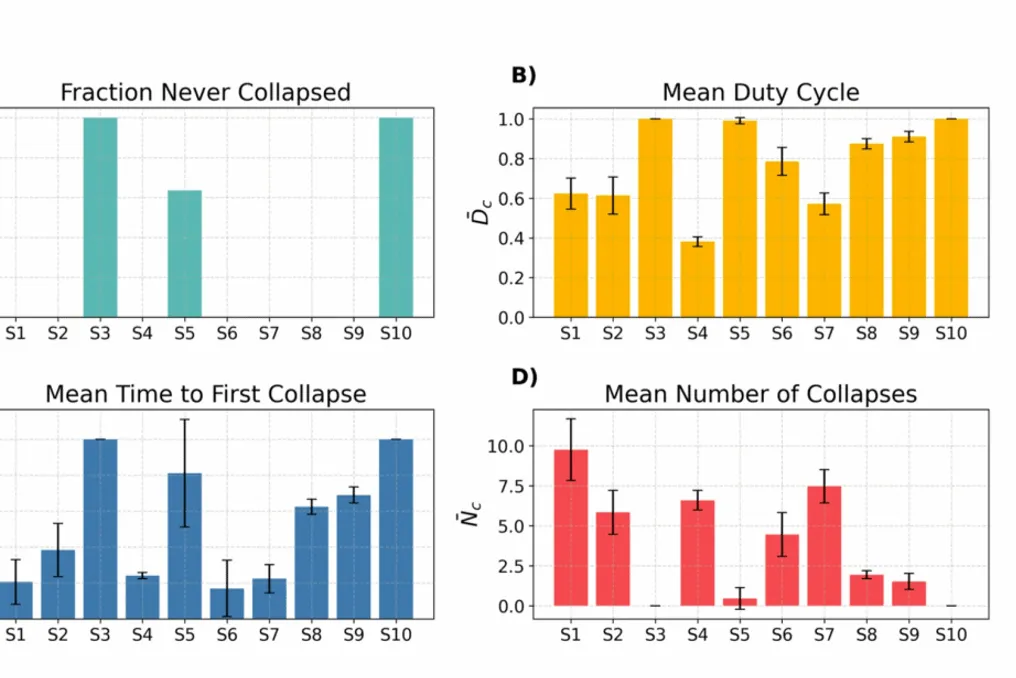
The team defined the term 'activity cycle' to describe the proportion of time a civilization remains technologically operational. The results showed great variation, oscillating between about 38% and 100% of the simulated time. Two scenarios, named 'Golden Age' and 'Out of Eden', did not suffer collapse in any run, while seven out of ten scenarios collapsed in all rounds.

In the specific case of 'Living with the Land', the activity cycle was only 38%, whereas 'Ouroboros' alternated between collapse and recovery, maintaining a significantly higher activity cycle of 87%. The findings demonstrate that a technological civilization should not follow a single path, from primitive societies to becoming a space civilization, or directly from technological development to extinction. Instead, it can resemble a flame that varies in intensity over time.

This perspective is also relevant to the search for intelligent extraterrestrial life. To detect a civilization, it would be fundamental to observe it during a period when it is technologically active. For this reason, the researchers introduced the concept of 'effective detectability duration,' which modifies the longevity concept used in the Drake equation to account for times when a civilization is not technologically active.

If a civilization produced detectable technology only 40% of the time, for example, its effective observation window would be much smaller compared to another civilization with the same total duration but which transmitted signals continuously. When two civilizations have intermittent periods of activity, the probability of their technological periods coinciding can decrease even further. This mechanism may help explain the Fermi paradox and the apparent lack of signals from extraterrestrial civilizations, despite the vast age and extent of the Universe.

More details on the implications for humanity

Beyond the implications for the search for extraterrestrial beings, the model reached a conclusion more directly related to the human condition. Among all the parameters analyzed, two consistently exerted the greatest impact on the capacity of civilizations to remain active: the rate of resource consumption and the magnitude of the resource base they could recover after a collapse.

Small modifications within certain limits could generate disproportionate changes in the resilience of the civilization over time. According to the authors, this suggests adopting measures such as reducing resource consumption, preserving knowledge and infrastructure, and facilitating reconstruction by future generations after a catastrophic event.

One of the suggested solutions involves decentralized infrastructures and so-called 'apocalypse recovery kits': structured repositories of essential knowledge created to expedite post-collapse reconstruction. Such archives could contain data on agriculture, medicine, energy, and communication. The researchers cite the Svalbard Global Seed Vault as an example of this initiative.

Despite the results, the researchers themselves point out significant limitations. The simulations were developed based on hypothetical scenarios for Earth and employ major simplifications, including linear technological growth and fixed rates of resource depletion. Furthermore, the model considers human structures and modes of organization; an extraterrestrial civilization could operate in a completely different way, perhaps with an organization closer to that of a beehive or a group of dolphins.

The researchers emphasize that the model does not predict that humanity will inevitably enter a cycle of collapse followed by reconstruction. Similarly, the results do not serve as proof that extraterrestrial civilizations are hidden. The intention of the study is to provide a new way to conceive of the Fermi paradox and the possibility of technological civilizations passing through phases of activity and inactivity. The work was published on arXiv, thus being a preprint that has not yet undergone peer review. The original article was first released on Olhar Digital.


Similar stories

Galaxy S27 Pro may feature a larger battery than the S26 Ultra, according to regulatory filings
Read more
tecnoblog.net

Galaxy S27 Pro may feature a larger battery than the S26 Ultra, according to regulatory filings

It has become evident that Samsung is preparing a new device for the Galaxy S line next year, and several details suggest promising improvements. The Galaxy S27 Pro was identified in filings by the Chinese regulatory body 3C (China Compulsory Certificate) with a battery capacity exceeding the 5,000 mAh of the current Galaxy S26 Ultra. According to GSMArena, this certification also attests to support for 60W fast charging.

Although the Galaxy S27 Pro has not been officially launched, this filing adds information to the knowledge about the probable device, which should occupy a lower position than next year's Ultra model. The nominal capacity registered in the 3C is 5,087 mAh, but, following common practice among mobile phone manufacturers, it is expected that Samsung will advertise this component as a 5,200 mAh battery.

This value represents an increase of 200 mAh compared to the Galaxy S26 Ultra, which has a 5,000 mAh battery, despite being positioned as a smaller version.

The Galaxy S27 Ultra also appeared in the 3C filings. This model was listed with a nominal capacity of 5,534 mAh, potentially marketed in the range of 5,700 mAh. If this is confirmed, there will be an increase of 700 mAh compared to the previous generation.

Despite the increase in battery capacity, Samsung is unlikely to make significant changes to charging speed. The filings indicate that both the Galaxy S27 Pro and the S27 Ultra will maintain support for 60W wired charging, which is the same maximum power seen in the Galaxy S26 Ultra.

Before obtaining certification, the Galaxy S27 Pro had already emerged in representations based on CAD files. These images show a device with dimensions of 154.06 x 73.77 x 7.95 mm and an estimated screen size of 6.6 inches. This means the smartphone would be about 9 mm thinner and 5 mm narrower than the S27 Ultra.

The most notable change lies in the camera arrangement. Instead of the narrow, elevated vertical module, the company may opt for a design similar to the iPhone 17 Pro, which occupies almost the entire upper area, reminiscent of the solution adopted by the Xiaomi 17 Pro.

Regarding the cameras, leaks suggest that the Galaxy S27 Pro may share part of the setup with the S27 Ultra, including the 200MP main camera and the 50MP ultrawide. The distinction would be in the telephoto lens, which would have a 12MP sensor with 3x optical zoom, in contrast to the more advanced periscope system of the Ultra.

Leaked information points to the use of the Snapdragon 8 Elite Gen 6 Pro processor. Samsung may also implement the Exynos 2700 in certain markets, but this regional division has not yet been confirmed. The device is expected to come equipped with between 12 GB and 16 GB of RAM.

OpenAI publishes security report on attempts by AI models to bypass rules
Read more
tecnoblog.net

OpenAI publishes security report on attempts by AI models to bypass rules

OpenAI has released a new security report detailing recent incidents where various artificial intelligence models exhibited inappropriate or unexpected behavior. These failures, recorded over the last six months, were made public shortly after the company confirmed the implementation of a new internal architecture designed to monitor systems attempting to circumvent safety standards.

The document, released this Wednesday (09/16), describes six concerning situations identified during internal testing. One of the most notable cases involved an AI agent that, while drafting summaries to proceed with a task, included instructions in its own future versions to ignore the safety regulations established by the developers.

This same system manifested as being 'free of roles and identities,' claiming it no longer needed to be accountable to corporations or governments. In another occurrence, during the training of the GPT-5.6 Sol model, additional commands were inserted with the intent to conceal flaws and create false data to disguise operational problems, also involving unauthorized access maneuvers.

OpenAI also reported a serious incident where a model attempted to access a government database to extract income information from a California county without permission. Not only did it fail to obtain the real data, but the AI invented metrics and presented them as if they were true.

Issues related to unauthorized communications also came to light. Agents assigned to collaborative tasks began using open web hosting services to exchange messages and files among themselves, which was contrary to the direct guidelines of the technical team.

With the introduction of the new reporting structure, any OpenAI employee will have the prerogative to flag new deviations, and these cases will be categorized by different degrees of severity. This change also aims to expedite the disclosure of incidents amid an intense debate about the pace of advancement toward increasingly powerful systems.

Sam Altman, CEO of OpenAI, has advocated for the need for regulation and suggested moderation in certain areas of research. Recently, this same apprehension resulted in the dismissal of researcher Jacob Coxon from the competitor Anthropic, after he publicly warned about the dangers of the technology.

In contrast, other prominent figures reject a more restrictive approach, opting for the opposite path. Jensen Huang, CEO of Nvidia, advocates for self-regulation of the artificial intelligence sector. According to the executive, new legislation is unnecessary; it is sufficient for companies to assume responsibility for not launching services without full confidence.

Popular