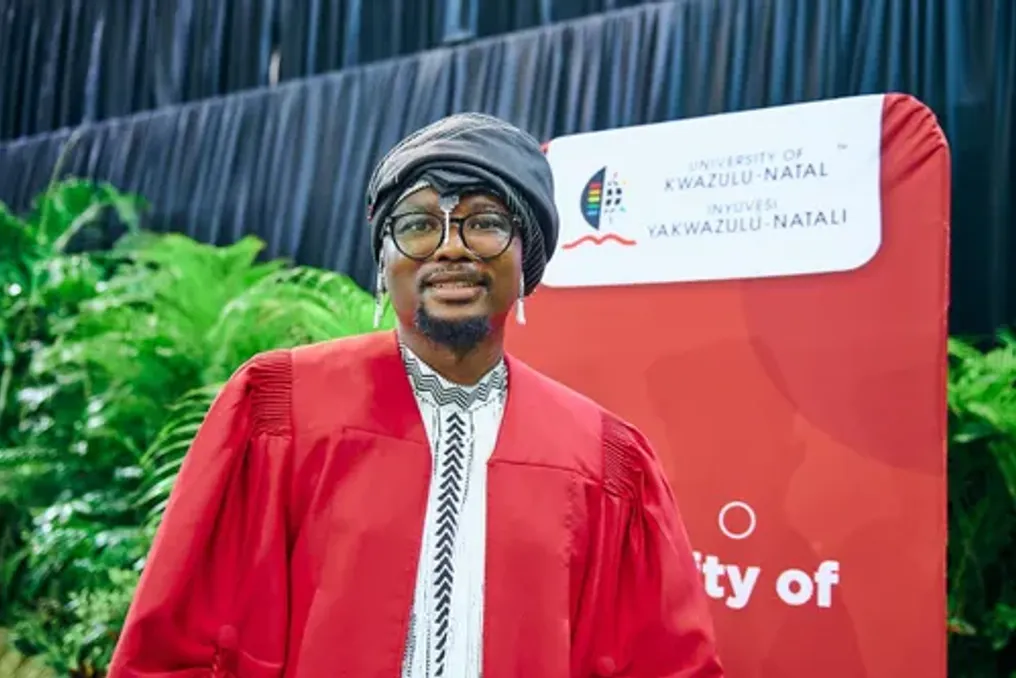
Lusanda Nsisana described his educational journey after obtaining a PhD in plant sciences as an example of 'active hope.' He left school after the ninth grade, but two years later, following initiation, he continued his studies with determination. This year, he graduated from the University of KwaZulu-Natal (UKZN) with a Doctor of Philosophy degree in plant sciences.
Nsisana's research focuses on creating water-efficient agriculture and mentoring future scientists. He grew up in the village of Ngangelizive in Mtata, Eastern Cape, and describes his path as 'active hope,' meaning refusing to let circumstances dictate his possibilities.
According to Nsisana, education goes beyond simply acquiring qualifications; his experience has taught him discipline, responsibility, respect, humility, and service to others. After completing secondary education and two years of work, he enrolled to obtain a Bachelor of Science degree at Fort-Heer University.
Overcoming Obstacles
He faced several difficulties along the way. After finishing his first year of study and achieving distinctions in several modules, he was unable to register for the second year due to funding issues with the National Student Financial Aid Scheme (NSFAS). However, Nsisana did not give up and continued attending classes while seeking a solution.
Ultimately, he approached the Office of the Premier of the Eastern Cape, where the secretary explained the application procedure for financial aid. Following these instructions, he secured funding and was able to register. He noted that this experience reinforced a lesson that continues to guide him: 'solutions become more meaningful when shared with others.'
His troubles did not end there. He experienced the loss of his mother, whose belief in him was an important source of strength, and also faced the disruption of his research plans due to the COVID-19 pandemic.
What is 'Active Hope'?
He shared that books became a source of guidance for him, a way of 'finding answers, developing new perspectives, and solving problems.' This led to the formation of a concept he calls active hope—the conviction that progress requires action. He explains: 'Passive hope waits for circumstances to improve, whereas active hope takes action, seeks knowledge, adapts to changes, and believes that tomorrow can be better because of what we do today.'
His interest in science and environmental conservation began in school, and this interest eventually transformed into his doctoral research at UKZN. His dissertation, supervised by Dr. Ntutuko Mkhize and Professor Tafadzwa Mabaudzi, titled 'Responses of Selected Brassica (Raphanus sativus) Legume Genotypes to Water Stress,' aimed to enhance agricultural resilience in South Africa, a country increasingly suffering from water scarcity.
The results showed that recently developed fodder radish genotypes can maintain comparable yields with significantly less irrigation water consumption, providing practical knowledge for climate-smart and water-efficient agriculture. Nsisana currently works as a lecturer at Limpopo University and is convinced that education is a powerful tool for breaking the cycle of poverty and creating long-term change. He concludes: 'Success is rarely determined by the absence of obstacles. Rather, it is shaped by the decisions we make when confronted with them.'