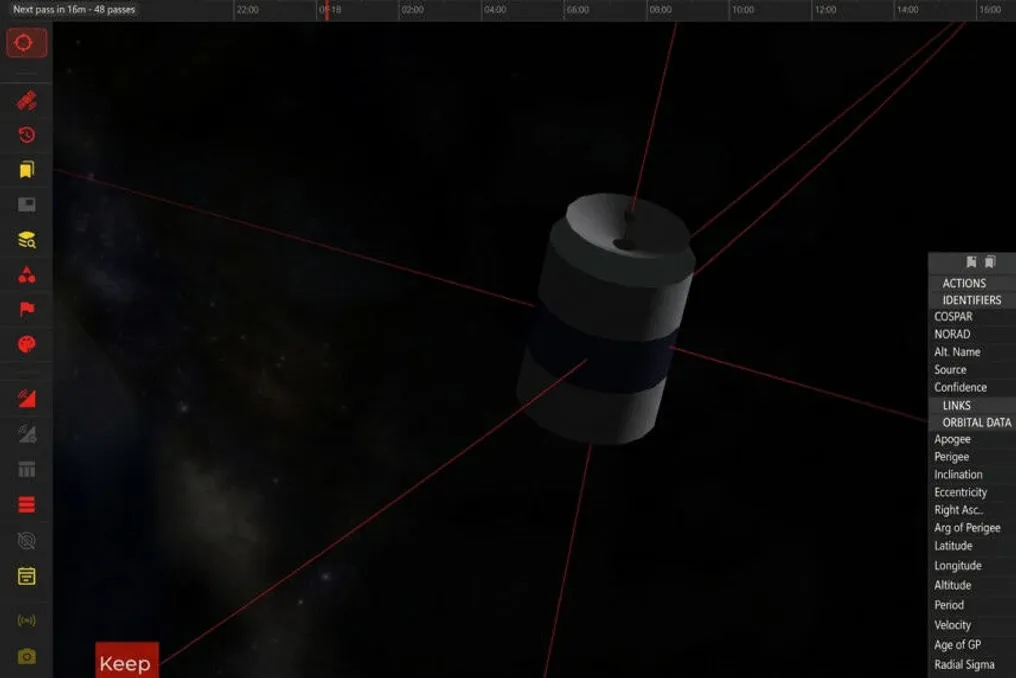
An old United States spy satellite, which was orbiting at approximately 775 km from Earth, unexpectedly disintegrated last Sunday (the 13th). This was reported in a notification published on Space-Track, the official platform of the North American government that collects data on tracking and cataloging space objects. Although the incident itself has been confirmed, the cause of the fragmentation has not yet been determined.
According to the record, the disintegration occurred around 21:13 UTC (18:13 Brazilian time). The announcement was identified in the catalog on Thursday (the 17th).
The main subject of this story is the USA 32 satellite, designated with the number 19460. Public data shows that it was launched on September 5, 1988, on a Titan II rocket and participated in a top-secret mission to monitor Soviet radars in orbit. This equipment was used for electronic and signal intelligence tasks, known by the abbreviations ELINT and SIGINT.
USA 32 was also part of a series of satellites named after actress Farrah Fawcett. The object was known as Farrah III and remained in orbit for almost four decades before its breakup.
When a satellite fragments, its structure breaks down into numerous pieces that begin to follow their own trajectories. These fragments can include both large parts subject to detection and cataloging, and smaller components that may temporarily remain outside the range of tracking systems.
As of now, no final number of fragments resulting from this event has been announced. US Space Forces have stated that tracked debris is included in routine analysis of possible approaches to other space objects. According to the notification, no immediate threat has been identified, although Spaceweather.com reports that other spacecraft may be in danger. There are over 200 active satellites within a 50 km radius of where USA 32 disintegrated.
Marcelo Zurita, an astronomer, president of the Paraíba Astronomy Association (APA), member of the Brazilian Astronomical Society (SAB), technical director of the Brazilian Meteor Observation Network (Bramon), and columnist for Olhar Digital, explains: 'In fact, the fragmentation was confirmed by independent observers, but the exact cause is still unknown. It could have been a meteor, a collision, or possibly a anti-satellite system test.'
This episode is significant because USA 32 was in a relatively high orbit, approximately 775 km above the surface. In this region, fragments can remain around the Earth for a long time before losing altitude and entering the atmosphere.
Furthermore, the breakup of such a large object adds new debris to the space environment and requires tracking its trajectories. Each tracked piece can represent a new object that must be considered when assessing the safety of satellites and other spacecraft.
As mentioned, the available information is still insufficient to determine what led to the destruction of USA 32. Fragment identification and new orbital analyses may help clarify the circumstances of the incident.