GWM transforms Tank 300 into a more robust SUV; Hyundai reduces power of HB20 and Creta for lower IPI
Read more
FlatOut
flatout.com.br

GWM transforms Tank 300 into a more robust SUV; Hyundai reduces power of HB20 and Creta for lower IPI

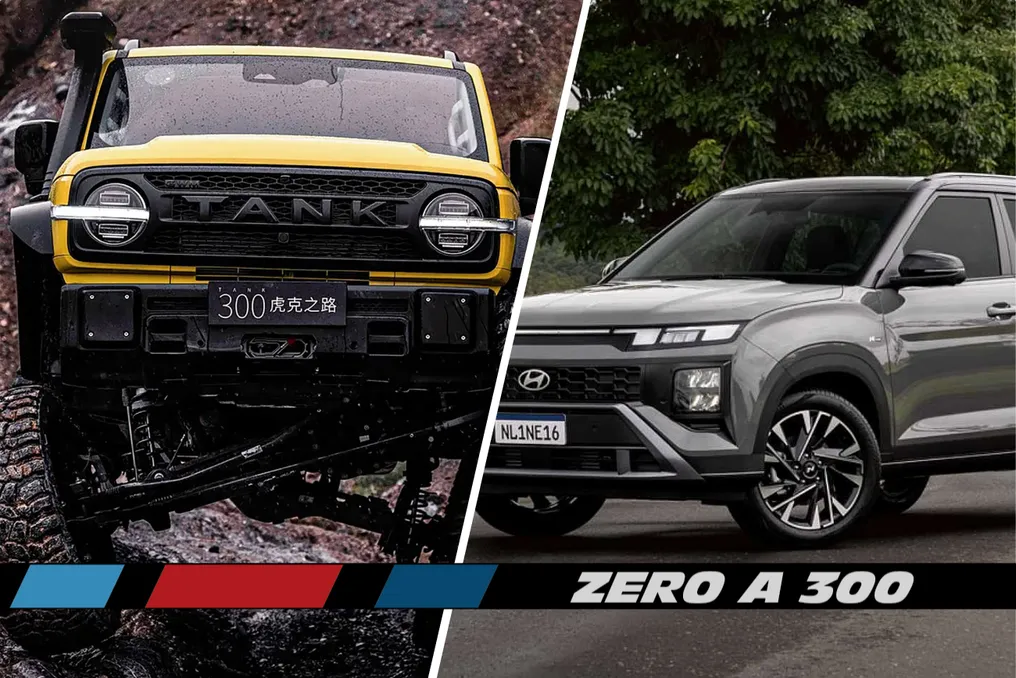
GWM has developed a version of the Tank 300 focused on heavy-duty off-road capabilities and rock crawling, replacing the independent front suspension with a solid axle. This new model, named Tank 300 Hooke Trail, is based on the Tank 300L with an extended wheelbase but incorporates a rigid front axle equipped with 80mm tubes, reinforced arms, a Panhard bar, and more durable steering. Thus, the vehicle now uses a solid axle both in the front and rear, following the standard of the Jeep Wrangler.

GWM claims that this new suspension has increased the rigidity of the assembly by 38%. Furthermore, electronic disconnect of the stabilizer bar has been added, allowing for over 500mm of wheel articulation, along with electro-hydraulic steering and specific modes for various terrains. In terms of performance, the vehicle features a 41-degree approach angle, a 34-degree departure angle, 245mm ground clearance, and 850mm wading depth. Standardly, the suspension supports 35-inch tires, although GWM indicates that tires up to 40 inches can be used with modifications.

Currently, the Hooke Trail is offered with a 2.0-liter turbo engine producing 231 hp and 40.8 kgfm, paired with a nine-speed automatic transmission and a part-time 4x4 system with low range and locks. However, Chinese documents accessed by European press suggest that a future version may feature a 3.0-liter turbo V6 engine.

In another piece of news, Hyundai opted to reduce the power of the 1.0 TGDI engine in the 2027 models of the HB20 and Creta. The power drops to 115 hp, for both gasoline and ethanol, compared to the 120 hp previously achieved with ethanol. The torque remains unchanged at 17.5 kgfm. This change was motivated by fiscal issues, as the new Green IPI now considers engine power in the calculation of the rate, and Hyundai adjusted the turbo to fit within the 85 kW range.

Other updates include the registration of the Slate Truck electric pickup in Brazil with INPI. This pickup, conceived by the startup Slate Auto, founded by Jeff Bezos, features a minimalist and rectilinear design. With a length of 4.43 meters and a total load capacity of 635 kg, it offers a range of 240 km with its 52.7 kWh batteries, potentially reaching 385 km with an optional 84.3 kWh kit. Its differential lies in its modularity, allowing the conversion from a single cab to a van or a five-seater SUV.

Additionally, Volvo acknowledged exaggerating the removal of physical buttons and plans to reintroduce tactile controls in future releases. Thomas Ingenlath, responsible for Volvo's design, stated that screens should only be used where they are most efficient, arguing that basic operational functions should not depend on digital menu navigation, citing Leica cameras as an ergonomic reference.

In the hypercar scene, McLaren tested its MCL HY in Portimão, Portugal, with Lando Norris behind the wheel. The prototype uses a 2.9-liter biturbo V6 with a hybrid system and demonstrated the ability to exit the pit lane using only the electric motor. Norris completed 38 laps on the circuit, raising speculation about its preparation for the 2027 Endurance Championship.

Similar stories

Cadillac launches models in Brazil; VW presents the most powerful electric GTI in history
Read more
flatout.com.br

Cadillac launches models in Brazil; VW presents the most powerful electric GTI in history

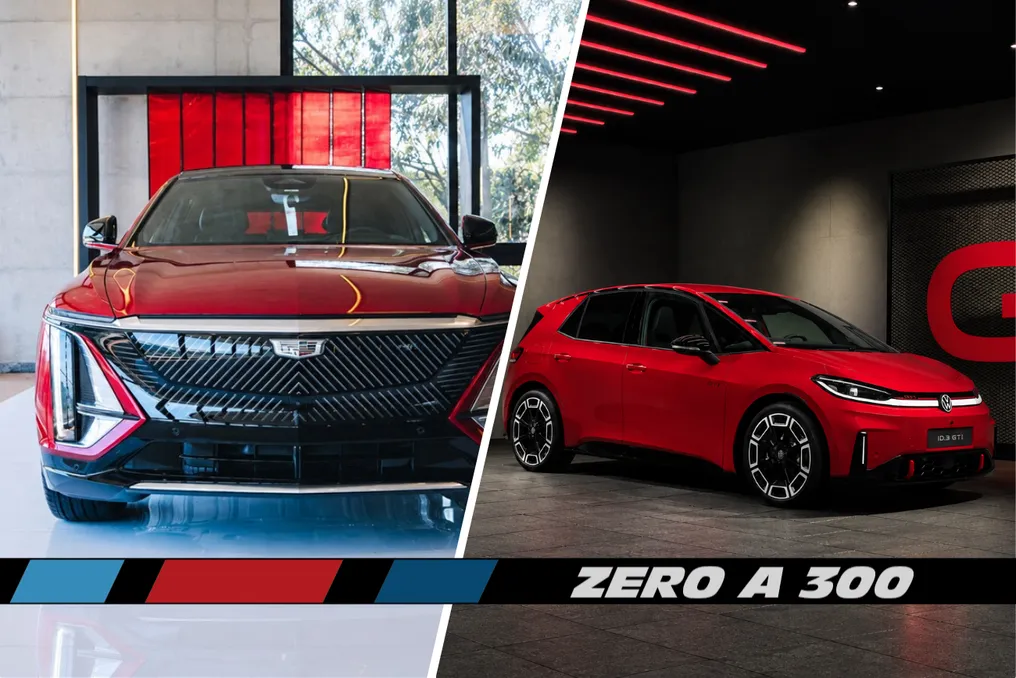
Cadillac began its commercial operations in Brazil on Wednesday, the 16th, introducing two high-value electric SUVs: the Lyriq, priced at R$ 820,000, and the Vistiq, priced at R$ 990,000.

These models will initially be available through reservations or pre-sales in the cities of São Paulo, Curitiba, and Brasília, with deliveries expected to begin in November. The Lyriq arrives in the Signature Luxury configuration, equipped with two electric motors, all-wheel drive, and 500 hp. Its 95.7 kWh battery guarantees an autonomy of 405 km according to Inmetro and supports fast charging up to 132 kW. Its interior features 22-inch wheels, seats with heating, ventilation, and massage functions, a panoramic roof, a head-up display, and an AKG sound system with 19 speakers.

The Vistiq, a three-row, six-seater SUV, has two motors, all-wheel drive, and delivers 604 hp. It accelerates from 0 to 100 km/h in 4.1 seconds and offers 395 km of autonomy according to Inmetro. Additionally, this model includes air suspension, rear wheel steering, five-zone climate control, infrared night vision, and an AKG system with 23 speakers.

Initially, service will be provided in three locations, operated by Eurobike in São Paulo, Metrosul in Curitiba, and Tecar in Brasília. A third vehicle in the line, the Optiq, is expected to launch in the first half of 2027 and will be positioned below the Lyriq. The initial prices are considered high, and Cadillac is expected to maintain a focus on low volume, leveraging its luxury reputation from GM, despite increasing competition from Chinese brands.

Volkswagen revealed the most powerful model in its GTI lineup, which is the electric ID.3 GTI. This represents the second battery vehicle to bear the legendary designation, succeeding the ID. Polo GTI, launched in May with 226 hp and front-wheel drive.

The ID.3 GTI elevates performance, boasting 326 hp and 55.6 kgfm of torque. This power surpasses the Golf GTI Edition 50 by 1 hp, which was launched at the end of 2025 and has 325 hp and 42.8 kgfm in the 2.0 turbo TSI engine. The design incorporates characteristic GTI elements, such as emblems, a red stripe on the front, and exclusive wheels, in addition to a straight-base steering wheel with a red mark and bucket-style seats with partial Alcantara upholstery.

Technically, the ID.3 GTI is essentially identical to the ID.3 GTX that circulated before the April redesign, using the previous generation's MEB platform, with a 79 kWh battery in the floor. Its performance is the same as the GTX: 0 to 100 km/h in 5.6 seconds and maximum speed electronically limited to 200 km/h. However, the strong point of the ID.3 GTI is the autonomy, capable of traveling up to 601 km under ideal conditions, and the battery charges from 10% to 80% in just 29 minutes.

Rolls-Royce presented the Phantom Hummingbird, an ultra-luxury sedan built under the brand's 'Architecture of Luxury Series II'. This vehicle is powered by a 6.75-liter biturbo V12, generating 570 hp and 91.8 kgfm of torque, allowing it to reach 100 km/h in 5.4 seconds, making it the version with the longest wheelbase.

The differentiator of this specimen lies in the interior finish with abalone mother-of-pearl, a material obtained from mollusks, which displays striking patterns of intense colors and dark lines that vary depending on light incidence. Unlike common mother-of-pearl, abalone mother-of-pearl is more fragile, and Rolls-Royce artisans dedicated nine months to developing the correct cutting and positioning technique, a process that consumed 45 hours of work.

The car was commissioned by a client from Dubai through the Private Office division, as a tribute to his wife. The tribute included hummingbird-shaped patterns on the folding rear tables and a floral pattern on the vertical panel between the rear seats, called 'Rear Waterfall'. Each bird was composed of 53 pieces of abalone, and the floral decoration used 84 pieces. Furthermore, the silhouette of a hummingbird was hand-painted on the body. Rolls-Royce justifies the choice of the hummingbird due to the iridescent effect of its feathers, which recalls the color changes in the abalone finish.

Although the value of the exclusive specimen has not been disclosed, it is mentioned that a model in the Dubai region starts at 2 million Dirhams, which is equivalent to just over R$ 2.8 million.

CAOA Changan launched the CS55 this Wednesday (16), aiming to compete with models such as the Jeep Compass and Toyota Corolla Cross. The vehicle is available in three configurations, with prices ranging from R$ 145,000 to R$ 190,000 for the top version, which incorporates a 286 hp plug-in hybrid system.

This mechanical package combines a 1.5 turbo flex engine with an electric motor and a specific hybrid transmission, resulting in 286 hp and 47 kgfm. The total declared autonomy reaches 1,200 km with the tank and battery full, although CAOA Changan has not yet provided details on battery capacity, charging time, or purely electric range.

The other versions, Prime and Infinity, use the 1.5 turbo flex engine producing 180 hp and 29.2 kgfm, coupled with a seven-speed dual-clutch gearbox. The Prime version costs R$ 144,990, and the Infinity, R$ 154,990. Both are manufactured in Anápolis, and the presented values are promotional, without a defined end date for the campaign.

With a length of 4.55 meters, a wheelbase of 2.66 meters, and a trunk capacity of 525 liters, the CS55 fits into the mid-size SUV segment. It also offers features common in the Chinese market, such as large screens, panoramic roof, electric seats with heating and ventilation, 540-degree cameras, adaptive cruise control, and lane keeping and centering assistants. The highlight is the positioning of the CS55 PHEV, which places 286 hp in the price range of conventional Compass and Corolla Cross versions, also competing with the CAOA Chery Tiggo 7.

There is now a miniature replica of the Porsche 550, licensed and developed in collaboration with Porsche itself, intended for enthusiasts who cannot yet drive the original model. This luxury toy is named 550J and is produced by Hedley Studios, a company specializing in scale replicas of classic cars from brands such as Aston Martin, Ferrari, Bugatti, and Bentley.

The 550J replicates the Porsche 550A, presented in 1956, which replaced the Volkswagen chassis with its own tubular structure and used a four-cylinder, 1.5-liter air-cooled boxer engine with power between 110 and 135 hp. In the toy version, the body is made of carbon fiber, resulting in a weight of 330 kg. An 11 hp electric motor on the rear axle is sufficient to reach up to 40 km/h. There is also an RS option, equipped with a 22 hp engine and a maximum speed of 80 km/h, which includes Bilstein shock absorbers and drilled disc brakes.

This luxury item has a high cost: the most basic version costs US$ 95,000, which corresponds to almost R$ 490,000 at the current exchange rate.

VW Amarok Unlimited farewell and highlight of the Genesis Magma GT at a hillclimb event
Read more
flatout.com.br

VW Amarok Unlimited farewell and highlight of the Genesis Magma GT at a hillclimb event

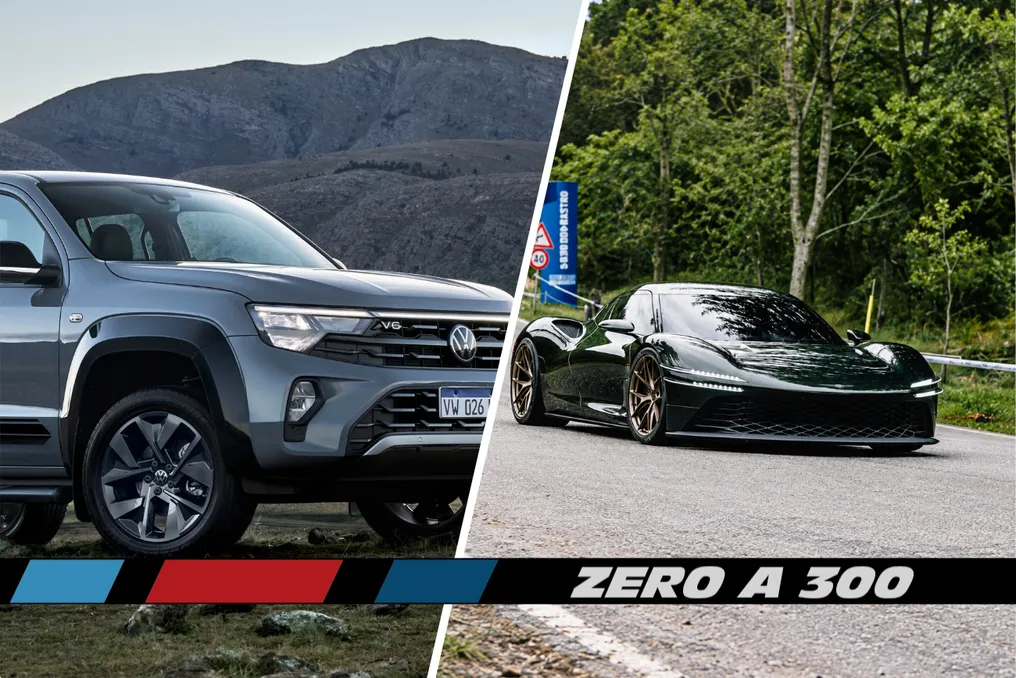
Volkswagen is launching the special Amarok Unlimited series, which marks the end of the current generation of the pickup truck. This model was recently presented in Argentina and is now available in Brazil, being a limited edition with only 200 units available, although the price has not yet been disclosed.

Volks used the characteristic design of the Amarok, which maintained its appearance after 16 years of updates, to decorate the body. The exclusive paint is in Moonstone Gray, complemented by sill stripes with the inscription "V6 Unlimited," glossy black wheel arch moldings, and diamond-finished alloy wheels. The Saint Anthony on the bed also has a glossy black finish, resulting in an aesthetically pleasing look.

The interior features various resources, including leather-upholstered seats and steering wheel, two-zone digital air conditioning, 9-inch Composition Touch multimedia center, six airbags, ABS brakes with off-road function, automatic post-collision braking, and rear differential with mechanical lock. A numbered plaque on the dashboard confirms that it is a special edition.

The Amarok Unlimited will be equipped exclusively with the three-liter V6 turbodiesel engine, which delivers 258 hp (reaching peaks of 272 hp with the overboost system) and 59.1 kgfm of torque, coupled with the eight-speed ZF automatic gearbox, maintaining 4Motion all-wheel drive. The pickup is expected to arrive at dealerships in October, but before that, it will be displayed at the Circuito Sertanejo event in Jaguariúna (SP) next weekend.

Genesis Magma GT roars loudly at hillclimb event

The Genesis Magma GT, a supercar from the Genesis brand—which emerged as a luxury division of the South Korean manufacturer—proved to be a serious competitor in the supercar segment, rivaling models such as the Chevrolet Corvette, McLaren Artura, and Ferrari 296 GTB. Its performance was noted during the Tutto Bene Hillclimb, held near Lake Maggiore, Italy.

Besides having a sophisticated design that reflects the Genesis visual language, what caught attention was the powerful sound of the V8 engine. Even at moderate accelerations, the Magma GT emits a deep, loud, and bubbling roar. This 3.2-liter V8 engine is derived from the 1.6-liter four-cylinder engine used in the Hyundai i20 N rally car. Hyundai already uses a hybrid version of this engine in its GMR-001 LMDh prototype, which participates in the Hypercars category at Le Mans; however, in the Magma GT, the system is purely combustion.

Although the Genesis Magma GT is still an official concept, the manufacturer keeps other technical specifications confidential. It is expected that this project will give rise to a family of vehicles, including roadster and track versions compatible with FIA GT3 regulations. The launch date for the final production version has not yet been defined, but the most optimistic estimates point to 2027, with 2028 considered more likely.

AI Cameras: A fine every 19 minutes

Two cameras equipped with artificial intelligence, installed at kilometers 17 and 18 of the Raposo Tavares Highway, at the entrance to the city of São Paulo, registered 2,316 fines in just one month, equivalent to one citation every 19 minutes, operating 24 hours a day. Of these infractions, none were for speeding; between August 3 and September 3, 1,386 infractions related to seatbelt use and 930 for using a cell phone or headphones were recorded.

The system works by analyzing internal images of vehicles to identify possible infractions, which are later checked by the Highway Military Police before the fine is issued. The technology also has OCR plate reading capability, although there is no confirmation that these devices are used to automatically locate stolen or stolen vehicles.

A debated point raised is the priority given to inspection automation. In this initial phase, the cameras cannot yet automatically detect stopped vehicles, pedestrians, or objects on the road—situations where AI detection followed by immediate intervention could prevent accidents. This raises the issue of the dehumanization of inspection, as the driver receives the fine weeks later, without the dangerous conduct being interrupted at the moment it occurs, unlike a police approach.

It is questioned whether these devices are effectively preventing accidents. After 2,316 monthly citations, it would be relevant to know how many accidents were avoided, how many risky situations were interrupted, and how many stolen vehicles were recovered with the help of these cameras, since the efficiency of the inspection must be measured by the safety provided, and not just by the volume of fines issued.

US Manufacturers Want to Ban Chinese Brands, But Trump Accepts Local Production

While traditional manufacturers in the United States seek to convince the American Congress to permanently restrict the entry of Chinese cars, President Donald Trump shows openness to Chinese brands, provided they establish local factories and hire American labor.

In an interview with Fox News, Trump mentioned that the problem would be the production of vehicles in Mexico for subsequent export to the US. He drew an analogy with Japanese manufacturers, who faced similar resistance decades ago but ended up investing in the country, employing thousands of Americans, and achieving leadership in certain sectors.

This stance diverges from the Alliance for Automotive Innovation, an association bringing together major American manufacturers such as Ford, GM, Stellantis, Toyota, Volkswagen, Hyundai, and Honda. At the beginning of the month, the group requested a definitive ban from Congress on the sale, import, and manufacturing of connected Chinese vehicles, hardware, and software, alleging that Chinese government subsidies and connectivity pose national security and economic risks.

Currently, Chinese cars already face barriers in the United States. In addition to tariffs exceeding 100% on Chinese electric vehicles, a regulation approved during Joe Biden's term limits automotive hardware and software linked to China, making the commercialization and production of connected Chinese cars difficult.

It is notable that, despite Trump accepting Chinese factories with American employment, members of his government and parliamentarians of his party have pressured Ford regarding its partnerships with Chinese companies such as CATL and Geely. It seems that the American conclusion converges with that of other countries: if a total ban is not feasible, the alternative is to force local production to foster jobs, investments, and technological development.

Route 66, one of the most iconic roads, can now be virtually traveled in its total length of 3,539 kilometers through mobile applications and computers. The idea came from Jake Boyles, developer of the Pit Stop application, which maps support points near American highway exits.

To celebrate the road's centenary, he created a specific version that covers the entire extent, including all existing restaurants, gas stations, and businesses. Although it may not be practical for the Brazilian public, the feature helps gauge the vastness of Route 66, which crosses the United States from coast to coast, passing through seven states.

The application catalogs not only commercial establishments but also notable tourist spots, such as the Santa Monica pier, the final point of the crossing in the Pacific, the famous corner in Winslow, Arizona, cited by the Eagles, and the meteor crater used by NASA in the Apollo mission training. In total, Boyles mapped about 2,400 dining locations, 1,300 motels, and 280 cities along the route. Inaugurated in 1926 and consecrated as the "Mother Road" by John Steinbeck in The Grapes of Wrath, Route 66 symbolizes the culture of automobile travel. Despite losing relevance to the interstates in the 1950s and 1960s, culminating in its federal decommissioning in 1985, the road remains alive in the popular imagination.
Popular