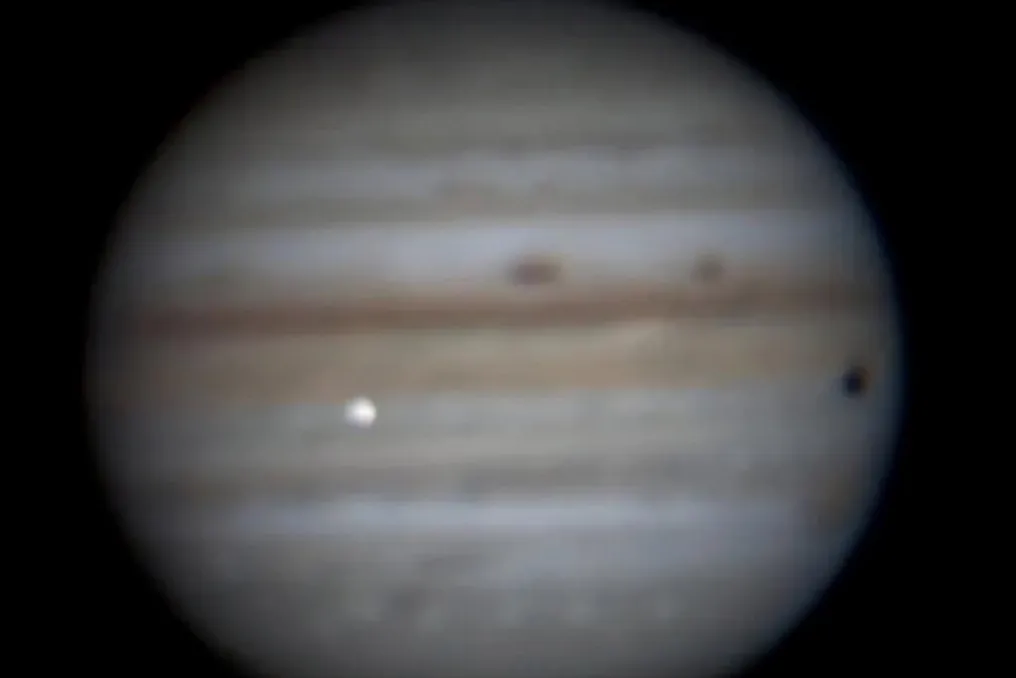
A Brazilian observer captured the precise moment an object collided with Jupiter. Asteroids are remnants of the formation of the Solar System, which occurred about 4.6 billion years ago. Many of them continue to orbit the Sun, mainly in the region known as the Asteroid Belt, located between Mars and Jupiter.
The trajectories of these objects are not entirely stable and can change under the influence of planetary gravity, especially that of the gas giant. Due to its enormous mass, Jupiter exerts a very strong gravitational influence on objects passing near it. This leads to the planet being struck by asteroids and other small bodies relatively often.
In most cases, these events are too small to be observed from Earth. However, in some instances, a cosmic chunk of sufficient size capable of causing a more energetic impact passes through the atmosphere of the gas giant, creating a brief flash. This phenomenon may last only a few seconds, but it can be registered by telescopes installed on Earth, even if Jupiter is hundreds of millions of kilometers away.
One such incident occurred on September 13, 2021, and was recorded by an amateur astronomer from Brazil who was observing Jupiter and noticed a rapid flash caused by the impact. This recording helped document another rare episode that can be observed directly.
The observation also demonstrates how continuous monitoring of Jupiter can contribute to the study of the dynamics of the Solar System. By collecting records from different observers, researchers can estimate the frequency of such collisions and better understand how small celestial bodies move and interact with planets.
In the program 'Olhar Espacial' this Friday (the 18th), José Luís Pereira, a retired civil engineer and amateur astronomer from São Caetano do Sul (São Paulo state), will participate. He has been systematically monitoring the gas giant since 2018. He will recall the 2021 recording and explain how he observed the planet at that time.
The discussion will also cover what these impacts reveal about the dynamics of the Solar System and why monitoring objects close to Earth is important for astronomy and understanding collision risks on our planet.
More details:
The program, presented by Marcelo Zurita, President of the Paraíba Astronomy Association – APA; member of SAB – Brazilian Astronomical Society; technical director of the Brazilian Meteor Observation Network (Bramon) and national coordinator of Asteroid Day Brazil, is broadcast live every Friday at 9:00 PM (Brasília time) on the official channels of the publication on YouTube, Facebook, Instagram, X (formerly Twitter), LinkedIn, and TikTok. The material about how a Brazilian recorded the impact on Jupiter first appeared in Olhar Digital.