Hairstyles are considered an adornment that frames the face, and research shows that hair care products are among the top three most popular purchases in the beauty sector, including shampoos, conditioners, lacquers, and dyes.
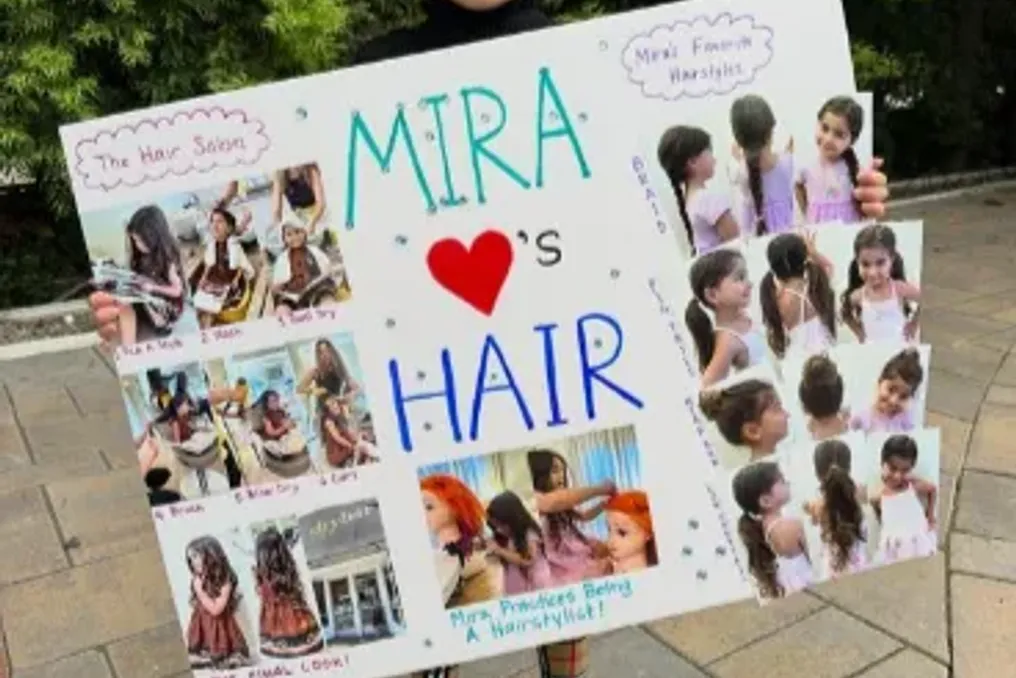
Once, the author's granddaughter, Mira, decided to complete a school project on hairstyles. Being a five-year-old girl, she is interested in fashion and spends a lot of time dressing up Barbie dolls and styling their hair. She even has a small head mannequin on which a rainbow wig sits, which she brushes and decorates with clips and bows.
During quiet time after the presentation, Mira and her friend decided to cut each other's hair using dull scissors from the craft corner. Because the scissors were blunt, the result was catastrophic. Mira has long curly hair, and her friend has straight hair; as a result, they ended up with uneven, jagged, and broken ends.
The teacher's assistant who was on duty was extremely upset and carefully packaged Mira in a bag. He apologized to the author's son when he came to pick up Mira, expecting serious punishment for the incident that occurred under his supervision. However, the author's son was more amused than upset and calmed the worried assistant by saying that hair grows back. He also suggested keeping the scissors out of easy reach.
Of course, these two little girls had to go to a real hairdresser to fix the damage. When the author was young, shampoos and conditioners did not exist; the only luxury was washing with soap under the sun. Once a week, her mother applied coconut oil to her hair, making it smooth and shiny. On school days, her hair was braided and tied with beautiful white ribbons, and on weekends, bright clips called 'love in Tokyo' were used.
Sometimes each braid was coiled into 'telegraph coils' on both sides of her ears. Today, looking back at old school photos, the author thinks the word 'nerd' might have fit then. But that was a style from sixty years ago. Over time, her long hair became shorter and stopped being a thick hairstyle. Regular monthly visits to the hairdresser became a routine, and the author admits her vanity.
The author dyes her hair every four to six weeks, and she has no gray hair, as if regular coloring slows down aging. Sometimes, when she cannot get to the hairdresser, she uses quick correction methods, which are last resorts.
Today, the beauty industry is on a completely different level. There is a colorful choice of colors available, from red to blue, blonde, and green. The author prefers black, without being too bold. Some women look very striking with a radical change in hair color, while others do not. Of course, one can change hairstyle and color daily thanks to the variety of available wigs and hairpieces.
Late last year, the author noticed high activity in a mall store selling such extensions. She went to look and was amazed to find wigs and extensions indistinguishable from human hair. Their origin could be Brazil, China, or India, and the prices are enormous. A good wig can cost thousands. For example, the cheapest wig imitating human hair in that store cost about R5k. Add to this the wig cap, a mannequin to maintain shape, and all necessary washing and styling products, and the sum becomes significant.
Speaking of extensions, the author's mother bought one such wig over fifty years ago during one of her first trips to India. It was black, resembled a small bunch with fine curls, and was attached to the head with several clips. Her mother was proud of this accessory and wore it with dignity, using it only on special occasions, such as weddings. A few days before, she would take it out of her bag, carefully brush the fine curls, and even use a little lacquer to keep them in place.
The author can confidently say that it was one of her most cherished possessions, and despite her mother's death five years ago, the wig was not thrown away and remains a topic of conversation when she remembers with her sisters how elegantly her mother looked.
Nowadays, there are many new and creative ways to style hair. Those with curly hair straighten it, and those with straight hair desire curls. There were no hair straighteners before. The author recalls how one of her aunts would place her long hair on an ironing board, cover it with brown paper (which was previously used to wrap school books), and then use a hot iron to straighten it. This usually required two hands and some head gymnastics.
If curls were desired, strands of hair were placed in old stockings and tightly twisted, left overnight. In the morning, the hair would be in curls. Perming was a fashionable phenomenon where hair was placed in rollers, and then ammonia solution was sprayed. After 15–30 minutes, the hair was washed off. Large rollers were used for looser curls, and the perming lotion was left on for a short time; for tighter curls, small or medium rollers and longer exposure to the lotion were used. The whole process could take up to two hours or more, and the smell of the perming lotion was awful.
Due to lack of information, people did not know about the harm of ammonia products to the scalp and hair fibers. It was a case of fashion at any cost. Some people voluntarily go bald, while others may lose their hair for many reasons. Certain types of cancer treatments and medications can cause hair loss, as can stress, genetics, hormonal imbalance, and iron or protein deficiency.
Intensive procedures, such as perms, daily use of high-temperature blow dryers or straighteners, and braiding can lead to hair loss and premature baldness. The author wonders about the tight braids or plaits that some people do; it seems the skin is severely stretched, and the scalp is visible. It is interesting whether this hurts or can cause headaches.
The author didn't dare to ask for fear of seeming impolite. Hair loss can cause severe emotional distress, and there are many remedies for it. The question of their effectiveness is highly debatable. Ancient practices of oil treatment have a certain benefit. The oil itself does not stimulate hair growth; it is the regular massage that activates blood circulation to the hair follicles, promoting growth. Oil also acts as a moisturizer.
In Hinduism and Islam, shaving the head of a newborn is a ritual of purification and release from negativity. It is a personal decision of the parents. The author believes it is a good ritual to follow. Old folk beliefs about bad luck or ill omens if a newborn's head is not shaved, or that shaving will cause regrowth, may just be the opinions of elders or a myth.
The author doesn't know. Sometimes we do things simply because that's how it has always been. The younger generation demands scientific explanations for ancient cultural practices, which cannot always be fully explained. Recently, the author read that Manchester City forward Erling Haaland was famous for his long blonde hair. When he wore it loose, he literally resembled a Scandinavian Viking.
On the field, he wore a stylish bun, and many of his fans were disappointed when he decided to cut it. He said he needed a change, and although he misses it, he knows that hair grows back. Wishing him good hair days until next time.