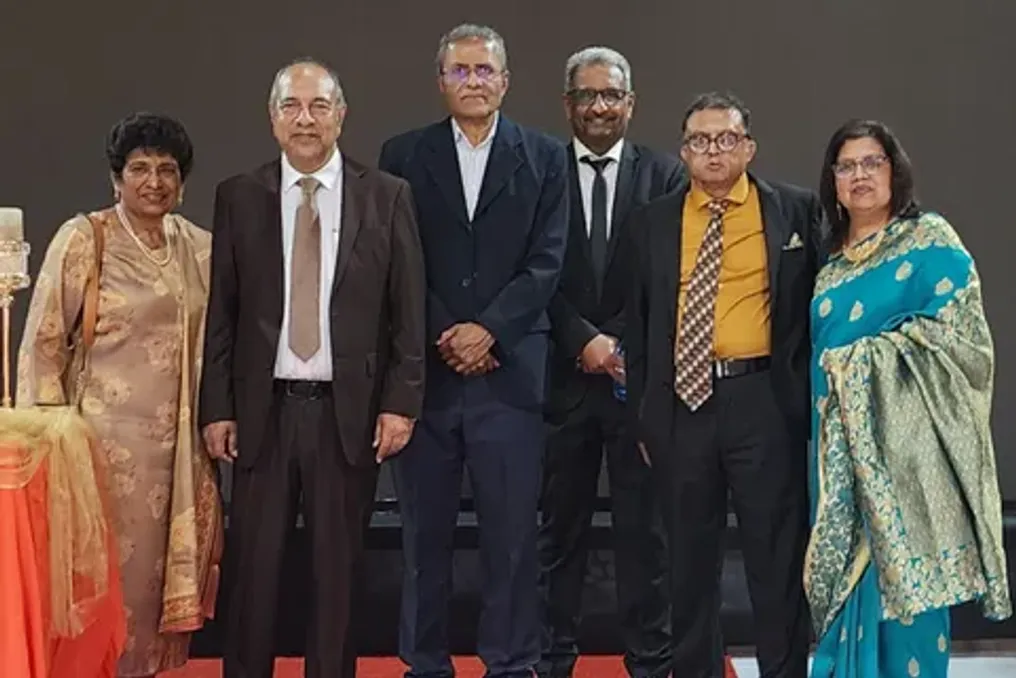
The Merabang Books Project editorial team, which includes Shamla and Viren Singh, Bridge Maharaj, Kumarasen Govender, as well as Ashoka and Logas Madunlala, presented the book 'Merabang Legacy: Our People, Our Culture, Our Stories'. The book launch took place on Saturday at the MTSS hall.
On Sunday, the long-awaited publication 'Merabang Legacy: Our People, Our Culture, Our Stories' was presented. A distinctive feature of this edition is that it was researched and written by the community members themselves, rather than by a single author. The book tells not about one individual, but about an entire community.
Professor Karty Govender noted that 'the Merabang book is a collective autobiography filled with the love of a resilient and diverse community that has not only survived despite enormous difficulties but is also thriving, exceeding most expectations.'
It presents various opinions and viewpoints from residents, former residents, community leaders, teachers, and organizations. As a result, it offers a rich, authentic, and comprehensive description of Merabang's history, based on the personal experiences of its inhabitants.
The history of Merabang is a story of resilience, self-sacrifice, community spirit, and collective action. This book does not just document events; it describes how a displaced community confronted the injustices of the apartheid era and socio-economic hardships, raised freedom fighters, and turned adversity into strength, and neighbors into family.
After reviewing the manuscript, Dr. Jaggi Pather wrote: 'The Merabang community demonstrated its resilience and managed to overcome all obstacles, turning the ghetto they were forced to move into into a thriving suburb.'
The book demonstrates how ordinary residents used solidarity, mutual aid, and determination to build strong institutions, defend their rights, raise future generations, and transform Merabang into a vibrant, flourishing community.
As Professor Jaynatan Govender notes, the book 'presents Merabang not just as a geographical location, but as a biography of a place where personal memories, collective struggle, and civic engagement intersect.'
From the beginning, Merabang was characterized by a spirit of selflessness, generosity, and dedication to the common good. Parents and grandparents overcame serious challenges because they knew the strength of the community. Neighbors were not just acquaintances; they were family.
More specifically, according to Professor Managai Reddy, the book is fundamentally a 'tribute to the generations whose courage, foresight, and commitment to justice have left their mark both in Merabang and in the nation they helped transform. The history of Merabang is the history of South Africa, and on these pages you can find a part of your own.'
Education was viewed as a path to social and economic progress. Institutions such as Merabang State Primary School and Shieldside School became centers of excellence due to the dedication of outstanding teachers who shaped generations of young minds. Equally influential were religious, cultural, sports, and civic organizations that instilled values, promoted social cohesion, and developed leadership within the community.
The book highlights the vital role played by the Merabang Residents Association (MRA) in fighting for the rights and interests of the community against the injustice inflicted by the Durban City Council during the apartheid era. Residents, through collective action and self-help initiatives, transformed humble, uniform houses into prosperous family homes, often so much so that the original structures are barely recognizable.
These achievements are constant symbols of the determination, resilience, and ingenuity of the people of Merabang. The history of Merabang is also the story of remarkable people whose lives embodied service to others. Figures such as Mr. MR. Mudli, who became synonymous with MTSS, Parashakti Temple, and MRA; and Mr. Abinand Harase, who worked at Settlers Primary School, Merabang Indian Association, school sports, and Woonathee Sabha, were examples of selfless leadership that helped shape our community.
The book is replete with countless acts of generosity and self-sacrifice that embody the tradition of self-sufficiency and service to the Merabang community. VS Pillay donated the land on which the first school in Merabang was built. The first Hindu temple was erected on land donated by EM Paruk. The land on which MTSS was first built was gifted by ST Nadasen Odayar. Jogji Naidu and RK Naidu laid down their homes to finance critical MRA lawsuits against the racist Durban City Council.
Mr. MR Mudli received a targeted loan and then provided funds to MTSS interest-free. R Gopalasing also made similar sacrifices for Shieldside School. These examples show a powerful truth: unity is strength.
As the book illustrates, Merabang often surpassed its time. One of its greatest strengths has always been the tradition of dialogue, interaction, and collective problem-solving. This tradition found new expression through the Merabang Books Project (MBP), which evolved into something more than just a historical exercise.
Since its inception, MBP has provided an inclusive platform through which residents, stakeholders, and community leaders could reconnect, share perspectives, identify issues, reach consensus, and explore solutions. In many ways, it represents a practical expression of the values that have long defined Merabang: participation, cooperation, and shared responsibility.
These values are particularly important in the modern world. We live in an era where political, racial, religious, and social intolerance can spread faster than our ability to counter it. When intolerance and corruption become the norm, it threatens the foundations of democracy, social cohesion, and peaceful coexistence. This reality places a special responsibility on all of us to promote understanding, cultivate empathy, encourage dialogue, and maintain ethical leadership.
MBP has also offered many of us an opportunity for personal reflection. It reminded us of our journey from a modest beginning in Merabang while affirming the enduring influence of friendship, values, and shared experience that continue to shape our lives.
According to MBP team member (and poet) AK Madunlala: 'Rooted in Merabang, yet boundless in spirit, this is a story that speaks to readers everywhere, no matter where they call home.'
Thus, this book is much more than just a historical record. While it honors the past, it aims to inspire action in the present and help shape a brighter future. It serves as a catalyst for reviving community pride, strengthening social cohesion, and motivating future generations to keep alive the traditions of selfless service, leadership, and collective responsibility that have long characterized Merabang.
Rich in memories, meaning, and hope, 'Merabang Legacy' honors those who came before us while prompting us to build upon their successes. It reminds us that when Merabang unites, extraordinary achievements are possible. The final words of Judge Mohini Mudli: 'Many commendable achievements of the people of Merabang and the entire community are carefully recorded in this wonderful book, which should find its place in every home of a former, current, or future resident of Merabang.'
Professor Bridge Maharaj is a son of Merabang and a member of the MBP editorial team. For further information, please contact Logas Madunlala at 0837754401.