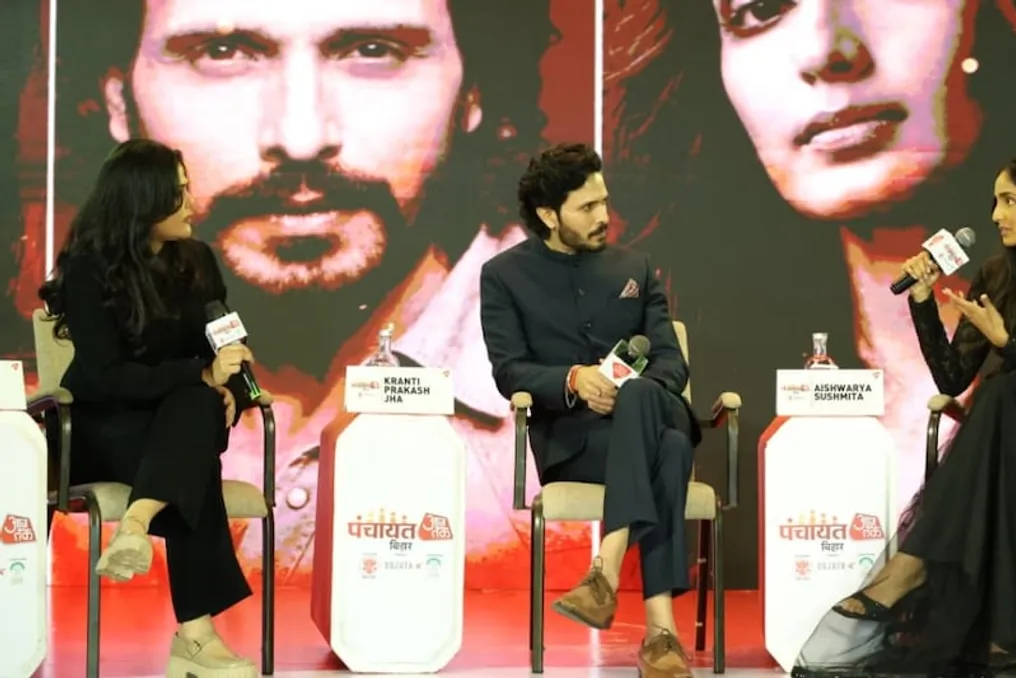
During the session 'Sitare Bihar Ke' on the Panchayat Aajtak channel, actors Kranti Prakash Jha and Aishwarya Sushmita openly discussed the presence of Bihari artists in Bollywood, the stereotypical image of Bihar, and the multifaceted linguistic and cultural identity of the state. Both artists emphasized that Bihar is abundant in talent, but the stories of this region are often presented through a limited lens.
They also talked about how artists from Bihar are developing their unique identity while moving forward. Kranti Prakash Jha noted that it took time for people to notice the talents coming from Bihar. He stated that art is not confined to one sphere, and the people of Bihar know how to overcome life's difficulties. According to him, the people of Bihar possess resilience and the ability to emerge from difficult circumstances. Moreover, living in Mumbai, he never felt that he was perceived worse because of his origin from Bihar.
Kranti Prakash Jha added that there is a special simplicity and connection to the native land in Bihari artists. He cited figures such as Manoj Bajpayee, Pankaj Tripathi, and Sanjay Mishra, noting that the aroma of the Bihari soil, naturalness, and sincerity can be felt in their performances.
Kranti Prakash Jha raised the topic of depicting Bihar in cinema. He believes that selling the image of Bihar is easy, but creating it is difficult. Although there are many stories about Bihar, films and web series often use already popular and outdated images. He pointed out numerous stories from Bihar's history and society that have not yet received enough attention, citing Vir Kunwar Singh, whose stories about heroes and significant personalities of Bihar should be presented.
Aishwarya Sushmita stressed that the identity of Bihar cannot be reduced to a single language or culture. She noted that although Bollywood has gained much space for Bhojpuri, Bihar has a rich tradition of other languages and dialects. She mentioned Maithili films, pointing out that stories are now emerging that are gaining recognition from audiences and the industry. Aishwarya cited the film 'Pokhar Ke Dunu Par,' which, in her opinion, demonstrates the unique history and culture of Bihar, calling the recognition of such films a positive change.
She continued that public acceptance is growing, and viewers are positively responding to films and stories created in different languages of Bihar. Aishwarya has worked in both Bhojpuri and Maithili cinema, mentioning the Maithili film 'Mithila Makan,' which received national recognition. In her view, the main challenge for regional cinema and artists from Bihar remains the ability to convey their stories to a wide audience, although a slow positive trend is being observed.
Sharing personal experiences, Kranti Prakash Jha spoke about the stereotypes he faced outside of Bihar. When he moved to Delhi to study, there was a stereotypical perception of Bihari residents there. He was sometimes told that he 'didn't look like a Bihari.' Kranti expressed confusion over what criterion could determine how a Bihari should look. He recounted his journey, noting that the values and resilience gained in Bihar gave him the strength to move forward in difficult conditions. His life principle is that one must not give up, regardless of the complexity of the circumstances. He emphasized that his parents' roots and upbringing taught him this. Furthermore, he mentioned another problem for himself as an artist: when he talks too much about Bihar, people start seeing him exclusively as a 'Bihari artist,' whereas his personality should be defined as an artist.

