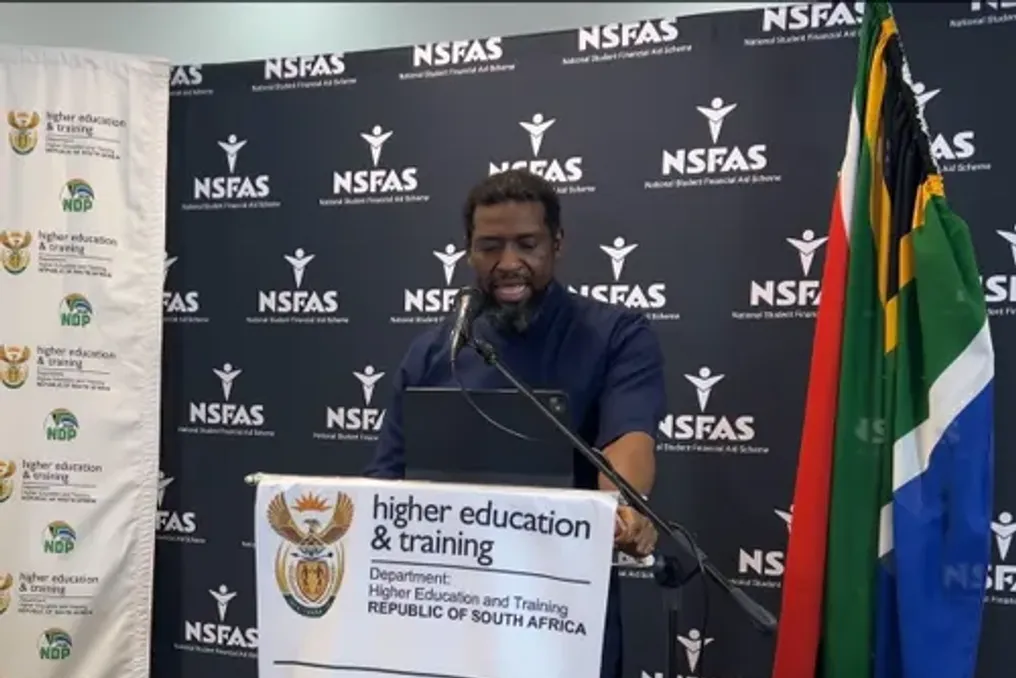
The Minister of Higher Education and Training, Boitumelo Manamela, officially opened the application process for NSFAS funding for the 2027 academic year in Parktown, Johannesburg, on Friday. The National Student Financial Aid Scheme (NSFAS) has opened submissions for prospective students, who have until October 31, 2026, to submit their applications.
Manamela announced the opening of the funding cycle in Parktown, Johannesburg, on Friday, clarifying that successful applicants are expected to receive funding information in December. This measure aims to give students greater financial certainty before registering at universities and colleges for the 2027 academic year.
Manamela stated: 'I am pleased to announce that the NSFAS application cycle for 2027 is officially open today and will close on October 31, 2026.' He added that 'funding information will be communicated to successful applicants in December, providing greater certainty before registration for the 2027 academic year.'
Modernization of the NSFAS Application System
This launch comes amid efforts by the National Student Financial Aid Scheme to strengthen its systems following a period of institutional upheaval. Manamela reported that NSFAS has exited administration and returned to council-led governance structure after four months of significant transition.
The Minister emphasized: 'Our message today is clear: these interventions have always been aimed at strengthening NSFAS, its stability, governance, efficiency, and ability to perform its most crucial function.' He noted that NSFAS received a record number of applications during the 2026 cycle, which increased pressure on the scheme to improve systems and service delivery.
For 2027, NSFAS is implementing automated document verification, electronic document signatures, and stricter student information checks. Furthermore, student data will be extracted directly from institutional systems in an effort to reduce errors and increase the accuracy of funding decisions. Verification of registration and banking details is being enhanced in collaboration with the Department of Home Affairs.
Manamela concluded that 'these improvements are intended to make the application process simpler, faster, safer, and more responsive to students.'
Appeals System Requires Attention After 'Historical Weaknesses'
NSFAS is also taking steps to address issues with the appeals process, an area Manamela acknowledged suffered from historical shortcomings. The scheme is working to improve communication with students and ensure that appeals are considered according to clearer rules and timelines.
These changes are part of broader efforts to stabilize NSFAS and ensure that students receive funding decisions before the start of the academic year. Manamela stated: 'The stability of NSFAS itself is not the ultimate goal. Behind every application is a young person whose future depends on the effective operation of this organization.' He added that 'our duty is to ensure that NSFAS can fulfill its mandate sustainably, fairly, and effectively.'
Strengthening Credit System for the 'Middle Ground'
Meanwhile, the government is expanding its focus beyond traditional NSFAS scholarships. Manamela reported that work has begun on a Credit Management System for students who fall into the so-called 'middle ground.' These are students whose household income exceeds the threshold for NSFAS scholarships, but whose families still cannot afford tuition, accommodation, learning materials, and other higher education expenses.
'We cannot ignore these students,' said Manamela. 'A young person should not be excluded from the opportunity to study just because their household income slightly exceeds the scholarship threshold, even if they still cannot cover the actual cost of education.'
The government is strengthening the credit system for the middle ground as an additional source of funding for eligible students who do not qualify for NSFAS scholarships. Unlike scholarships, these loans are subject to repayment under applicable terms.
Call to Students Not to Wait Until the Deadline
Manamela strongly urged prospective students to apply as early as possible rather than delaying until the last days of the application period. He advised: 'To all potential applicants: do not wait until the deadline. Apply as early as possible.' He explained that early application allows time for information verification, submission of missing documents, and seeking assistance if difficulties arise.
NSFAS will also deploy outreach teams to provinces, districts, rural areas, settlements, and marginalized communities to help prospective students obtain information and support with applications. The Ministry stated it would work with schools, provincial departments of education, civil society stakeholders, and institutions to reach applicants who may find it difficult to access student funding information.
Manamela also warned applicants that receiving NSFAS funding does not automatically guarantee a place in a university or TVET college. He stressed: 'Applying to NSFAS does not guarantee access to your chosen field of study. You must also apply to the institutions, as having the right to funding alone will not secure a place in the desired qualification.'
Meanwhile, the application deadline for the 2027 academic year at public TVET colleges is September 30, 2026. Manamela urged prospective students to apply separately for admission and for NSFAS funding if financial aid is required. He concluded: 'Admission and funding are two important steps in planning your educational journey.'