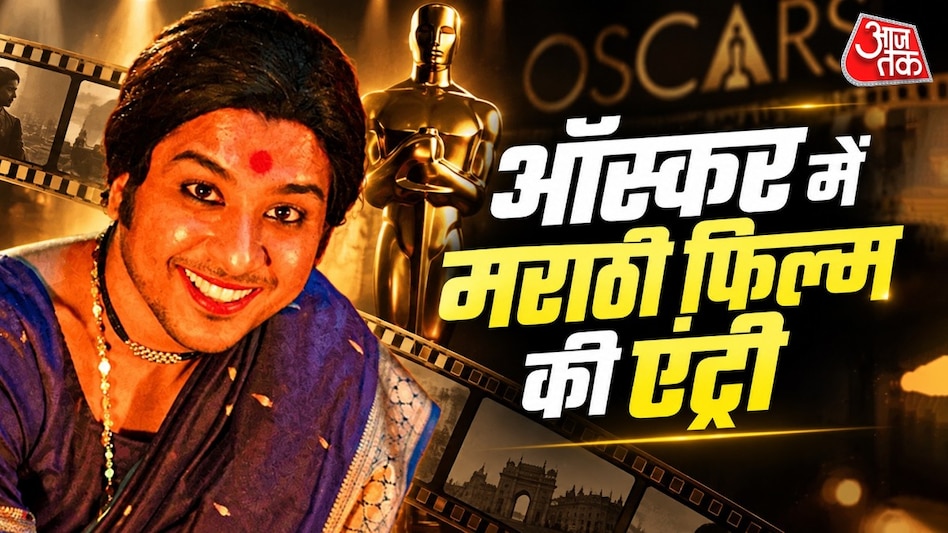
Marathi film 'Gondhal' becomes official representative of India at the 99th Academy Awards ceremony
Read more
Aaj Tak
www.aajtak.in

Marathi film 'Gondhal' becomes official representative of India at the 99th Academy Awards ceremony

According to an announcement made in Mumbai on Friday, September 18, the Marathi film 'Gondhal' has been selected as the official representative of India for the 99th Academy Awards ceremony. The jury of the Film Federation of India (FFI) chose the film by Santosh Davkhare from over 30 competing films.

The announcement was attended by FFI President Abhay Sinha, Secretary Dharmendra Mehra, Treasurer Sangram Shirke, Trustee TP Agrawal, Vice-President Hirachand, Nishant Ujwal, and Chairman Sheshadri.

The head of the selection committee, which consisted of 14 members, was the film director Sheshadri himself. The committee included figures such as actor-director-producer Vijay Patkar, actor-director Hithu Konodia, cinematographer Sanjib Parasar, dance master Shant Kumar, director Narsimha Nandi, screenwriter-director Sanjay Patil, editor VDJ Sabu Joseph, director Anil Thomas, director Vasant, actor-producer Vivek Vaswani, actress Tanishtha Chatterjee, costume designer Bijon Dasgupta, and producer Firdausul Hasan.

In an exclusive interview with India Today, producer Firdausul Hasan noted that 'Gondhal' stood out among all other works and surpassed them in every aspect. He emphasized that the film beautifully showcases Indian culture, and its cinematography and music are executed at the highest level. According to Hasan, the jury unanimously decided that this film would represent India at the Academy Awards.

The film 'Gondhal' features Kishore Kadam, Ishita Deshmukh, Yogesh Sohoni, Nishad Boyr, and Anuj Prabhu. Based on the traditional Marathi ritual 'Gondhal', the picture is a multi-hour folk performance that includes music, dance, and mythological plots. The story, which begins as part of a wedding celebration, gradually transforms into a dark drama exploring themes of desire, jealousy, deceit, and hidden bitterness in a village.

This was the first feature film by director Santosh Davkhare. The premiere took place in Goa at the International Film Festival of India, where the film received a Silver Peacock for special jury recognition. Despite the festival success, the commercial run of 'Gondhal' was not as impressive. Released in November 2025, the film showed a slow start at the box office, and trade reports rated its run as average.

The selection of 'Gondhal' is just the first step. Next, the Academy will begin the voting process for international feature films, during which a shortlist of 15 films will first be formed, followed by the determination of five final nominees. The 99th Academy Awards ceremony is scheduled for March 14, 2027.

'Gondhal' becomes the fourth Marathi film officially selected to represent India at the Oscars. Previously, films such as 'Harishchandra Factory' (2009), 'Shwas' (2005), and 'Kort' (2015) participated in the race.

India has not yet won an award in the category of Best International Feature Film, formerly known as Best Foreign Film. Last year, the official representative of India at the Oscars was the film 'Homebound' by Niraj Gaivan (starring Ishaan Khatter, Vishal Jethwa, and Janvi Kapoor), but it failed to make the final list in this category.

Thirty-three films participated in the race for India's official representation at the 99th Academy Awards ceremony, including 'Mai Vaapas Aunga', 'Border 2', and 'Dhurandar'. Other presented works included 'Dug Dug', 'Haq', 'Bhamardo', '120 Bahadur', 'Sing Geetam', 'Tera Mera Naata', 'Ladu', 'Oh My Dog', 'Gondhal', 'Balang Da Boy', 'Deul Band 2', 'Tigi', 'Peddi', 'Irumudi', 'Dorothy', 'Hunta', 'Gandhi Tox', 'Bison Kalamadan', 'Shep Of Momo', 'Governor', '2020 Delhi', 'Commando Vin Love Story', 'Ikkis', 'Pravas', 'Man Atale Manatle', 'Obsess', 'Equa', 'Ang', and 'Hanuman Ansh'. Sources also confirmed that 'Ikkis' and 'Ang' were among the top three films chosen by the jury.

Similar stories

Film 'Bedari' banned in Pakistan due to similarity with Indian film 'Jagriti'
Read more
www.aajtak.in

Film 'Bedari' banned in Pakistan due to similarity with Indian film 'Jagriti'

In 1956, the film 'Bedari' was screened in Pakistani cinemas. It achieved enormous success, filling all halls. This film, directed by Rafiq Rizvi and starring Ragini and Santosh Kumar, became a blockbuster thanks to its songs, especially the song 'Ao Bachcho Seir Karen Tumko' performed by Salim Razi. The song became extremely popular among children across Pakistan.

However, the film was soon banned. Some viewers felt a strange sensation, as if they had seen this film before, and discovered that not only the plot but also the melodies of the songs were familiar to them. It soon turned out that 'Bedari' was an exact copy of the Indian film 'Jagriti', released in 1954, and 'Jagriti' itself was a remake of the Bengali film 'Parivartan'.

The most interesting connection in this story relates to Ratan Kumar. His real name was Syed Nazir Ali Rizvi, and he was considered a popular child actor in the Bombay film industry. Born in 1941, he began performing at the age of just five. Family friends and writer Krishna Chander gave him the role of a child actor in the film 'Rakh'. After this, Ratan Kumar worked in several famous films, such as 'Boot Polish' and 'Baiju Bawra', before getting the role of Shakti in Satyen Bose's film 'Jagriti'.

When 'Jagriti' was released in 1954, Ratan Kumar was about 13 years old. Two years later, in 1956, he moved to Pakistan with his family. Many relatives of his family had already settled in Pakistan after the partition. Limited job opportunities in India also contributed to the family's decision to move to Pakistan.

After arriving in Pakistan, Ratan Kumar's elder brother, Wazir Ali Rizvi, founded a production company called 'Hayat'. The first film of this company was 'Bedari', and it was here that the story took an unexpected turn. The film 'Jagriti', in which Ratan Kumar himself acted, was recreated in Pakistan under a new title and in a new context.

'Bedari' featured Ratan Kumar in two roles. He played Ajay, whose name was changed to Jaffar in the Pakistani film. Furthermore, the character Shakti from 'Jagriti' was renamed Sabar Ali. Notably, despite the change in names, the essence of the characters was preserved: both Ajay and Jaffar mean 'victory' in Hindi and Urdu, respectively.

However, the similarity between the two films was not limited to the plot and characters. The most striking similarity was in the songs. In 'Bedari', the original melodies and harmonies were largely retained, but the lyrics were altered. Instead of Indian nationalist references, Pakistani nationalist motifs were added.

For instance, the famous song from 'Jagriti' sounded like: 'Ao Bachcho Tumhen Dikhaen Janki Hindustan Ki'. In 'Bedari', this song was changed to 'Ao Bachcho Seir Karen Tumko Pakistan Ki'. Similarly, where the original featured 'Vande Mataram', 'Bedari' used 'Pakistan Zindabad'.

Another song from 'Jagriti' contained the lines: 'De Di Hme Azadi Bina Kadg Bina Dhaal, Sabarmati Ke Sant Tune Kar Diya Kamal'. In 'Bedari', these lines were replaced with 'De Di Hme Azadi Ki Duniya Hui Haran, Ai Kaide-Azm Tera Ehsan Ha Ehsan'. Thus, instead of Mahatma Gandhi, Muhammad Ali Jinnah appeared.

This process was not limited to a couple of songs; in many songs of the film, the original melodies were preserved while the lyrics were changed, replacing the Indian context with a Pakistani one. How was the truth about 'Bedari' revealed?

Initially, the similarity between the two films might have gone unnoticed because there was a ban on the public screening of Indian films in Pakistan at the time. Consequently, most of the Pakistani audience could not see 'Jagriti'. Later, a member of the Pakistani censorship board informed Donna about this situation, noting that Lahore filmmakers created 'Bedari' in 1956, which was a carbon copy of 'Jagriti' in terms of plot and songs, utilizing the ban on the import and public screening of Indian films.

Initially, 'Bedari' enjoyed great commercial success in cinemas. However, after some time, viewers began to realize its true nature, understanding that the film they were watching bore a resemblance to a previously existing Indian film in terms of plot and melodies. Following this, protests against its public screening began, and the situation escalated to the point where the Pakistani censorship board immediately banned 'Bedari' and restricted the screening of its songs.

Did this affect Ratan Kumar's career? For a long time, there have been speculations that after moving to Pakistan, Ratan Kumar sought to establish himself in the local film industry, and perhaps that is why he participated in creating a film similar to 'Jagriti' in a new form. Nevertheless, Ratan Kumar, being a very popular child actor, could not achieve the same level of success as a leading adult actor.

Mahabharata: The Curse Allegedly Affecting Women in Kali Yuga According to Legends
Read more
www.aajtak.in

Mahabharata: The Curse Allegedly Affecting Women in Kali Yuga According to Legends

You may have heard jokes about women, but there is an ancient mythological story that explains this concept. According to legend, women were once cursed so that they could not keep secrets. However, the question arises: did such a curse exist? And why was it directed specifically at women? And if it didn't exist, how did this story and perception persist for centuries?

Perhaps the roots of what we perceive today as a joke lie in a very important episode of the Mahabharata. This story is connected to a secret that was revealed after the Mahabharata war and changed the world of the five Pandavas. It was a secret that their mother, Kunti, kept to herself her entire life. When Yudhishthira learned about this secret, his anger and remorse intensified so much that he cursed women. It is said that it is because of this curse that women still cannot keep their secrets.

Imagine this situation: you find out that a person you considered your greatest enemy, with whom you waged war and whose death became your responsibility, is actually your own elder brother. What would you feel then? Something similar happened to the Pandavas. Karna, whom they considered a rival all their lives, turned out to be their elder brother. But the truth came out too late.

Who was Karna?

Karna was Duryodhana's closest friend and fought on the Kaurava side during the Mahabharata war. He was an outstanding warrior, but due to his background, he suffered humiliation his whole life, often being called the son of a charioteer. But how did Karna's story reach such a scale?

The conflict between the Kauravas and the Pandavas over the throne of Hastinapura constantly escalated. Duryodhana never intended to give up their right to the Pandavas under any circumstances. Then came the game of Chaupar, which changed everything. In this game, full of deceit and cunning, the Pandavas lost their kingdom, wealth, and even Draupadi. In a public assembly, Draupadi was humiliated, and from that moment, the enmity between the two sides grew so much that the Mahabharata war eventually began. The brutal battle continued for 18 days in Kurukshetra, and countless warriors died. In the end, the Pandavas won, but the price of this victory cost the entire Kuru clan.

The Secret Revealed After Karna's Death

On the seventeenth day of the war, Karna fell at the hands of Arjuna. Duryodhana was devastated by the news of the death of his dearest friend, Karna. Meanwhile, when Kunti learned of Karna's death, she could not restrain herself. She came to the battlefield of Kurukshetra to Karna's body, weeping. Her tears hid not only the grief over the loss of a great warrior but also a mother's pain. At that moment, all five Pandavas and Shri Krishna arrived there. Everyone was stunned. There was one question in their minds: why was Kunti's mother grieving so much over the death of Karna, whom they considered their greatest enemy?

They had no idea that in the next moment, the truth that would change their entire world would be revealed.

Karna was the Elder Brother of the Pandavas

Regarding the matter of children, Kunti informed them that Karna was none other than her own son and the elder brother of all five Pandavas. Hearing this truth, the ground fell out from under the Pandavas. They themselves were responsible for the death of the brother against whom they had waged war. Everyone present froze, and regret filled the hearts of the Pandavas. Yudhishthira asked his mother why she had hidden such a big thing from them until now. What was the reason she kept this secret her whole life? Kunti had no answer at that moment except remorse and tears.

Before the war, Kunti and Karna also met in an emotional setting. Kunti did not want her sons to fight each other. Therefore, she approached Karna and told him that he was her son. This shocked Karna. The mother he had searched for his whole life suddenly stood before him. Kunti asked Karna to support the Pandavas. However, Karna replied to his mother that although she gave birth to him, Radha and Adhiratha raised him. Since the whole world humiliated him, Duryodhana gave him respect. Therefore, he could not refuse to support the war. Karna did not change his decision to fight against the Pandavas.

Why Did Yudhishthira Curse Women?

This is why Kunti's grief after Karna's death intensified. When this truth became known to the Pandavas, Yudhishthira's anger and remorse reached a peak. He was upset that if he had known about Karna's birth secret earlier, circumstances might have turned out differently. According to the story, in this anger, Yudhishthira cursed the entire female race along with his mother Kunti. It is said that Yudhishthira declared that women would no longer be able to completely hide any thoughts in their hearts.

National Film Awards to be held in Gujarat after 72 years; director questions regional choice
Read more
www.aajtak.in

National Film Awards to be held in Gujarat after 72 years; director questions regional choice

A tradition spanning 72 years is being broken: the National Film Awards this year will take place not in Delhi, but in Kevadia, Gujarat state. This government decision has drawn criticism from filmmakers, particularly director Rahul Dholakia.

Rahul Dholakia expressed doubt regarding the selection of Gujarat, suggesting that if the decision was made to move the ceremony outside of Delhi, states or cities that have made significant contributions to Indian cinema could have been considered. He named regions such as Maharashtra, Kerala, Tamil Nadu, and Hyderabad.

On Tuesday morning, Rahul Dholakia posted his thoughts on his X account, noting that it was not essential for him for the awards to be held in Delhi. However, he questioned the reasons for choosing Gujarat specifically for the relocation of the event. The filmmaker emphasized that when breaking a long-standing tradition, the right to receive this award should go to the regions that have made substantial contributions to the film industry.

He directly asked why Maharashtra, Kerala, and Tamil Nadu, as well as the city of Hyderabad, were not taken into account. Dholakia, who himself is a recipient of the National Film Award, received the award for Best Director in 2007 for the film 'Parjania,' which is based on the events of the 2002 riots in Gujarat. Furthermore, his 2017 film 'Rais,' starring Shah Rukh Khan, was also shot against the backdrop of Gujarat.

Despite not denying the importance of Gujarati cinema, Dholakia noted that the major center of the film industry in Gujarat has historically been located in cities like Ahmedabad, whereas the ceremony is scheduled for Kevadia. At the same time, he reminded that Mumbai and Pune in Maharashtra have served as a strong foundation for Hindi and Marathi cinema for decades, Chennai as the center of Tamil cinema, and Hyderabad as a major hub for Telugu cinema.

The main feature of this year is that for the first time in 72 years, the ceremony will be held outside of Delhi. The first National Film Awards were held at Vidyan Bhavan in Delhi in 1954, and most subsequent events were also held there. Now, a significant change is occurring in this tradition.

The ceremony will take place in Kevadia, Gujarat, also known as Ekta Nagar, where the world's tallest statue—the Statue of Unity—is located. This 597-foot statue of Sardar Vallabhbhai Patel was inaugurated by Prime Minister Narendra Modi in 2018.

The 72nd National Film Awards ceremony is scheduled for September 22 in Kevadia, where the President Draupadi Murmu will present the awards. The list of winners also caused widespread discussion: the film 'Article 370' received the award for Best Feature Film, and lead actress Yami Gautam was recognized as Best Actress. The Best Actor award was jointly given to Malayalam superstar Mammootty for 'Brahmagyam' and Kartik Aaryan for 'Chandu Champion.' Randeep Hudda received the award for Best Debut Director for 'Swatantrya Vir Savarkar,' and the Telugu film Naga Ashwin's 'Kalki 2898 AD' will be recognized for Best Popular Film, providing comprehensive entertainment. The Tamil film 'Captain Miller,' featuring Dhanush, was chosen as Best Feature Film promoting national, social, and environmental values.

Thus, the relocation of the National Film Awards ceremony from Delhi to Gujarat has sparked a new debate: if the tradition is changing after 72 years, shouldn't a region with rich historical contributions to cinema have been chosen?

Popular