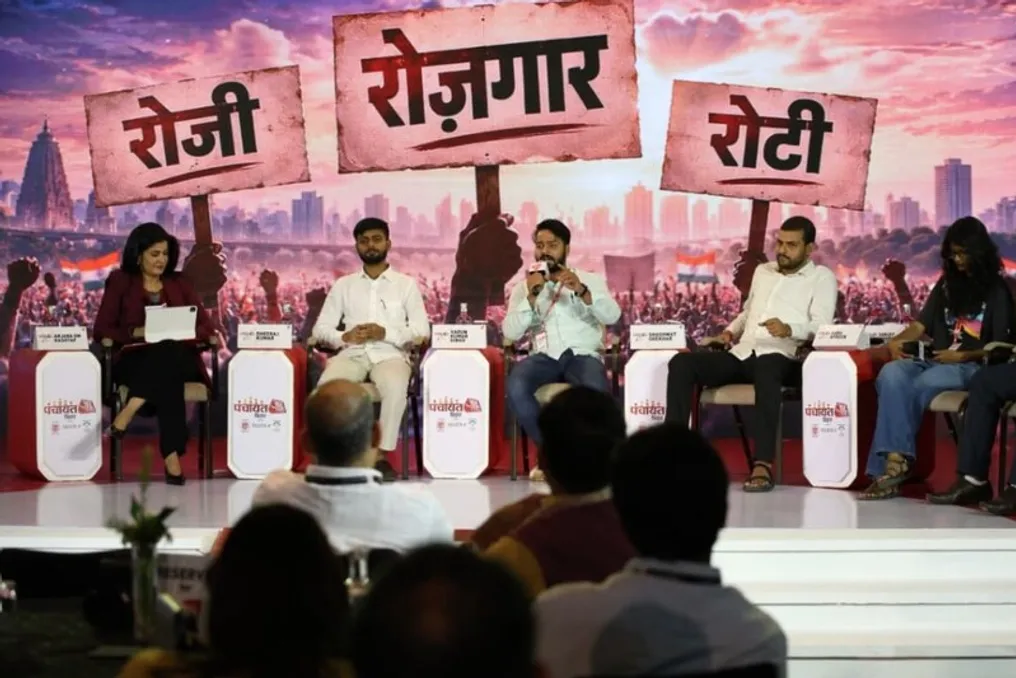
During the special session 'Bihar Panchayat Aajtak,' active debates took place between student leaders from Bihar and across the country concerning the pressing issues of 'income, earnings, and employment.' Representatives from key student organizations, both those aligned with the ruling NDA and the opposition, participated in this significant discussion. The event featured intense arguments regarding leaks of examination materials, the use of batons against students, campus safety concerns, and development claims.
Participants in the discussion included Diraj Kumar, regional president of JD(U)'s student wing; Saba Afrin, Vice President of AISA for Bihar; Varun Kumar Singh, leader of the BJP's youth wing; and Shashwat Shekhar from NSUI.
Opening the session, Diraj Kumar, the regional president of Chhatra JDU, defended the government's work. He emphasized that basic state infrastructure is primarily necessary to ensure employment. Diraj Kumar noted that when discussing employment, one should recall the period 20 years ago when infrastructure was virtually non-existent. He stated that the government first strengthened core systems such as roads, electricity, and security, and initiatives like Jeevika became the most successful example in providing livelihoods.
From the opposition side, Saba Afrin, Vice President of AISA for Bihar, leveled direct accusations against the central and state governments for undermining the future of students. She argued that over the last decade, instead of providing education and jobs for the youth, the government has only engaged in spreading hate speech. Saba Afrin stated that today's youth fully understands how education is being commercialized and how jobs are being taken away from them, forcing students to take to the streets demanding their rights.
Responding to AISA's allegations, Varun Singh, representative of Bharatiya Janata Yuva Morcha (BJYM), presented a report on the work of the central and state governments. He claimed that the opposition merely seeks to sow polarization and unrest on campuses. Varun noted that the Modi government at the center has made historic changes in education: 14,500 schools were opened under the PM Shri scheme, and Patna University received 160 million rupees under the PM-USHA scheme. He added that new academic blocks and modern hostels are being built at the university, and only the BJP is realizing the vision of a developed India by 2047.
NSUI leader Shashwat Shekhar sharply criticized the government regarding job and exam fraud. He raised issues about administrative conduct towards students from Patna to Siwan and Ranchi. Shashwat pointed out that when a fraud case surfaced in Uttarakhand, relevant leaders resigned, whereas the ruling party evades responsibility in similar matters. He questioned the administrative approach to students protesting in Gardanibagh and the uncertainty surrounding examinations in Bihar. Shashwat stated that due to irregularities in Bihar, the 30 million youth population is at risk because candidates are being disqualified due to irregularity. He also mentioned that exam controllers use disrespectful language towards students, and when students assert their rights, they face lawsuits.
Meanwhile, Diraj Kumar from Chhatra JDU clarified that his government or organization never supports the use of batons or police measures against students. He explained that delays in degree issuance are an old systemic problem that the organization intends to resolve through meetings with the Education Minister and demanding a timely system.
Harshvardhan, a representative of Akhil Bharatiya Vidyarthi Parishad (ABVP), supported the students' struggle, stating that ABVP has always acted in the best interest of students. He mentioned the NEET case, noting that ABVP was the first to protest it. Harshvardhan stressed that the share of government jobs in the country's total employment is only 2–3 percent, so students should not limit themselves to traditional degrees but learn new options such as skill development, MBA, finance, and startups. Speaking about future solutions, Harshvardhan noted that youth should move towards skill development and innovation rather than relying solely on government service. He also reported that India has become the third-largest startup ecosystem in the world, with over 51% of these startups emerging in small towns (Tier-2 and Tier-3 level).
AISA student objected to Harshvardhan's claims, stating that most ordinary students in Bihar cannot afford to study at large private institutions at high costs. She demanded that the government publish a regular examination calendar, ensure transparency, and issue degrees on time.
Questions regarding the current status of Patna University and campus safety were deeply addressed during the debates.