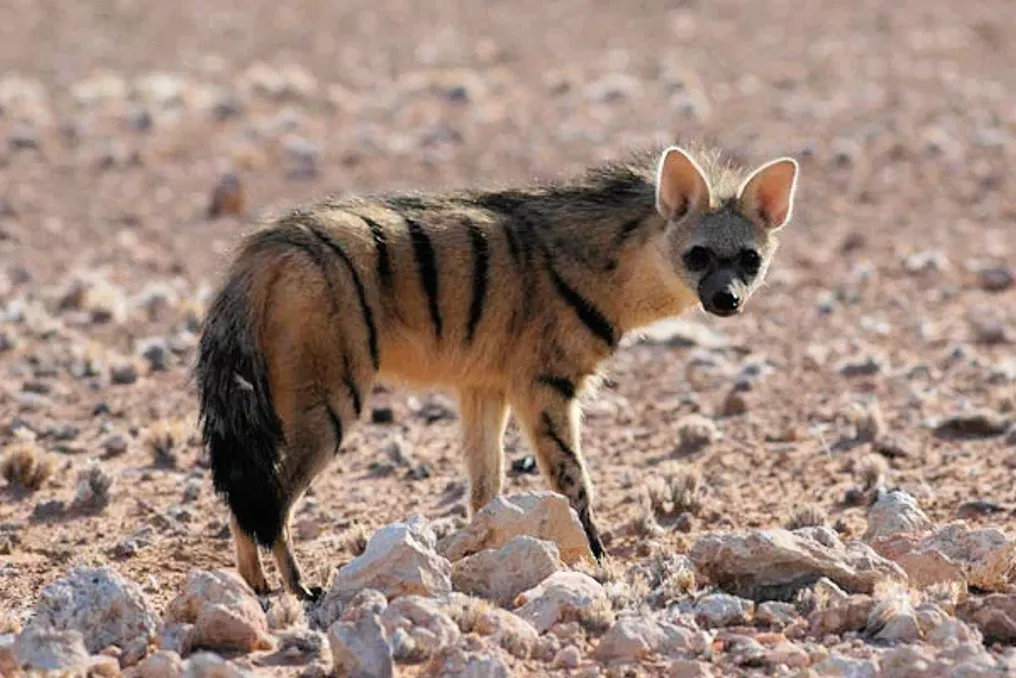
The aardwolf, which externally resembles a hyena, feeds on termites and can be one of the most specialized predators on the grasslands of South Africa. This species is one of Africa's unusual carnivores, yet it often goes unnoticed compared to lions, leopards, cheetahs, and larger hyena relatives.
At a quick glance, the slender striped animal can easily be mistaken for a small hyena, but a detailed study of its lifestyle reveals a completely different picture. Although aardwolves belong to the hyena family, they have undergone a very peculiar evolutionary path. Unlike spotted and brown hyenas, which are capable of hunting meat, carrion, and bones, the aardwolf's diet is almost entirely focused on termites.
The scientific name of the aardwolf, Proteles cristata, reflects its distinctive features: a long snout, large ears, a sloping back, and a mane along the neck and back. Its striped coat provides camouflage among shrubs and grass, and its front paws are equipped with strong claws suitable for digging.
The most striking adaptation of the aardwolf is its mouth. Compared to other hyenas, it has reduced cheek teeth because it does not require heavy dental equipment for tearing flesh or crushing bones. Its jaws and teeth indicate a completely different way of life: instead of hunting large prey, it uses a long, sticky tongue to collect termites, particularly termite gatherers.
In one night, an aardwolf can eat thousands of termites, while usually avoiding the complete destruction of the colony, thus preserving a food source for future feedings. This extreme dietary specialization has allowed the aardwolf to occupy a niche with much less competition from large African predators.
To understand the aardwolf, one must stop viewing termites merely as an element of the menu. Termites play an important role in savanna and grassland ecosystems. Their colonies influence soil structure and nutrient cycling, and their activity interacts with vegetation and a wide range of other organisms. They themselves are part of a larger food web, supporting reptiles, birds, mammals, and other predators.
The aardwolf occupies its place in this web as a highly specialized termite consumer. This means that its story concerns not only one strangely-looking predator but also serves as a reminder that ecosystems consist of countless interconnected relationships that are easily overlooked. Soil supports plants, plants support insects, and insects support animals like aardwolves. A change in one part of this system can cause consequences far more extensive than expected.
Aardwolves are closely associated with open biotopes, including savannas and grasslands. In South Africa, their range covers parts of the Free State, Eastern Cape, Northern Cape, and other suitable areas. The species' dependence on these landscapes gives it an interesting place in conservation discussions.
South African grasslands face pressure from agriculture, urbanization, habitat fragmentation, and changes in land management. Fire and livestock grazing are natural and important processes in many grassland systems, but changing their frequency, timing, or intensity can alter vegetation and the broader ecological community.
For such a specialized animal as the aardwolf, habitat preservation means maintaining the ecological conditions necessary for its food base. This does not mean that every aardwolf population automatically indicates the health of the grasslands; rather, the species offers an interesting insight into what happens when highly specialized animals depend on increasingly altered landscapes.
There is something refreshing about the aardwolf's version of predation. Its advantage lies in doing one thing exceptionally well. This is an important lesson for conservation efforts. Wildlife protection is often associated with charismatic megafauna, but functioning ecosystems also depend on smaller, strange, and lesser-known species. Aardwolves demonstrate how evolution can create an animal perfectly adapted to a very specific resource.
The existence of the aardwolf also challenges the notion that predators must be formidable hunters. Predation can take many forms. Sometimes it looks like a leopard creeping through the forest. Sometimes it is a slender striped hyena quietly moving through the grass after dark, feeding on termites.
For wildlife enthusiasts, observing the aardwolf can be a completely different experience than ticking off a 'Big Five' list. These animals are predominantly nocturnal, so finding them requires patience and some luck. Potential search locations include the Kgalagadi Transfrontier Park National Park, the Mountain Zebra National Park, the Karoo National Park, and the Mokala National Park, as well as suitable private reserves and protected areas throughout the grassland and savanna region of South Africa. It is recommended to check information regarding accessibility and sightings at the relevant park or reserve before traveling.