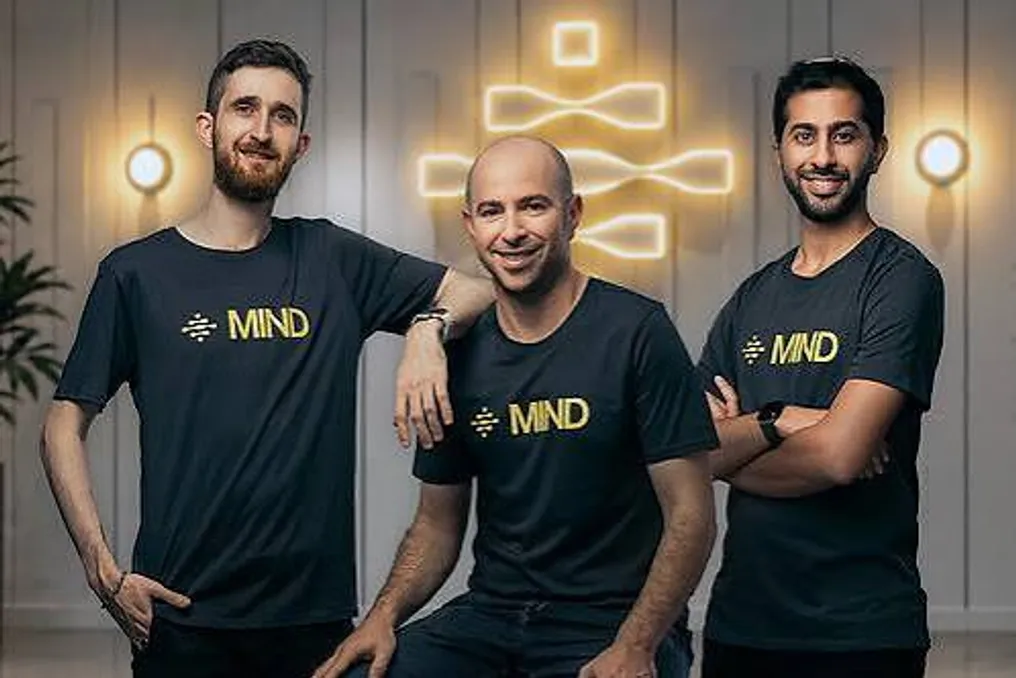
MIND raises $72 million to create an AI-era data leak prevention system
Read more
Ventureburn
ventureburn.com

MIND raises $72 million to create an AI-era data leak prevention system

As companies increasingly utilize artificial intelligence tools such as ChatGPT and internal AI agents capable of independently reading and moving data, a serious problem has emerged: sensitive files can be lost in mere seconds. To address this issue, the company MIND has raised $72 million to develop the first Data Loss Prevention (DLP) platform specifically designed for AI operations.

The Data Loss Prevention (DLP) system has existed for over twenty years. Although early DLP tools functioned, they are inadequate for the modern pace of AI development. Currently, employees upload confidential documents to generative AI tools, and AI agents can scan the entire network, collect customer data, and send it to external vendors without manual approval at every stage.

A study conducted by MIND this year showed that 65 percent of enterprises are uncertain about controlling the data used to train their AI systems.

MIND's AI DLP platform secured $72 million in a Series B funding round. Crosspoint Capital Partners led this round, with participation from existing investors YL Ventures and Paladin Capital Group. This brings the company's total funding to $112 million.

The company was founded in 2023 by individuals such as Eran Barak, Itai Schwarz, and Hod Bin Noon. The team consists of veterans from Israel's cyber unit Unit 8200. The startup is headquartered in Seattle, with development taking place in Tel Aviv. MIND positions its platform as a system that automates DLP and insider risk management using multi-level classification that analyzes both content and context, rather than relying solely on static rules.

The use of AI-based DLP agents is a relatively new concept. These agents autonomously perform daily tasks of the DLP program. They are capable of creating custom classifiers, developing policies, investigating incidents, and configuring rules without requiring full manual intervention from security teams. Analysts can interact with these agents in plain language through the Model Context Protocol interface.

The company's growth rate has been significant. Over the past year, MIND reported revenue growth of more than 17 times, and the number of clients increased eightfold. Notable clients include the anime streaming service Sony Crunchyroll and Sungrow Power Supply. The company attributes this growth to securing multi-year contracts worth six figures with large enterprises aiming to safely implement AI.

The $72 million raised will be directed towards accelerating platform development, which includes creating deeper AI management capabilities and expanding coverage for agentic AI. Plans include integrating DLP into a unified platform covering endpoints, SaaS, generative AI, on-premise servers, email, and agentic AI. Furthermore, the funds will be used to enter key corporate markets in the United States, deepen technological and partnership relationships, and scale the team. A significant part of the plan involves doubling the product and R&D team in Israel.

Eran Barak emphasized that security leaders must protect data moving at AI speed using complex, manual, and incomplete tools designed for a slower world. He noted that while the DLP market is vast, it was created for different purposes than AI, and MIND intends to reimagine it with the capital raised.


Similar stories

Kinetix AI raises $75 million angel funding round to develop AI model hardware
Read more
ventureburn.com

Kinetix AI raises $75 million angel funding round to develop AI model hardware

Engineers have long faced a problem: artificial intelligence capable of writing novels in seconds struggles to grasp fragile glass without crushing it. This issue stems from a significant gap between digital intelligence and physical execution.

Bridging this gap requires flawless and continuous feedback between software systems and mechanical bodies. To solve this narrow problem, Kinetix AI has secured $75 million in a major and significant angel funding round, marking a serious step forward in embodied intelligence.

The historic funding round was led by Vertex Ventures, the powerful venture arm of Singapore's Temasek Holdings. F&G Venture and Wanshi Capital also joined the round to invest over 500 million RMB (approximately $75 million) in the early-stage startup, Kinetix AI.

Kinetix AI is not a small garage project. Founded in September 2025, the company has rapidly grown to nearly 200 employees. Driving Kinetix AI's rapid growth is CEO Yu Ze, who previously commercialized autonomous mining trucks for Huawei.

The team also includes Luo Ping, an outstanding deputy dean from HKU, and Zheng Qunyuan, former head of robotics at XPeng. This group possesses deep knowledge combining academic theory, autonomous vehicle logic, and manufacturing capabilities.

Many robotics companies cut corners on quality, but Kinetix does not accept this. The company firmly believes that since the world's infrastructure is built for humans, robots must look and move exactly like us to integrate seamlessly.

Their flagship creation, KAIBot, stands 1.73 meters tall and boasts an impressive 115 degrees of freedom. It is distinguished by its high quality and ultra-realism. Although creating such a robot requires significantly higher initial costs, and the supply chain is a nightmare, co-founder Zheng Qunyuan argues that starting with cheap, low-quality equipment is simply foolish. By locking down a true human form factor, they ensure their AI models will not fail as soon as any joint is updated.

Imagine a robot that doesn't just mimic the human silhouette but perfectly matches human motion data. When the hardware directly reflects our biology, algorithmic work transfers effortlessly.

The core magic happens thanks to the attracted capital, which is directed towards accelerating their closed ecosystem. This can be visualized as a three-headed monster. First, it involves collecting multimodal, egocentric data. Then, this raw data is fed directly into the native fundamental model embodied in the body. Finally, hardware such as KAIBot and the highly maneuverable KAI Hand physically executes the learned actions.

This continuous loop creates an 'intelligence flywheel.' As the robot collects sensory data from the real world, the AI model becomes smarter, instantly enhancing the capabilities of the physical hardware. There is no longer a need to rebuild the physical machine with every software update.

The system's dynamism was demonstrated at the 2026 World Games for Human Robotics, where their system played table tennis against world champion Ding Ning. The goal is to create a premium class of robots ready for complex real-world tasks.

Cognition raises $2 billion with a $48 billion valuation to develop AI coding company
Read more
ventureburn.com

Cognition raises $2 billion with a $48 billion valuation to develop AI coding company

Amid growing demand for software and a shortage of engineers who hinder teams from completing features, fixing vulnerabilities, and updating systems, Cognition has introduced a solution based on AI coding tools. The core idea is to allow engineers to act as architects while artificial intelligence agents perform the actual coding, testing, and deployment.

Cognition AI successfully raised $2 billion in a Series E round. The round was led by new investors Andreessen Horowitz and Accel, with participation from existing partners including Founders Fund, General Catalyst, and Avenir.

Cognition's annual revenue increased from $492 million in May to nearly $900 million currently. The startup has developed Devin—an autonomous software development agent capable of planning, writing, testing, and deploying code with minimal human involvement.

Devin differs from simple code auto-completion tools like Copilot because it operates based on high-level requirements. The user only needs to give a command, such as 'fix this bug' or 'create this function.' Devin independently determines the necessary steps, writes the code, verifies it, resolves any shortcomings, and then deploys it to a secure test environment.

Recent feature additions include Devin Auto-Triage for analyzing production incidents, Devin Security Swarm for finding code vulnerabilities, and Devin Automations, which runs agent tasks via Slack, GitHub, and Linear.

Large corporations are already using the product. Cognition's clients include Nvidia for chip design, GE Aerospace in the aviation industry, Citi in financial services, Mercedes-Benz in the automotive industry, and Goldman Sachs. Since the system is not tied to one AI company, it can select the most suitable AI 'brain' for a specific task, whether it be OpenAI, Anthropic, or Cognition's own development. Engineers focus on design and verification, while agents handle execution.

Scaling AI coding requires significant expenditure, as Cognition leases a large number of Nvidia chips, costing them hundreds of millions of dollars annually. Experts predict that the company's expenses could reach $800 million just in 2026. To address this, Cognition is training its own model based on open-source alternatives, aiming to reduce dependence on expensive third-party models and approach the break-even point.

The company is also expanding Devin's capabilities and entering new markets. Annual revenue is expected to reach $4–5 billion by the end of 2026. The growing demand for software is driven by AI development: every company needs AI features, but implementing them requires code, creating a closed loop where AI needs more software, and software needs more AI for writing. Cognition is betting that this cycle is so massive that it can support several $50 billion companies.

CEO Scott Wu's vision is for engineers to transform into AI agent managers. Instead of writing every line of code, they will focus on verifying, directing, and approving it. If this model proves successful, the potential for software creation globally could multiply, allowing for faster security fixes and launching startups in weeks instead of months.

Having reached a $48 billion valuation, Cognition has become another giant in AI coding. Four months ago, its valuation was $26 billion, and it could grow even more by next year. Investors are clearly betting that the future of software lies not in one AI, but in many, and that coding will become the first task AI can truly automate at scale.

Popular