At the Asian Games, the Indian team secured a spot in the semi-finals, but the true story of this victory is far more interesting than just the score on the board. In Nisshin (Korogi Sports Park, Nisshin) on Tuesday, Indian spinners created such a complex game that the Japanese batsmen had no chance of scoring runs. As a result, the entire team was brought down to a score of 57 points, and India won with a score of 59 in five overs, taking eight wickets.
India bowled first and chose the bowling option, immediately putting pressure on Japan. The Japanese batsmen had no answer to the Indian bowling. The situation became clear within six overs, which constituted the powerplay. Japan accumulated only 24 points during this period, with only two fours being hit, and one of them came not from hitting the center of the bat, but from touching the periphery.
Advancing to the Semi-finals
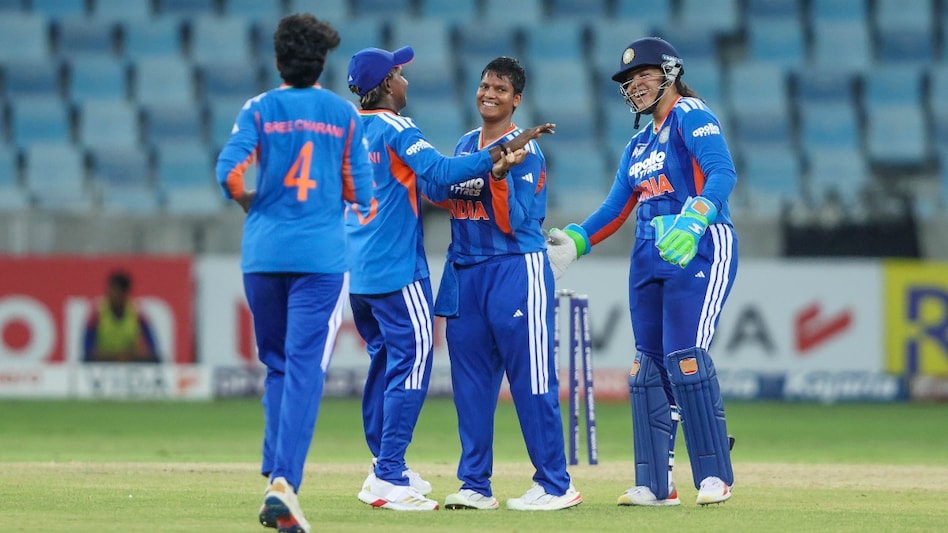
The experienced spin attack of the Indian team completely stifled the Japanese offense. The most significant contribution came from left-arm spinner Shri Charni. In the seventh over, she dismissed two batsmen consecutively: Haruna Iwasaki and captain Mai Yanagidu, which was a serious blow to Japan's hopes. After this, Charni did not allow the Japanese batsmen to play freely and took four wickets, conceding only 10 runs. This was her best performance in the T20 format.
The rotation and bounce of the ball also complicated matters for the Japanese batsmen. The ball either hit the bat or suddenly soared upwards, surprising the players. Under these conditions, attempts to score big often ended in catches.
Shefali also demonstrated spinning mastery
Although the attacking stars appeared later, Shefali Verma also proved to be a strong bowler. Bowling off-spin, she took two wickets, conceding only 13 runs. She forced Ayaka Kato-Stafford and Shimako Kato to try and hit big, and both times the ball fell into the hands of Indian fielders. Japan scored only three fours in the innings, and no sixes were seen. This means that the Indian bowlers almost completely prevented the easy runs that could have been earned through fours and sixes over 20 overs.
Japan missed opportunities even while running
The problems were not only in the bowling. Between wicket falls, the Japanese batsmen also showed a lack of coordination while running, which allowed India to take several outs. For a team with very little experience playing against top teams and regular training, the pressure from the Indian bowling and fielding constantly increased.
India's target of 57 points became a formality
Nevertheless, the start of the Indian innings was also not easy. Gunalan Kamalini was dismissed without scoring any runs. Then Harti Fulmali returned to the bench, scoring only 6 runs. However, the target was so small that it did not significantly affect India.
Shefali's powerful attack
After this, Shefali Verma finished the match within five overs. She scored 40 runs without getting out, using only 15 balls. Her innings included 6 fours and 2 sixes. Thus, Shefali came close to Japan's total score.
Richa Ghosh also helped India reach the target, scoring 12 runs without getting out in just 6 balls. While the Japanese batsmen managed to score only 57 runs in 20 overs, India surpassed this barrier in just 30 balls. This is the essence of this quarter-final: the confrontation between Japan's inexperienced batting and India's experienced spin bowling was one-sided. India has now advanced to the women's cricket semi-finals of the Asian Games.