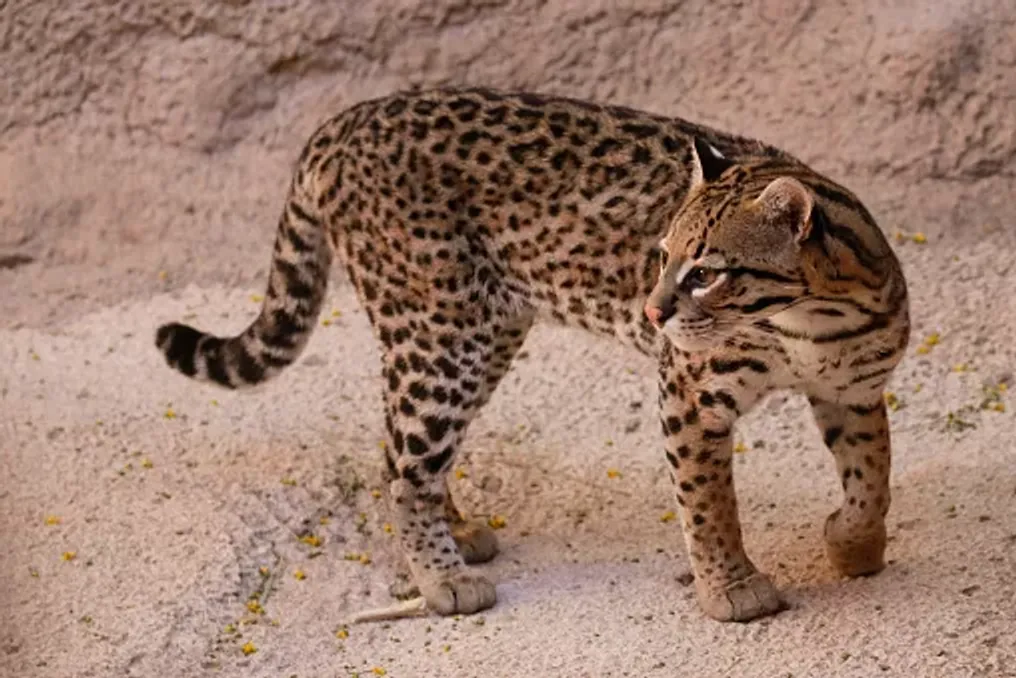
Scientists have identified a small spotted wild cat, found as a kitten near a road in Bolivia, as a new species for science. This occurred more than a hundred years after the last new wild cat species was described.
The cat, named Leopardus tilcayo, was discovered in the Yungas eco-region of Bolivia, on the eastern slopes of the Andes. This species belongs to the world's little-known small cats and weighs only about 1.4 kg.
The discovery was officially presented in a new study published in the journal Current Biology. The work also reveals that what was previously considered one widespread species of tiger cat actually consists of several different species.
The story began in 2016 when Bolivian biologist and National Geographic researcher Paola Nogales-Ascarruns received a call from a wildlife reserve. A local resident found the animal as a kitten on the road near the forest and took it home, believing it was a domestic cat. However, about a year later, he realized the animal was clearly wild and would be better suited for the reserve.
Nogales-Ascarruns, founder of the Bolivian felid research program, visited the animal at the Senda Verde reserve. She immediately noticed that it was unusual. The cat had a small face, short round ears, long whiskers, and a slender body covered with leopard-like spots.
“I took a hundred photos of this animal,” recalled Nogales-Ascarruns. At the time, she thought the mysterious cat was a tiger cat, Leopardus tigrinus, a small spotted predator known by names such as tigrina, onzilla, and small spotted cat.
Several years later, Nogales-Ascarruns began to suspect something was wrong with the animal. In 2019, while preparing a brochure on Bolivian wild cats, she compared her photos with reference images of tiger cats from neighboring Brazil. The differences were striking. The Bolivian cat possessed much larger rosettes than those observed in Brazilian animals.
This observation eventually prompted researchers to study the animal's genetics. Working with geneticist Eduardo Eisirik from the Catholic University of Rio Grande do Sul in Brazil and co-author Jonas Lescart from the University of Antwerp, Nogales-Ascarruns compared the genomic data of 38 individuals of the genus Leopardus. The results showed that the Bolivian cat is genetically distinct from other tiger cats.
Researchers suggest that L. tilcayo diverged from other tiger cat species about 1.4 million years ago, revealing an evolutionary history that cannot be determined solely from photographs. This discovery is significant because it is not just about upgrading the status of a previously recognized subspecies to a species. Instead, Leopardus tilcayo is described as a previously unknown species to science. It is also the first new wild cat species described in over a century; the last new wild cat species was described in 1923—the pamper cat.
The study also changed scientists' understanding of the tiger cat group. What was once considered one extensive species is increasingly proving to be a complex of genetically distinct species. The new research increases the number of recognized tiger cat species to five and provides evidence of a new tiger cat subspecies in Peru. Researchers believe that similar genetic investigations could reveal additional hidden diversity among small wild cats in other parts of the world.
Identifying different species is more than just updating scientific records; it can directly influence conservation decisions. If tiger cats are viewed as one widespread species covering most of Central and South America, their overall population may seem relatively stable. However, if this population is actually divided among several separate species, each species may have a much smaller range and population than previously assumed.
Scientists still do not know how many Tilcayo cats remain in the wild. Currently, it is known that the species is found in the Yungas eco-region of Bolivia, but many basic questions remain unanswered, including what the cats eat, how they reproduce, and what threats they face. The Yungas forests themselves are under pressure from habitat loss, making a better understanding of the newly described cat particularly important.
Small wild cats are notoriously difficult to study. Unlike larger and more recognizable species such as lions and tigers, they are elusive and can be hard to distinguish from closely related cats in the wild. Sometimes even museum specimens are misidentified. Modern genomic analysis gives researchers a new way to uncover these hidden differences, potentially changing our perception of small wild cats worldwide. The scientists involved in the study believe that the same methods could ultimately reveal additional species in Africa and Asia. For Nogales-Ascarruns, this discovery serves as a reminder that there is still so much to learn about the natural world. Even after centuries of scientific inquiry in the Bolivian forest, an unknown wild cat lived in plain sight. And now that scientists know of its existence, the next task is to find out how many Tilcayo cats are left and ensure the protection of their forest habitat.