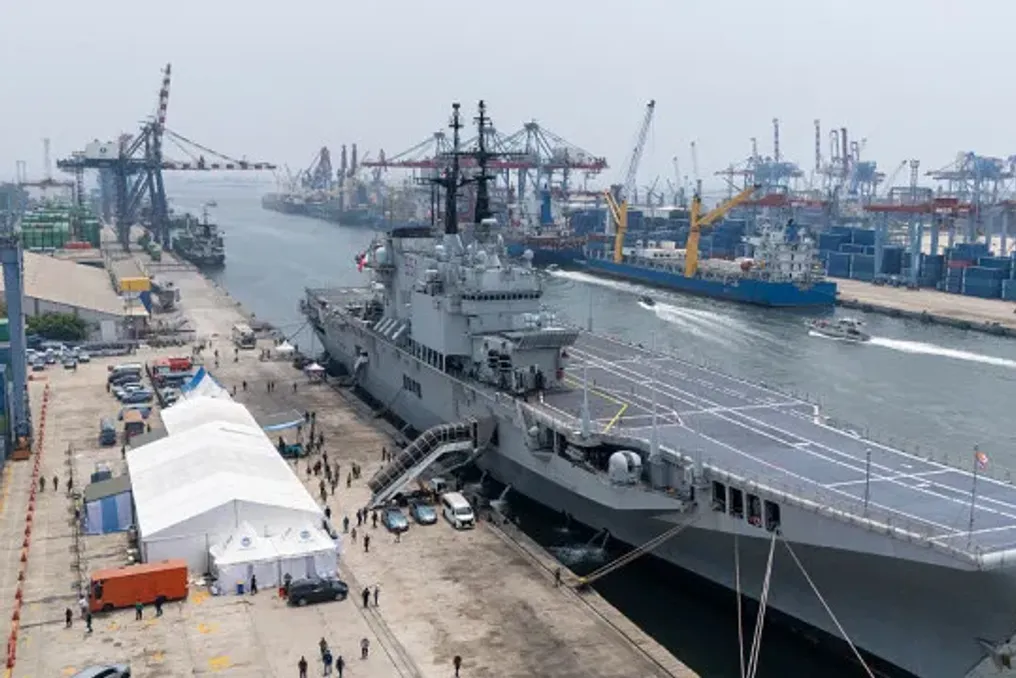
Indonesia has become the second country in Southeast Asia to possess an aircraft carrier. The ship, formerly known as ITS Giuseppe Garibaldi, is 41 years old and capable of operating short take-off and vertical landing aircraft, as well as helicopters. It was received with a military ceremony at the Tanjung Priok naval base, located in the northern port of Jakarta.
In March, Italy agreed to transfer the aircraft carrier to Indonesia, which had been withdrawn from service in 2024. This action is part of an initiative aimed at strengthening defense cooperation between the two nations. Furthermore, Rome seeks to establish agreements for the supply of submarines and aircraft, and the transfer of the ship avoids the costs associated with its dismantling.
After the ceremony, the Indonesian Navy chief, Admiral Muhammad Ali, informed journalists that the intention is to use the vessel mainly in non-war military operations, but it can be activated for combat missions if necessary. According to him, the aircraft carrier can serve for a period of 15 to 20 years and support 14 or more helicopters, depending on its size.
With this, Indonesia achieves the position of the second country in Southeast Asia to operate an aircraft carrier. Thailand has been operating the HTMS Chakri Naruebet since 1997, after acquiring it from Spain along with AV-8S Matador aircraft. He detailed that the ship will be incorporated into the Navy next week under the name KRI Sriwijaya, in honor of the maritime empire of Srivijaya, a kingdom located in Sumatra that was an important naval and commercial power between the 7th and 13th centuries. Previously, the Navy planned to name it KRI Gajah Mada.
Strengthening military capabilities is a priority of President Prabowo Subianto's administration, which advocates for the expansion of the Armed Forces through the acquisition of frigates, combat aircraft, submarines, and missile systems, in addition to deepening military cooperation with various countries.
However, the acquisition of the Garibaldi raised questions about the real need for Indonesia to have an aircraft carrier and about the feasibility of investing hundreds of millions of dollars in the modernization and operation of an already old warship. The Indonesian Ministry of Finance approved funding of 450 million dollars (equivalent to 383 million euros) for this project in 2025. However, some deputies warned that the total cost could be significantly higher. TB Hasanuddin, a member of the Parliamentary Commission I, mentioned that only the adaptation of the ship could cost 16 billion rupiah (766 million euros).
Unlike major naval powers, which use aircraft carriers to project long-range fighters, Indonesia intends to use the ship as a mobile command and support center for helicopters, unmanned aerial vehicles, and maritime operations in the thousands of islands of the archipelago. During a disaster management meeting held earlier this month, Prabowo stated that the vessel will assist authorities in combating forest and peat fires, which frequently cover parts of Southeast Asia with toxic smoke.
Prabowo declared during a video conference that the ship would be renovated and transformed into a helicopter and drone carrier, which would provide great assistance in disaster response. The President also revealed plans to operate drones from the vessel and use it as a mobile platform, ready to be quickly deployed in natural calamity situations, such as monsoon-induced floods, earthquakes, and volcanic activity, which are common events in Indonesia.
This acquisition comes at a time when the largest economy in Southeast Asia faces growing budgetary pressures. Prabowo's government has been funding an ambitious program of free nutritious meals and other expensive initiatives, while economists warn of slowing growth, reduced state revenues, and tightening budgetary restrictions.