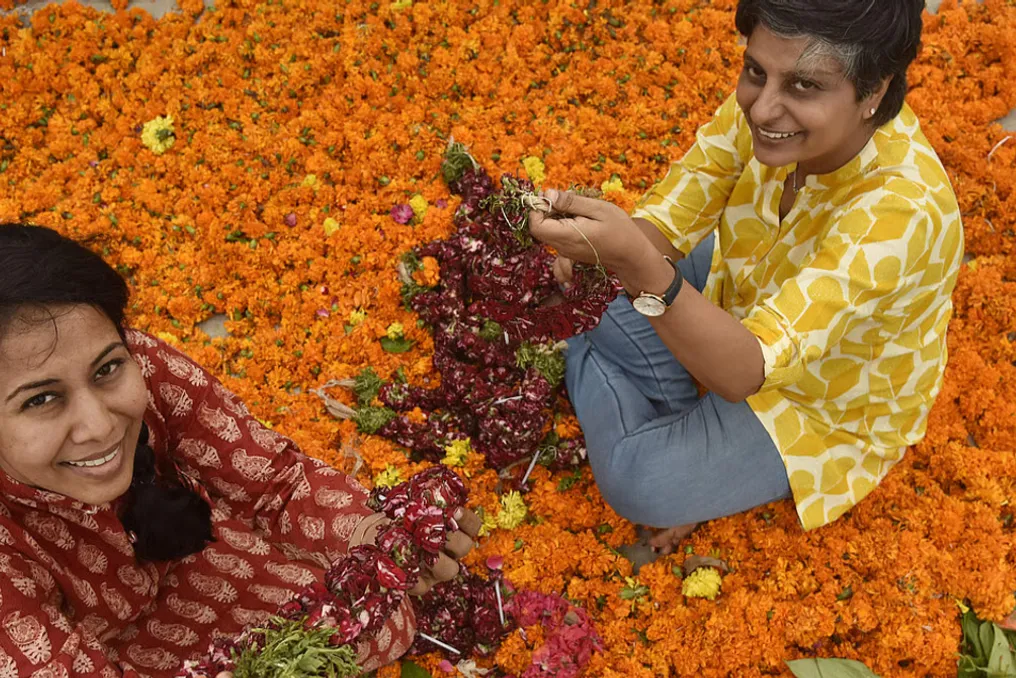
During the festive season in India, flowers play an important role, adorning temples with marigold garlands and being used in offerings of roses and jasmine. However, large volumes of these flowers remain after rituals and celebrations conclude.
For several Indian entrepreneurs, this raised the question of giving a useful second purpose to material that has already participated in a significant ritual. In recent years, startups and small businesses across the country have begun collecting floral waste and transforming it into incense, compost, soap, decorative items, and even new biomaterials. Four such projects are presented, which view flowers not as trash, but as a recyclable resource.
In the city of Kanpur, the idea for the startup Phool arose from the observation of founder Ankita Agarwal: flowers from temples were ending up in the Ganges River. Agarwal, along with Pratik Kumar, founded Phool in 2017, developing an idea he had started studying several years earlier.
The company collects discarded temple flowers and processes them into various products, including incense sticks, cones, and other wellness goods. The company's research also led to the creation of Fleather—a biomaterial derived from floral waste as an alternative to animal leather. Thus, what began as an attempt to solve the problem of floral waste has evolved into a larger experiment in the circular economy, combining waste collection, product development, and livelihood provision.
For Maya Vivek and Minal Dalmi, the idea originated from the realization that a structured approach to disposing of discarded flowers was needed in Hyderabad. Both founders established HolyWaste, a venture under Oorvi Sustainable Concepts, in 2018.
This women-led enterprise collaborates with temples, florists, event organizers, and decorators to collect floral waste. The flowers are then sorted, dried, and undergo a process the company calls 'FloRejuvenation.' Depending on the material, the flowers can be transformed into items such as incense, natural fertilizers, aromatic cones, and soap. The model also creates jobs for women engaged in sorting and processing flowers, making the enterprise as vital for livelihoods as it is for waste management.
In Gurugram, Poonam Sehrawat noticed that flowers brought during prayers at the temple were soon discarded. She began exploring the possibility of collecting and using them for other purposes. In 2019, Sehrawat, along with Pinky Yadav, founded Aaruhi Enterprise, focusing on collecting floral waste from temples across Delhi-NCR.
The flowers are separated from other waste, processed, and manually crafted into items such as dhoop, incense sticks, idols, decorative items, and air fresheners. Aaruhi also works with women, training them in making floral products and creating opportunities for home-based work. For Sehrawat, what started with a few collection bins gradually turned into a small business built on two principles: reducing floral waste and creating jobs.
In the state of Himachal Pradesh, Ravinder Prashar took a different path. The entrepreneur from Una worked with Dr. Y.S. Parmar from the University of Horticulture and Forestry in Nauni to develop incense sticks using flowers brought to temples. This initiative, named Yuvan, received support under the Himachal Pradesh State Startup Support Scheme. The resulting incense uses natural parts and essential oils from flowers that do not contain charcoal or synthetic chemicals. Even unused floral material can be turned into compost.
This project demonstrates how a familiar material can go through a different cycle: from a flower brought during worship to something that can later become part of another daily ritual. For these founders, the goal is not to change traditions related to flowers, but to rethink what happens to them afterward. By doing so, they show how something deeply familiar can find a new purpose long after prayers and celebrations.