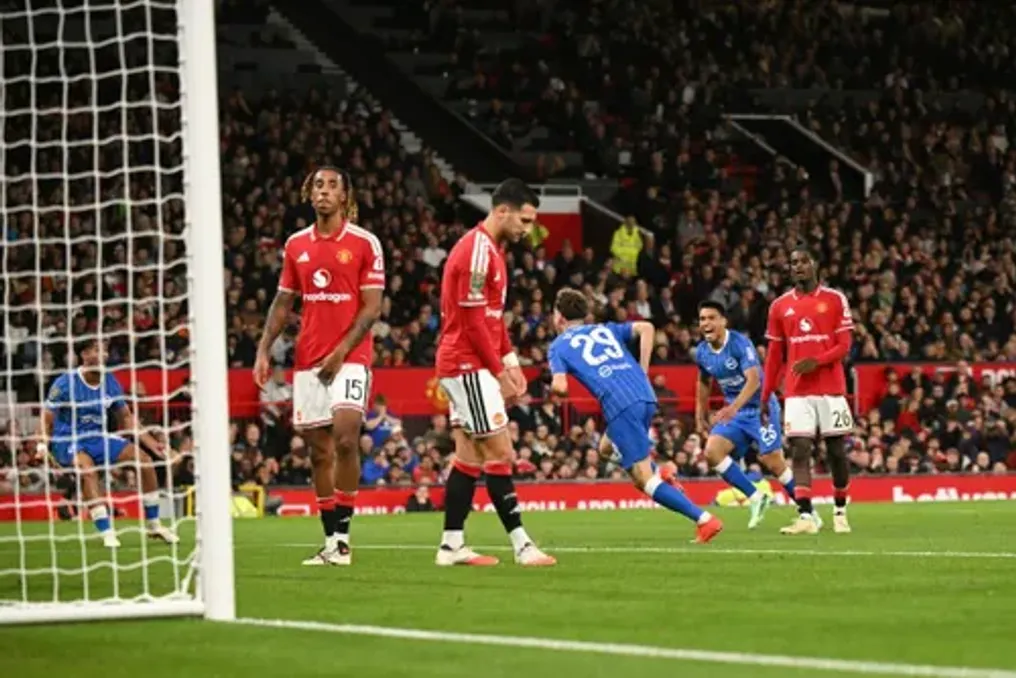
Manchester United's recent 3-2 League Cup defeat to Brighton at Old Trafford has cast doubt on the optimism surrounding the team's third-place finish last season under Michael Carrick. Manchester United shows a tendency to turn unsuccessful matches into an existential crisis; for instance, they are prone to starting identity discussions even when holding a 2-0 lead at Old Trafford.
The defeat to Brighton on Wednesday was highly unconvincing. United became the first team in 50 years to lose at home after leading twice. This marks the team's third loss in six matches this season and forces Michael Carrick to answer questions just four months after leading United into the Champions League.
While the narrative of a crisis is obvious, the question arises whether it is the only valid perspective. There is an alternative view: perhaps the team has not yet revealed its full potential. For example, Carlos Baleba has not yet debuted for United, Manuel Ugarte is on the bench, Matthijs de Ligt has faced fitness issues, and Luke Shaw has also missed games.
Carrick had already spoken before the match against Brighton about Baleba's imminent return, describing the midfielder as a player capable of improving the balance and dynamism of the midfield. De Ligt has returned to full training, and the club expected other players to return. These absences cannot be considered minor, so it is entirely reasonable to question how depleted United's squad truly is, as shown in Wednesday's match.
The team has its weaknesses; the situation with the left-back remains imperfect because the club failed to sign a player in that position over the summer, forcing Carrick to make tactical changes due to injuries. However, there is a difference between acknowledging weaknesses in the squad and stating that the squad is not good enough.
Young Players Deserve a Chance
Since we have not seen the full picture, the next challenge for Carrick appears extremely interesting. He needs to bring back injured players, integrate new signings, and, most importantly, trust the young players already within the club.
Jay Lacey showed a hint of this on Wednesday by scoring United's first goal of his full debut, beating two defenders before finishing the attack near the near post. Less than two minutes later, Mason Mount made it 2-0. After that, everything went catastrophically wrong.
Nevertheless, Lacey's appearance does not make his contribution any less encouraging. On the contrary, it raises an interesting question about United's recruitment philosophy. If the club has invested heavily in the squad, but concerns remain about squad depth, the answer may not automatically lie in another January transfer push. Perhaps some answers are already at Carrington.
This does not mean throwing a dozen teenagers into the Champions League hoping for the best. It means giving talented young players enough trust to become genuine members of the squad, rather than temporary substitutes who disappear as soon as an experienced player returns. United has always emphasized its academy as part of the club's identity, and now Carrick has the opportunity to turn this from a marketing slogan into reality.
There is also a broader issue hanging over all of this. Carrick is being judged based on the impressive turnaround of last season, but circumstances have changed. Last season, he was the person who stopped the bleeding. Now he must prove he can build something new. These are completely different tasks. Furthermore, last season he did not have matches for several days.
This is precisely why the temptation to press the 'sack' button on the manager should be resisted—at least until we get a clearer picture of what this squad is capable of when fully fit.
The defeat to Brighton exposed some real problems: United was passive after taking a 2-0 lead, failed to respond when Brighton changed the game's momentum, and registered no other shot on target until the 76th minute. Carrick accepted responsibility, as he should. But this does not mean he should take responsibility for everything that has gone wrong at Manchester United in the last decade. This club has repeatedly changed managers, players, and philosophy. At some point, it might be useful to let one manager find out if the squad given to him can actually work.
This requires Baleba to recover, Ugarte to return to action, de Ligt to stay healthy, new signings to adapt, and the youth to receive opportunities. Carrick, however, needs to demonstrate the ability to rotate, adapt, and develop the group, instead of relying solely on the same core players. Only then will it become clear whether United truly has a squad depth problem. And perhaps that is the most important thing to remember after Wednesday's match. A 3-2 defeat after leading 2-0 is a problem, but it is not necessarily proof that everything is ruined.