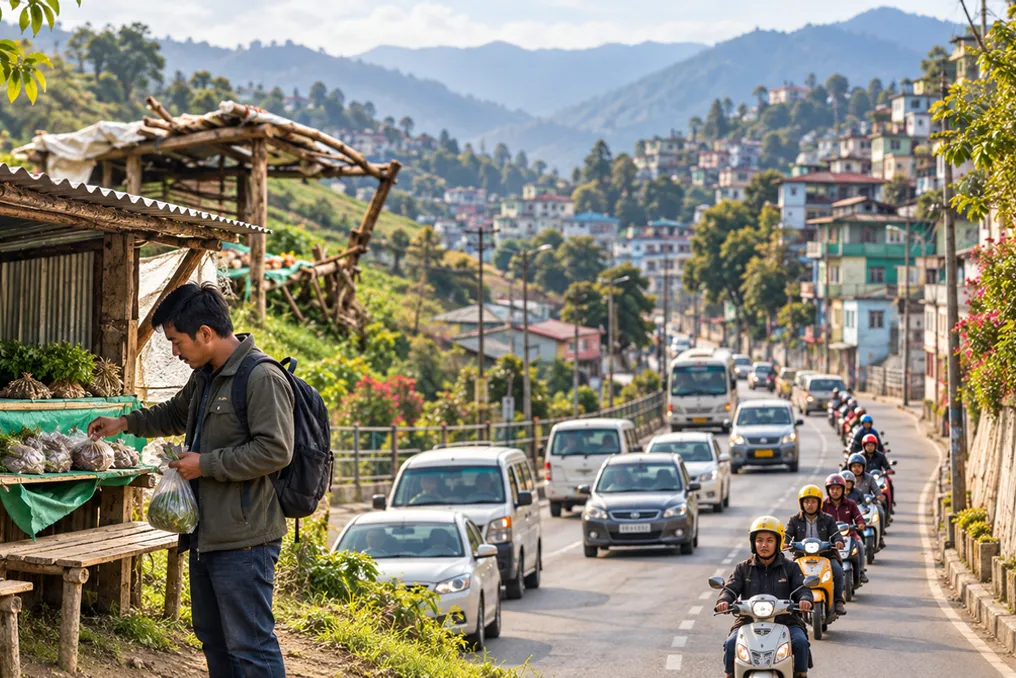
In Aizawl, the hilly capital of Mizoram, cars queue at unmarked intersections, and the loudest sound in the early morning is the polite 'beep-beep' of gratitude between drivers. In the village of Bade, located 900 kilometers away in Nagaland, 83-year-old Shevotso Keikho has not sat behind his shop counter since 2021, yet his vegetables continue to sell, and his money box fills up.
In many parts of the northeast, an order functions that in other places would require a police officer, cameras, or fines, thanks to the absence of road horns and shelf supervision.
The Capital That Never Needed Traffic Lights
Aizawl has deservedly earned the nickname 'Silent City.' Many of its intersections are not equipped with traffic lights; a whistle from a road patrol officer and gestures are usually enough to manage traffic. Cars drive on the left side, and two-wheelers on the right, and a sudden lane change is considered deeply shameful in Mizo culture.
Residents surveyed by The Quint in 2022 described this restraint as a daily manifestation of mutual respect, rather than a rule imposed by the police. The Mizoram police explain the transformation of Aizawl into an officially recognized 'Horn-Free City' through years of educational campaigns at the school level. This capital, with over four hundred thousand residents, rarely faces the transport collapse familiar to most Indian cities, even without signals or intensive police control.
When the Shop Owner Acts as Conscience, Not Cashier
In the highways of Mizoram and Nagaland, shops without sellers are as commonplace for locals as quiet roads. Near Seling, 65 kilometers from Aizawl, farmers display fruits, vegetables, and flowers on wooden shelves next to a handwritten price list and a collection box, trusting travelers to pay exactly what they take. This practice is locally called 'nghah loh dawr,' meaning 'shop without a seller.'
Keikho's stall in Bade operates on the same principle since 2021. He displays his organic harvest every morning, and buyers either leave the correct change or, if they lack money, take what they need and promise to pay later. His business partner, Riteu Hamo, told Morung Express that her daily income ranges from 200 to 3000 rupees depending on the harvest, and customers who cannot pay in full often leave a handwritten note promising to return.
A similar concept has spread further west. In the Golagat area of Assam state, tea plantation workers who do not have time to sit in a shop began selling rice, vegetables, and duck meat unattended after seeing the idea on social media and adapting it for their villages.
Trust Deeper Than Commerce
This culture of uncontrolled trust extends far beyond roads and shops. In the village of Maulnong in Meghalaya state, cleanliness is maintained through the traditional council 'Dorbar Shnong,' which has no municipal staff—a practice dating back to a cholera outbreak in the 1880s when hygiene became a matter of survival. Since then, this has helped make Maulnong one of the cleanest villages in Asia.
Mizoram applied the same instinct to education. On May 20, 2025, the state became 'India's first fully literate state' under the ULLAS program. This occurred after 292 volunteer teachers, many of whom were students and homemakers, helped 1692 adults achieve a literacy level of 95%, raising the state's rate to 98.2%.
In the village of Khonoma in Nagaland state, elders banned hunting and deforestation in an area of 125 square kilometers in 1998 after residents killed nearly 300 endangered Blyth's Tragopan birds during a week-long contest. This decision was made not by order of the forest department but entirely by the initiative of the village council, turning Khonoma into the first self-governing 'green village' in Asia. In Manipur state, the 'Ima Keithel' market in Imphal has been managed exclusively by women since the 16th century. Around 5000 vendors decide who trades, pass stalls from mother to daughter, and manage internal credit unions, with no government body handling its daily management.
None of this formed due to a single government program. It arose from small, repeated choices: a driver waiting in line, a farmer displaying a price list, a village agreeing to clean its streets, a hunter agreeing to lower his weapon, a vendor passing their stall to their daughter. None of these actions seemed significant on their own, but together they built something stronger than most 'top-down' interventions. For a country that often resorts to large budgets and stricter laws to solve its civic problems, the northeast offers a quieter lesson: the most durable systems are those that nobody needs to manage.