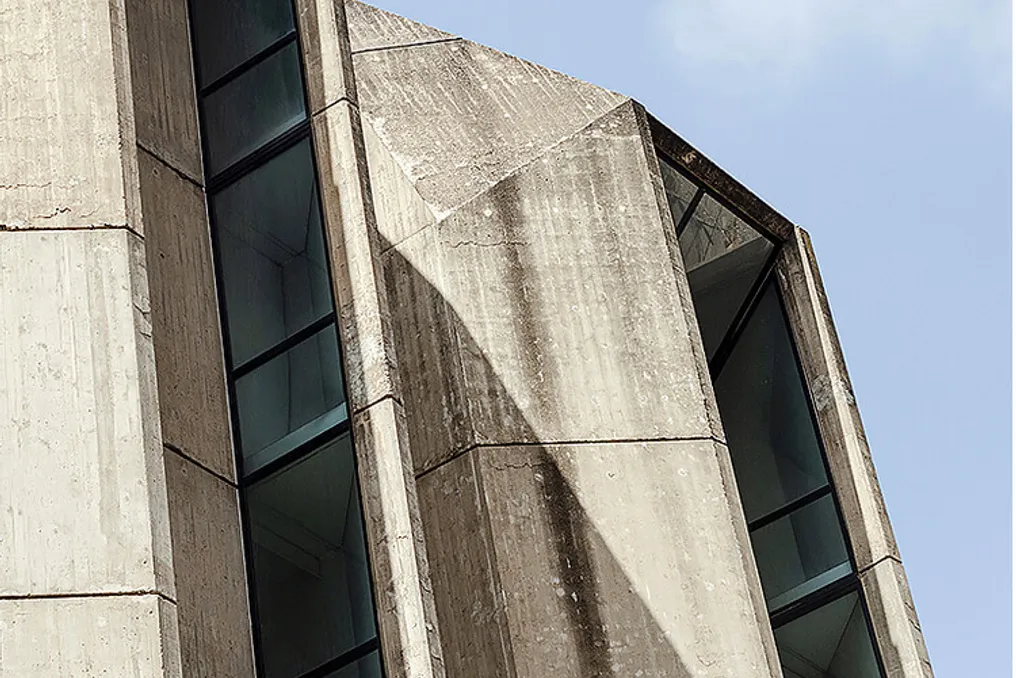
The history of brutalism has long been viewed predominantly from a Western perspective. However, the book 'Brutalist Asia' by Blue Crow Media offers a different view, analyzing how architects across Asia adapted, questioned, and transformed the architectural language of this movement in response to radically different political, climatic, and cultural conditions.
Covering 28 countries—from Japan and Southeast Asia to South and Central Asia and the Middle East, including Iran and Lebanon—the book features 140 buildings and over 150 photographs. It showcases both world-renowned works by architects such as Kenzo Tange, Paul Rudolph, Balkrishna V. Doshi, Raj Rewal, Charles Correa, Kim Swoo Geun, Leandro V. Luxin, and Le Corbusier, as well as lesser-known but important projects that expand the understanding of the continent's post-war architecture.
Within this broader geography, the history of Lebanon holds a special place, where the aspirations of modernism were inextricably linked to the country's profound social, political, and urban transformations. The book 'Brutalist Asia' contains a chapter written by Christelle Harrouk that illuminates the rise of brutalism in Lebanon, presenting architects and their works that acquired local identity, while also describing the incompleteness of this modernist project.
Brutalism in Lebanon
Brutalism emerged in the mid-20th century through the work of Le Corbusier, as well as Alison and Peter Smithson, and spread worldwide, peaking in the mid-1970s. From Europe to India, Japan, the USA, and Latin America, the movement underwent numerous contextual interpretations, becoming more than just a European export. Through this common architectural language, various regions forged their own path to modernity, development, governance, and identity. In the Arab world, this architectural evolution was inextricably linked to the political context, closely correlating with the ambitions of newly formed states and processes of national construction.
In Lebanon, this modernist landscape was shaped by local specialists in architecture and engineering, based on practical responses to local construction. It became particularly prominent in the 1960s, often called the golden age of the state-nation project. Architecture of that time was predominantly institutional, socially engaged, and politically oriented, embodying a collective vision of modernization. Brutalism appeared in this context relatively later than in other regions. Lebanese architects, such as Joseph Philippe Karam, Khalil Huri, Georges Huri, Antoine Romanos, and Grégoire Serouf, inspired by Le Corbusier and the Brazilian modernist movement, adopted exposed concrete as a means for new architectural expression, transforming it from a mere structure into a symbol of progress and modernity.
The concreting of reinforced structures, introduced earlier during the French Mandate in the 1920s through engineers and urban planning initiatives, gradually displaced traditional stone masonry. In the 1950s and 1960s, against the backdrop of rapid urban growth, it became the dominant building material. Architects like Jacques Liger-Beller reinterpreted it as a continuation of local tradition. He famously stated that 'concrete is our equivalent of stone,' often describing it as a kind of 'liquid stone.'
Taking on a more hybrid character, brutalism in Lebanon combines modernist ideas with regional identity, climate adaptation, and a deeply expressive, sculptural formal presentation. It was not merely an imported trend, but a localized evolution shaped by cultural, climatic, and political conditions.
However, this trajectory was sharply interrupted. The outbreak of the Lebanese Civil War in 1975 marked the collapse of the nation-state project and, consequently, the decline of the modernist movement that accompanied it. Over several years, this rupture became evident in the built environment. Today, Beirut is a city of contrasts, its skyline marked by bullet-scarred buildings, Ottoman and French colonial structures, post-war projects, and, among them all, monolithic concrete buildings dating from an earlier era. These brutalist structures remain fragments of a period of cultural aspirations, revealing both the drive toward modernity and its inevitable decay.
Interdesign Building
It is impossible to discuss brutalism in Lebanon without mentioning the Interdesign building. It exemplifies many defining characteristics of the movement and was designed by Khalil Huri in 1973. In 2024, during a Bernard Huri exhibition dedicated to his father's work, I had the opportunity to speak with him about this enigmatic project, and its story proved as fascinating as the building itself.
Although it is often placed within the broader context of modernism, the Interdesign building can be considered distinctly brutalist in its material presence and spatial organization. While Khalil Huri himself might agree or disagree with this label, it remains unclear; however, the use of exposed concrete, monumental volume, and uncompromising structural clarity directly relate the work to the fundamental principles of brutalism. Its strong geometric composition and repetitive structural rhythm reinforce this interpretation, allowing the building to be understood through its own logic of construction. Its internal, almost defensive configuration, lack of ornamentation, and emphasis on raw material further support this reading. The building stands as a single monolithic object, materializing the tension between function, form, and material that defines brutalist architecture.
The Interdesign building was conceived at the peak of Khalil Huri's career, a period when he worked as both an architect and a successful industrialist. In the 1960s, he established one of the most advanced furniture manufacturing industries in the region, designing, producing, and distributing contemporary pieces locally, expanding access beyond elite markets. As the company grew, so did its technical complexity: when imported equipment proved insufficient, Huri began developing his own technologies, creating custom machinery for the internal curvature of wood. In this context, the Interdesign building arose as the culmination of an integrated system—a showroom for furniture created and manufactured in Lebanon. Huri was effectively shaping the final stage of a process where architecture, design, and industry converged, embodying the optimism of an era when Lebanon saw itself as a center of production, innovation, and export.
Construction began in 1974, but in April 1975, when work had recently reached street level, the Civil War erupted, paralyzing all processes. Attempts to resume construction during the conflict failed, leaving the building suspended for years. After the war ended, in the early 1990s, the context that spawned the project had fundamentally changed. Beirut's economy shifted away from industrial production, reorienting towards banking, tourism, and speculative sectors, making the idea of a large-scale furniture showroom increasingly irrelevant.
Despite financial difficulties and the collapse of his industrial company, Huri decided to complete the building. By the late 1990s, the work was finished, but the building remained unused—a structure conceived for a reality that no longer existed. In subsequent years, the property was mortgaged to banks, briefly used, and then abandoned for decades. Its rigid spatial configuration and lack of flexibility made it difficult to inhabit. Today, the Interdesign building represents more than just an object in the urban environment; it is a physical manifestation of an interrupted modern project. Its history reflects both Huri's personal trajectory and the broader transformation of Lebanon.
More details on this story can be found in 'Brutalist Asia,' a collection that includes 140 buildings in 28 countries, over 150 photographs, and 8 original essays signed by Bob Pang, John Barr, Bhavna Dandona, Christelle Harrouk, Kyong Taek Lee, Karen Paredes-Santillan, Pinay Sirikiatikul, Soroush Mohajeri, and Amirhossein Radom. These texts illustrate how brutalism was interpreted and transformed in various political, climatic, and cultural contexts across Asia.