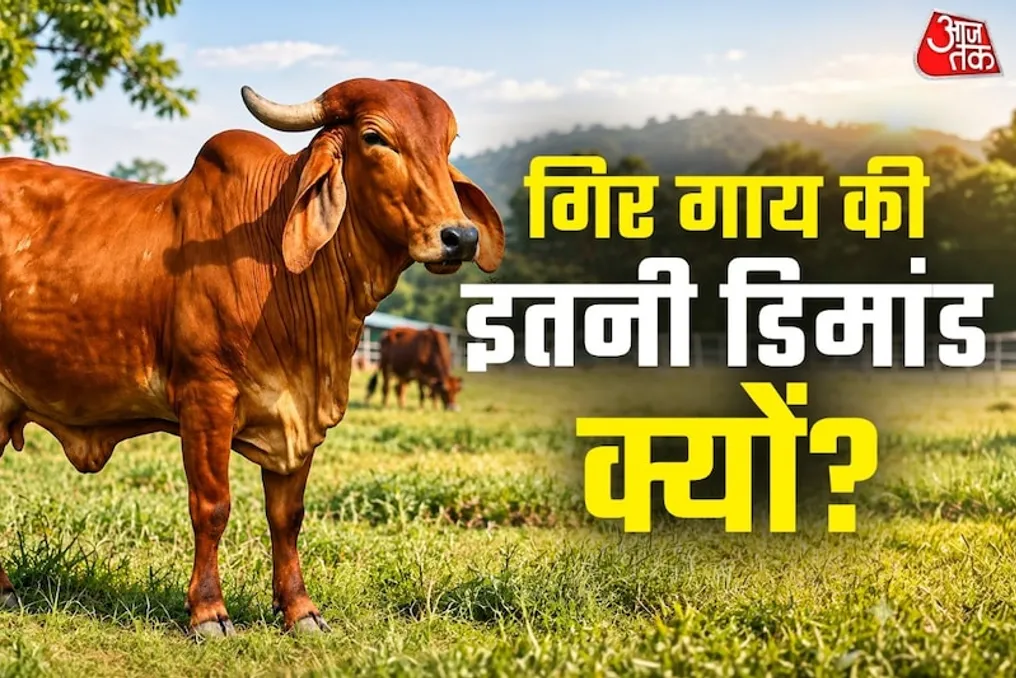
Among the many local cattle breeds common in India, the Gir cow from the state of Gujarat stands out due to its capacity for high milk yield and breed quality. It is easily recognizable by its characteristic features: long ears, a prominent forehead, and horns curved backward. In addition to its appearance, the animals are sought after by livestock breeders because of their ability to produce milk and adapt to hot weather.
The Gir cow is one of the leading indigenous breeds in India, and its historical homeland is the Gir forest and surrounding areas in Gujarat. Due to living in hot and relatively harsh climatic conditions, this breed has developed high resistance to local conditions. Key distinguishing features include long, drooping ears, a protruding forehead, and horns that curve backward and upward, differing from the horns of ordinary cows. Various patterns in red, white, and spotted tones may be observed on the body.
The main factor in the popularity of the Gir cow is its milk productivity. Although it is a local breed, with proper care and good nutrition, it is capable of producing a significant amount of milk. The Gir cow is also considered suitable for hot climates. In a country like India, where many regions suffer from intense heat, breeds well-adapted to the local climate are of great benefit to livestock breeders. Furthermore, the Gir breed is important for the conservation and breeding of the best local breeds in various locations, and its animals are used in dairy cattle breeding programs in other parts of India.
There is no single fixed figure regarding the daily volume of milk produced by a Gir cow. The amount of milk depends on the animal's age, breed purity, lactation period, diet, general health condition, and level of care. Generally, a well-cared-for Gir cow can produce about 8–12 liters of milk per day, although some more productive animals may yield more. It is not accurate to state that every Gir cow will produce 10–12 liters of milk.
Therefore, when purchasing a Gir cow, the decision should not be based solely on the breed name; it is essential to examine the animal's actual milk-yielding capacity, its previous records, age, and current condition.
Various claims are often made in the market about the milk of the Gir cow, especially concerning A2 milk. Like many local breeds, including the Gir, it may contain A2 protein (beta-casein). However, it is important to understand that the fact that a cow belongs to a local breed does not automatically mean that its milk possesses any special medicinal properties. Milk quality is determined by numerous factors, and scientific evidence supporting claims about the benefits of A2 milk is not equally convincing for every assertion.
The popularity of the Gir cow is not limited only to milk productivity. As a local breed raised in Indian conditions, livestock breeders view it as a breed adapted to the local climate. Moreover, there is high demand for quality Gir cows and their calves in some areas, especially among those who wish to keep local dairy breeds. Nevertheless, caution is also required here: not every red or spotted cow can be sold as a Gir cow. When purchasing, it is crucial to verify the breed's origin, the animal's medical records, and information about its milk production.
This is one of the most common misconceptions. Although the Gir cow is undoubtedly a good local dairy breed, the productivity of each individual is not the same. Milk yield can be 6–8 liters for one cow, while a more productive animal may yield significantly more. Feed, water, weather, animal age, health status, calving frequency, and level of care directly influence the production volume.
In conclusion, the popularity of the Gir cow is due to a complex set of reasons: it is a local breed, well-adapted to the Indian climate, has good milk yield, possesses recognizable physical characteristics, and is valuable for breeding. However, when making a purchase decision, one should not rely solely on rumors that this breed produces 10 or 15 liters of milk per day. The actual production volume varies from animal to animal, so before purchasing, it is necessary to check the age, health, milk production records, and authenticity of the breed.