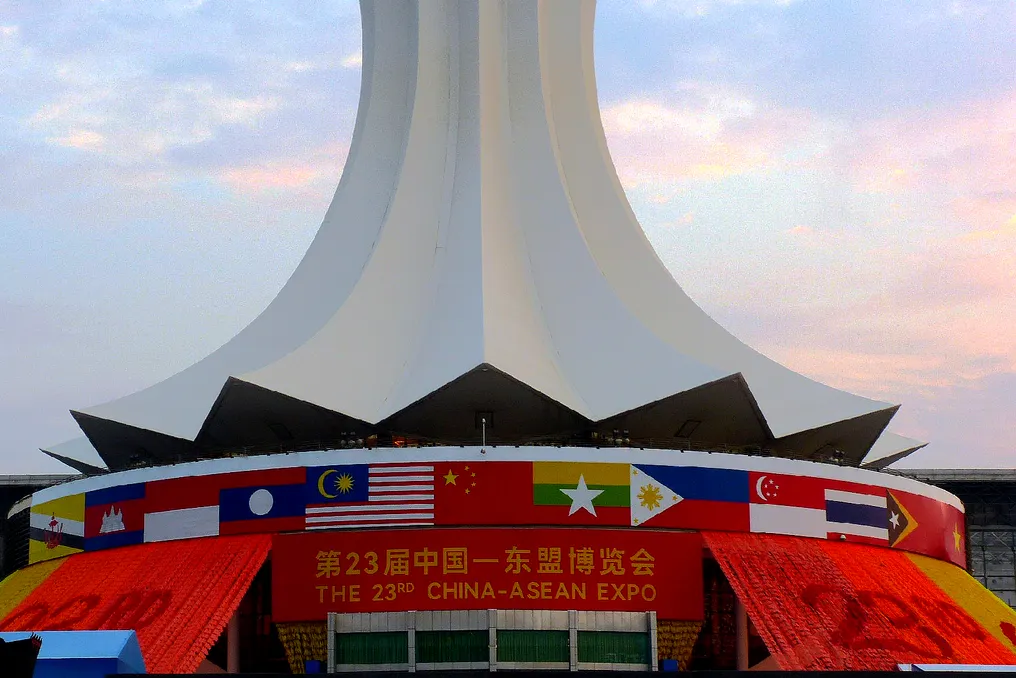
The XXIII China-Asia Expo (CAEXPO) kicked off on Thursday in Nanning, the capital of Guangxi Zhuang Autonomous Region in southern China. The exhibition focused on new business opportunities within the framework of the China-Asia Free Trade Area (CAFTA) 3.0 structure. The event runs from September 17 to 21 and has attracted over 3,400 companies from more than 70 countries and regions. The exhibition area covers approximately 170,000 square meters, with the number of participating enterprises increasing by 5.3% compared to the previous year.
Timor adopted its first participation as a full member and co-organizer of ASEAN, bringing together all 11 ASEAN member states in Nanning. This expo places special emphasis on artificial intelligence (AI) and the newly opened Pinlu Canal, for which dedicated exhibition zones are provided to demonstrate their potential in stimulating regional cooperation.
According to a recent CGTN survey, 90.9% of global respondents believe that the continuous holding of CAEXPO demonstrates China's commitment to the principles of high-standard opening up. Furthermore, 89.5% see the expo as an important platform for exchanging business contacts, seeking industrial partners, and sharing regional development opportunities.
The expo takes place during the initial implementation by China and ASEAN of the updated CAFTA 3.0 structure. This structure is designed to facilitate trade, strengthen supply chains, and expand cooperation in developing sectors. Delegations from countries including Cambodia, Indonesia, Malaysia, and Thailand presented scientific and technological institutions at the event.
Destarata Mustafa, Political Affairs Advisor at the Indonesian Embassy in Beijing, noted China's significant progress in areas such as renewable energy, electric vehicles, and AI. He added: 'We hope to expand cooperation with China in these fields.' Over 50 trade and investment promotion events are being held during the expo, focusing on simplifying trade and investment, regional economic integration, and cross-border industrial and supply chain cooperation.
In a CGTN survey, 84.5% of respondents stated that deepening free trade between China and ASEAN will give a greater impetus to openness, cooperation, and stable growth in the global economy.
AI plays a prominent role at the current expo. Specialized exhibition zones are located in the Nanning International Convention and Exhibition Center and the newly established Nanning AI Complex. The AI exhibition zone at the Nanning International Convention and Exhibition Center showcases AI products and technologies covering consumer applications, smart homes, intelligent terminals, robotics, and embodied intelligence, as well as AI technologies from ASEAN countries.
At the Nanning AI Complex, spanning 10,000 square meters, over 150 AI companies, including Huawei, iFlytek, and Unitree Robotics, are demonstrating applications across 11 thematic sections focused on industrial and daily use. The venue will also feature an AI market, service robot competitions, and performances.
A new exhibition zone has been developed to promote more targeted cooperation through an intelligent partner matching system. The system has pre-matched over 8,000 pairs of potential cooperation partners, and about 2,000 matching sessions are scheduled during the expo. The system collected around 60 project requests for cooperation from ASEAN countries and matched them with nearly 40 Chinese projects to help companies find potential partnerships. The focus on practical application reflects growing efforts to link China's AI capabilities with the specific industrial and consumer needs of ASEAN markets.
The recently opened Pinlu Canal is another major highlight of the expo. A special exhibition zone demonstrates this 134.2-kilometer waterway and its potential to strengthen regional connectivity. The canal connects the shipping network of the Yangtze River with Beibu Bay, allowing vessels up to 5,000 tons to access the sea directly, creating a more efficient route from China's southwestern interior to international markets.
The canal is expected to reduce maritime distances between Southwest China and Southeast Asia by more than 560 kilometers, lower logistics costs by 18%–30%, and save approximately 5.2 billion yuan (about $775 million) annually. It also strengthens the New International Land-Sea Trade Corridor, connecting western China with Southeast Asia via railways, roads, waterways, and ports.
According to a CGTN survey, 87.6% of respondents stated that multimodal transport, including river-sea and rail-water transport, when effectively linked with cross-border industrial and supply chain cooperation, will contribute to the further development of regional trade and investment. This new level of connectivity comes amid the ongoing expansion of trade between China and ASEAN. In the first seven months of 2026, trade between the two sides reached $744.41 billion, which is 24.7% higher than the same period last year and accounts for 21.8% of China's total foreign trade.